Affichage des articles dont le libellé est photography. Afficher tous les articles

jeudi, juin 06, 2013

le sacrifice

le sacrifice by comment dit-on
le sacrifice, a photo by comment dit-on on Flickr.
Today was the 69th anniversary of D-Day. I was lucky enough to spend some time in Normandy in 2004 and to visit several of the WWII battlefields and memorials.

I looked at my journal from the trip and came across this posting. I shot this image in the American Cemetery in Normandy, where nearly 9,500 soldiers (including 4 women) are buried.  The headstone struck me because of the soldier's name, his rank, the day he died, and because of the stone on the Star of David.  (A stone on a Jewish grave is a sign that the grave is tended and visited.)  After adding a small pebble of my own, I took the shot and moved on.
Sent: Thu, 22 Jul 2004 03:58:12 -0700 (PDT)Subject: France dispatch #3: The beautiful and the horrible 
Chèrs amis, 
This is probably my last note, since I'll be flying home in a few days.
I spent the past three days in Normandy and Brittany, because I wanted to visit for the 60th anniversary of D-Day and because I REALLY wanted to see Mont St-Michel. The trip was a transformative experience, but I can't imagine that anyone can come away from Normandy unchanged.
The people in Normandy disprove every American stereotype about the French. I found them to be warm and friendly, and enjoyed their hospitality. I spoke French pretty exclusively those three days, and feel confident in my ability to communicate my basic needs. My waiter even tried to set me up with the young man at the table next to me. : ) 
Monday -- Caen calls itself a martyred city, since bombs pretty much leveled it in WWII. I visited St. Peter's church in the morning and saw photographs of the church in ruins, before it was re-built in the aftermath of the war. There was an exhibition of children's drawings responding to the question "what does peace mean to you?" The images were startling and I'll share them once I'm home and have put them online.
The Peace Memorial was amazing. It is the best war museum I've ever seen. The most impactful moment was reading the handwritten letters of G.I.'s who never made it home. I ended up missing my train by minutes, but considered it to be serendipity, because I wanted to stay and see the D-Day beaches the next day. That evening, I wandered the city and found myself in a Monoprix (the French equivalent of Target plus a grocery store) before heading to a small restaurant for an inexpensive but excellent meal and some Norman cider. 
Tuesday--At 9 a.m., I took a bus to Arromanches, where British engineers built an artificial harbor that supplied Western Europe until Berlin fell. The remains of the huge concrete floaters are still there, and it was ironic to see children storming the beaches and swimming around the concrete. I also watched a film in the 360° cinema that combined archival footage with present-day shots. I got goosebumps when I saw a firefight in a square that morphed into the Monoprix where I'd been the night before. We got back on the bus and saw various sites, including the gun turrets that the Army rangers destroyed after climbing a cliff the Nazis had thought invulnerable. When we arrived at the American Cemetery, I saw miles of crosses and Stars of David. Nearly 9,500 soldiers (including 4 women) are buried there. It was overwhelming and after spending two days in Normandy, I feel that I finally understand the horrible sacrifice made by the Greatest Generation.

vendredi, septembre 14, 2012

mercredi, avril 27, 2011

street photography discovered

These shots are interesting not just for their artistic merit, but also because they were taken by an ordinary woman with an extraordinary eye. I'm curious how this nanny got to Yemen and some of the other places where she photographed. Unfortunately, much of Vivian Maier's story remains private (for now).
Amazing Mystery Photographer Comes To Fame After Her Death
An incredible story. Vivian Maier was a nanny who lived in Chicago for most of her life and passed away in 2009 at the age of 83. Little more is known about her, except that she was an avid street photographer. Her work was discovered at an auction in 2007, more than 100,000 negatives and undeveloped rolls of film, sold by a storage facility who were cleaning out her locker for delinquent rent. Here is a small sampling of Vivian Maier's stunning work from the Maloof Collection, spanning from the 1950s to the 1970s. Many of the photos, if they had any information at all, only provided a year and/or city.

mercredi, mars 17, 2010

tips for photographing toddlers and children

For friends who want to take better pictures of their kids ...
Tips for Photographing Toddlers & Children: Amy PostleGet down to your child's level
  1. Be a silent observer: Rather than instructing, positioning, and asking your child to smile - take a step back and enjoy the subtleties of your children. You will see, appreciate and capture the natural moments in your child’s life, rather than taking another staged “say cheese” picture.
  2. Activities are important: Keep your child occupied and happy by giving them an activity or toy that they love. If your children are happy and active, great photos are sure to follow.
  3. Get down to your child's level: Sit on the ground, or lay down if you need to. Physically moving to their level will give you a new and unique perspective. Move around and experiment with cropping. Make sure to come in close and observe the little things in those moments too- their hands, feet, smile, etc. Play around with the perspective and you'll find some amazing moments to capture that you would have otherwise missed standing up!
  4. Be aware of the light source: When outside, avoid direct sunlight, which causes harsh shadows and squinty eyes (cloudy days are great). On a sunny day, find a shaded spot and turn off your flash (even snapshot cameras have this option). You'll get a much more realistic, beautiful and naturally lit image. When indoor, try and position your children near a window- window light provides beautiful natural light and helps you avoid the harsh light from a flash. (Avoiding flash photography also helps with tip #1- flashes tend to startle children, especially younger ones.)
  5. Pay attention to the background: Try and avoid shooting towards backgrounds that are busy and distracting (poles in the background can often give the "skewered effect!") If the background is busy however, you can solve this simply by moving your own body and camera position even slightly- change the angle and you will change the photograph.
  6. Ask them to do simple tasks: For example, ask your child to look out the window- you’ll have beautiful window light on their face, while capturing their sense of curiosity at the world.
  7. Be a part of the moment: Have one parent (or friend) photograph while the other parent participates. Embrace the opportunity to interact with your child and be photographed with them. Do what they want to do, be a part of their world and enjoy it! A client told me once that the greatest gift was looking back at photographs of her playing with her children and being able to see the true joy she felt as a mother all over again.
  8. Shoot in Black & White: Black and white strips away the “noise” of every day life and really brings focus to the child and the moment. It is classic, timeless, and always beautiful. Plus, if you are photographing your child indoors, it will help you avoid the normal color shifts that occur on film when shot without a flash under standard household bulbs.
  9. Let them be themselves: Allow them to pick their own clothes for the photos. Even if it’s silly or sassy- capture that! Great photographs come from capturing the real moments that children experience not from the perfect smile, or a constructed moment. Ask them what ideas they have for photographs and indulge them. I bet they will surprise you.
  10. Making faces is fun: One of my favorite things to ask children to do is make faces- every face they can think of from silly, to serious, mad, sad, and anything else they can come up with. It’s a good way to warm them up for picture taking while making them realize that taking photos can be fun! Chances are they will start laughing half way through and be a ham for the camera afterwards.
  11. Make a contact sheet: Have a contact sheet made instead of prints. Contact (or proof) sheets show the story of the day- they are a fantastic way to see the personality of the shoot and your child, without having to choose one shot. Frame it as a single picture and it will be like having a mini movie on your wall.
  12. Think like a professional: Think about the big picture- what’s in the background? What’s in the foreground? If you move slightly to one side or the other will the shot improve? How is the lighting? Would this be better as a horizontal or vertical image? Would B&W or color be more effective? What do I hope to achieve? Think like a professional and over time your photographs will improve. Have fun, be adventurous and trust your instincts!
Learn more about Amy:
Podcast - Amy Postle pushes the boundaries of her art by evoking passion, beauty and emotion with color and black and white films.
Visit Amy's website: http://www.amypostle.com

lundi, mai 19, 2008

it's good to be on top

From the maps section of Scandinavian Airlines' magazine.

Proof (yet again) that it's all a matter of perspective.
"Upside-Down" North America
Originally uploaded by Claire L. Evans
Via Mercedes

dimanche, janvier 27, 2008

the mexican suitcase

"The truth is the best picture, the best propaganda." - Robert Capa
Robert Capa's photographs document pivotal moments in time. He was one of the earliest war photographers whose work was published in the mass media and is cited as an inspiration by countless photojournalists. His work also influenced thousands on the subject matter (Spanish Civil War, etc.)

When I picture the D-Day invasion of Normandy, I think of the grainy, black and white photos taken as Capa and the soldiers with whom he was imbedded fought their way onto Omaha Beach on June 6, 1944. These photos, along with nine others, were the only images that survived of the 106 frames taken, after a nervous photographic assistant in London managed to ruin many other rolls while developing them.

Capa is also famous for documenting the Spanish Civil War. This photo, "Death of a loyalist soldier, 1936," is still the subject of controversy, because it's unclear as to whether or not the photo was staged. Capa's Spanish Civil War negatives, were stolen from a Paris train station 50 years ago, and eventually made their way to Mexico. Contained in "the Mexican suitcase," they resurfaced late last year, when they were returned to the Capa estate and given to the International Center for Photography in New York, founded by Capa's brother Cornell. These negatives may settle, once and for all, the question of whether Capa staged the shot. They will also give us more insight into the man, his work, and his methods.

Capa co-founded Magnum, a photo agency owned by photojournalists, that allowed them to retain ownership rights to their work. His mantra, “If your pictures aren’t good enough, you’re not close enough,” is often quoted by photographers. He was a Hungarian-born Jew who worked in Europe and fled to the United States in 1939; later he was the only "enemy alien" photographer for the Allies. His romance with Ingrid Bergman was immortalized by their mutual friend Alfred Hitchcock in "Rear Window." He eventually died on assignment for Life Magazine in 1954 when he stepped on a landmine while covering the early days of the First Indochina War in Vietnam.

His courage and his work was honored by the Overseas Press Club, which created an award in his honor, the Robert Capa Gold Medal. It is given annually to the photographer who provides the "best published photographic reporting from abroad, requiring exceptional courage and enterprise".
Robert Capa - Lost Negatives
January 27, 2008
The Capa Cache
By RANDY KENNEDY

TO the small group of photography experts aware of its existence, it was known simply as “the Mexican suitcase.” And in the pantheon of lost modern cultural treasures, it was surrounded by the same mythical aura as Hemingway’s early manuscripts, which vanished from a train station in 1922.

The suitcase — actually three flimsy cardboard valises — contained thousands of negatives of pictures that Robert Capa, one of the pioneers of modern war photography, took during the Spanish Civil War before he fled Europe for America in 1939, leaving behind the contents of his Paris darkroom.

Capa assumed that the work had been lost during the Nazi invasion, and he died in 1954 on assignment in Vietnam still thinking so. But in 1995 word began to spread that the negatives had somehow survived, after taking a journey worthy of a John le Carré novel: Paris to Marseille and then, in the hands of a Mexican general and diplomat who had served under Pancho Villa, to Mexico City.

And that is where they remained hidden for more than half a century until last month, when they made what will most likely be their final trip, to the International Center of Photography in Midtown Manhattan, founded by Robert Capa’s brother, Cornell. After years of quiet, fitful negotiations over what should be their proper home, legal title to the negatives was recently transferred to the Capa estate by descendants of the general, including a Mexican filmmaker who first saw them in the 1990s and soon realized the historical importance of what his family had.

“This really is the holy grail of Capa work,” said Brian Wallis, the center’s chief curator, who added that besides the Capa negatives, the cracked, dust-covered boxes had also been found to contain Spanish Civil War images by Gerda Taro, Robert Capa’s partner professionally and at one time personally, and by David Seymour, known as Chim, who went on to found the influential Magnum photo agency with Capa.

The discovery has sent shock waves through the photography world, not least because it is hoped that the negatives could settle once and for all a question that has dogged Capa’s legacy: whether what may be his most famous picture — and one of the most famous war photographs of all time — was staged. Known as “The Falling Soldier,” it shows a Spanish Republican militiaman reeling backward at what appears to be the instant a bullet strikes his chest or head on a hillside near Córdoba in 1936. When the picture was first published in the French magazine Vu, it created a sensation and helped crystallize support for the Republican cause.

Though the Capa biographer Richard Whelan made a persuasive case that the photograph was not faked, doubts have persisted. In part this is because Capa and Taro made no pretense of journalistic detachment during the war — they were Communist partisans of the loyalist cause — and were known to photograph staged maneuvers, a common practice at the time. A negative of the shot has never been found (it has long been reproduced from a vintage print), and the discovery of one, especially in the original sequence showing all the images taken before and after the shot, could end the debate.

But the discovery is being hailed as a huge event for more than forensic reasons. This is the formative work of a photographer who, in a century defined by warfare, played a pivotal role in defining how war was seen, bringing its horrors nearer than ever — “If your pictures aren’t good enough, you’re not close enough” was his mantra — yet in the process rendering it more cinematic and unreal. (Capa, not surprisingly, later served a stint in Hollywood, befriending directors like Howard Hawks and romancing Ingrid Bergman.)

Capa practically invented the image of the globe-trotting war photographer, with a cigarette appended to the corner of his mouth and cameras slung over his fatigues. His fearlessness awed even his soldier subjects, and between battles he hung out with Hemingway and Steinbeck and usually drank too much, seeming to pull everything off with panache. William Saroyan wrote that he thought of Capa as “a poker player whose sideline was picture-taking.”

In a Warholian way that seems only to increase his contemporary allure, he also more or less invented himself. Born Endre Friedmann in Hungary, he and Taro, whom he met in Paris, cooked up the persona of Robert Capa — they billed him as “a famous American photographer” — to help them get assignments. He then proceeded to embody the fiction and make it true. (Taro, a German whose real name was Gerta Pohorylle, died in Spain in 1937 in a tank accident while taking pictures.)

Curators at the International Center of Photography, who have begun a months-long effort to conserve and catalog the newly discovered work, say the full story of how the negatives, some 3,500 of them, made their way to Mexico may never be known.

In 1995 Jerald R. Green, a professor at Queens College, part of the City University of New York, received a letter from a Mexico City filmmaker who had just seen an exhibition of Spanish Civil War photographs sponsored in part by the college. He wrote that he had recently come into possession of an archive of nitrate negatives that had been his aunt’s, inherited from her father, Gen. Francisco Aguilar Gonzalez, who died in 1967. The general had been stationed as a diplomat in the late 1930s in Marseille, where the Mexican government, a supporter of the Republican cause, had begun helping antifascist refugees from Spain immigrate to Mexico.

From what experts have been able to piece together from archives and the research of Mr. Whelan, the biographer (who died last year), Capa apparently asked his darkroom manager, a Hungarian friend and photographer named Imre Weisz, known as Cziki, to save his negatives in 1939 or 1940, when Capa was in New York and feared his work would be destroyed.

Mr. Weisz is believed to have taken the valises to Marseille, but was arrested and sent to an internment camp in Algiers. At some point the negatives ended up with General Aguilar Gonzalez, who carried them to Mexico, where he died in 1967. It is unclear whether the general knew who had taken the pictures or what they showed; but if he did, he appears never to have tried to contact Capa or Mr. Weisz, who coincidentally ended up living the rest of his life in Mexico City, where he married the Surrealist painter Leonora Carrington. (Mr. Weisz died recently, in his 90s; Mr. Whelan interviewed him for his 1985 biography of Capa but did not elicit any information about the lost negatives.)

“It does seem strange in retrospect that there weren’t more efforts to locate these things,” Mr. Wallis said. “But I think they just gave them up. They were lost in the war, like so many things.”

When the photography center learned that the work might exist, it contacted the Mexican filmmaker and requested their return. But letters and phone conversations ended with no commitments, said Phillip S. Block, the center’s deputy director for programs, who added that he and others were not even sure at the beginning if the filmmaker’s claims were true, because no one had been shown the negatives. (Saying that the return of the negatives was a collective decision of the Aguilar Gonzalez family, the filmmaker asked not to be identified in this article and declined to be interviewed for it.)

Meetings with the man were scheduled, but he would fail to appear. “And then communications broke off completely for who knows what reason,” Mr. Block said. Efforts were made from time to time, unsuccessfully, to re-establish contact. But when the center began to organize new shows of Capa and Taro’s war photography, which opened last September, it decided to try again, hoping that images from the early negatives could be incorporated into the shows.

“He was never seeking money,” Mr. Wallis said of the filmmaker. “He just seemed to really want to make sure that these went to the right place.”

Frustrated, the center enlisted the help of a curator and scholar, Trisha Ziff, who has lived in Mexico City for many years. After working for weeks simply to track down the reclusive man, she began what turned out to be almost a year of discussions about the negatives.

“It wasn’t that he couldn’t let go of this,” said Ms. Ziff, interviewed by phone from Los Angeles, where she is completing a documentary about the widely reproduced image of Che Guevara based on a photograph by Alberto Korda.

“I think it was that no one before me had thought this through in the way that something this sensitive needs to be thought through,” she said. The filmmaker worried in part that people in Mexico might be critical of the negatives’ departure to the United States, regarding the images as part of their country’s deep historical connection to the Spanish Civil War. “One had to respect and honor the dilemma he was in,” she said.

In the end Ms. Ziff persuaded him to relinquish the work — “I suppose one could describe me as tenacious,” she said — while also securing a promise from the photography center to allow the filmmaker to use Capa images for a documentary he would like to make about the survival of the negatives, their journey to Mexico and his family’s role in saving them.

“I see him quite regularly,” Ms. Ziff said, “and I think he feels at peace about this now.”

In December, after two earlier good-faith deliveries of small numbers of negatives, the filmmaker finally handed Ms. Ziff the bulk of the work, and she carried it on a flight to New York herself.

“I wasn’t going to put it in a FedEx box,” she said.

“When I got these boxes it almost felt like they were vibrating in my hands,” she added. “That was the most amazing part for me.”

Mr. Wallis said that while conservation experts from the George Eastman House in Rochester are only now beginning to assess the condition of the film, it appears to be remarkably good for 70-year-old nitrate stock stored in what essentially looks like confectionery boxes.

“They seem like they were made yesterday,” he said. “They’re not brittle at all. They’re very fresh. We’ve sort of gingerly peeked at some of them just to get a sense of what’s on each roll.”

And discoveries have already been made from the boxes — one red, one green and one beige — whose contents appear to have been carefully labeled in hand-drawn grids made by Mr. Weisz or another studio assistant. Researchers have come across pictures of Hemingway and of Federico García Lorca.

The negative for one of Chim’s most famous Spanish Civil War photographs, showing a woman cradling a baby at her breast as she gazes up toward the speaker at a mass outdoor meeting in 1936, has also been found. “We were astonished to see it,” Mr. Wallis said. (The photograph, often seen as showing the woman worriedly scanning the skies for bombers, was mentioned by Susan Sontag in “Regarding the Pain of Others,” her 2003 reconsideration of ideas from her well-known treatise “On Photography,” a critical examination of images of war and suffering.)

The research could bring about a reassessment of the obscure career of Taro, one of the first female war photographers, and could lead to the determination that some pictures attributed to Capa are actually by her. The two worked closely together and labeled some of their early work with joint credit lines, sometimes making it difficult to establish authorship conclusively, Mr. Wallis said. He added that there was even a remote possibility that “The Falling Soldier” could be by Taro and not Capa.

“That’s another theory that’s been floated,” he said. “We just don’t know. To me that’s what’s so exciting about this material. There are so many questions and so many questions not even yet posed that they may answer.”

Ultimately, Mr. Wallis said, the discovery is momentous because it is the raw material from the birth of modern war photography itself.

“Capa established a mode and the method of depicting war in these photographs, of the photographer not being an observer but being in the battle, and that became the standard that audiences and editors from then on demanded,” he said. “Anything else, and it looked like you were just sitting on the sidelines. And that visual revolution he embodied took place right here, in these early pictures.”

samedi, janvier 26, 2008

quotable

"If everyone could make art, it wouldn't be precious."
-Ellie Dworak, on photography, Nov. 05, 2005

vendredi, janvier 18, 2008

tagging our history

Information architecture 101 says that you ask the target audience what it calls things, in an effort to make them easier to find. That's the awesome power behind folksonomy. Now, the Library of Congress and Flickr are teaming up to categorize lots of vintage images. Awesome!

Flickr brings tagging to vintage images
By Daniel Terdiman
Staff Writer, CNET News.com
Published: January 17, 2008, 1:34 PM PST
Scores of gorgeous historic photos--from shots of early 20th century baseball players to 1940s-era images of horse-drawn carts and factory workers--showed up on Flickr this week, and the public is busy tagging them in an effort to bring new context to the collection.

The labeling is part of a pilot project by the U.S. Library of Congress, which is making 3,115 of its archival photos available for public tagging in an attempt to bring a sort of "wisdom of the crowds" intelligence to the photos' metadata.

The project kicked off Wednesday in conjunction with the launch of a Flickr initiative dubbed "The Commons." That effort aims to open peoples' eyes to the "hidden treasures in the huge Library of Congress collection" and to show people how their "input of a tag or two can make the collection even richer."

For now, the library is making two distinct groupings available on the popular photo-sharing site: "1930s-40s in Color" and "News in the 1910s." The former is filled with images of World War II-era industrial scenes and military personnel posing in full-dress uniform. The latter contains equally stunning shots of random ball players, barns, yacht clubs, and more.

The Commons is Flickr's attempt to showcase and add context to the archives of public-facing institutions--first the Library of Congress and later potentially others, such as museums or other civic entities.

"I'm interested in whether this can establish the usefulness of the folksonomic approach, in combination with the expertise and curatorial skills that these institutions hold," said George Oates, program manager for The Commons at Flickr. "I don't know what the future looks like, but I do know that there's a lot of interest in the museum industry about this...approach."

For now, though, The Commons is going to focus exclusively on the library's archives. One notable aspect of the project is the addition of a new Flickr copyright category in which the photos are said to have "no known copyright restrictions."

It might be tempting to read that designation as equating to "public domain," but that's not the case, say those driving the initiative at the Library of Congress.

"It's always incumbent on a user of any work to do their own due diligence" about copyright, said Matt Raymond, a public-affairs officer at the library. (The public can visit the library's Prints and Photographs Web page for an FAQ on the specifics of copyright issues pertaining to the images in The Commons project, as well as to any of the millions of other images in the library's archives.)

It may eventually be possible for the general public to submit photos to The Commons project, Oates suggested, but for now, Flickr will limit participation to public or civic institutions.

As a result, the public will have to continue using the previously existing copyright designations Flickr offers, such as "some rights reserved," "all rights reserved" and assorted licenses available under Creative Commons.

Regardless of the copyright issues involved, the library and Flickr are pushing these initiatives because of what they see as a unique opportunity to bring to bear the knowledge of the photo-sharing site's millions of users. The images, which previously had very little metadata attached, will now be searchable by the countless tags being added.

In addition, said Raymond, the project is giving the library a chance to experiment with the latest interactive technologies.

"We're moving as aggressively as a government agency can to recognize the growing importance of Web 2.0," Raymond said. "This was a very low-cost opportunity to observe the tagging behavior and evaluate the quality we could get, and get our feet wet in a Web 2.0 community."

Already, just a day after the project debut, some individual photos have received more than 50 tags. Some might think so many tags for an individual photo could water down the usefulness of the metadata, but those involved in the project disagree.

"That's where the long tail comes in," Oates said. "If you compare a photo with 3 tags with one with 26, you've increased" searchability by orders of magnitude.

The Library of Congress initiative shares characteristics of projects like SETI@home and Amazon.com's Mechanical Turk, both of which harness the power of the masses to look for solutions.

Those projects, which both task individuals with contributing their time or computer processing power for the larger good, are in some ways the definition of what Wired magazine contributing editor Jeff Howe calls "crowdsourcing."

"The cost of five minutes of a user's time is so marginal, it's almost a why-not," said Howe, author of the forthcoming Crowdsourcing: How the power of the crowd is driving the future of business. "Are they asking for a day of my time? No way, I've got kids. Are they asking for a few minutes? (Then no problem)."

One might think the public would be willing to help the Library of Congress because the institution's mission to archive and collect public knowledge and information is benign. But Howe suggested that there would be those who would want to get involved no matter what the agency was.

"If it was the (National Security Agency) asking if I'd want to classify spy photos," Howe said, "even then, you'd get the wannabe spooks" to help.

That's exactly what Flickr and the Library of Congress are counting on as their side-by-side projects get off the ground.

Some observers view the projects as an admirable way of mixing public and private expertise.

"Except for my general nervousness about putting this stuff into a privately held, for-profit organization," blogger David Weinberger wrote Wednesday, "I think this is quite cool. It has the advantage of putting the data where the people already are. As a footnote to the posting says, it takes a photo of a grain elevator as an example 'because it helps illustrate that there are active Flickr user groups for even such diverse subjects as grain elevators.'"

Michelle Springer, project manager of digital initiatives at the Library of Congress, said the agency doesn't mind that its partner is a company that can leverage its participation for potential profit.

"The library's interest is in working with virtually any partner that will help us achieve our mission," Springer said, "and the key thing we keep in mind is that we avoid exclusive arrangements. So if other people wanted to work with us and do similar things, it's not unprecedented for us to do that."

She added that she hopes that the library's experience with the project might spur other government agencies and public institutions to follow its lead.
But for now, the library is just getting used to the fact that the public seems to have responded to its project with very open arms and with an unexpected amount of participation.
"We didn't have a sense of what all we would learn," Raymond said. "And by going through the exercise, we will reach undiscovered territory and uncharted countries."

samedi, décembre 22, 2007

how a UNICEF photo makes the west's heart ache

I am thankful each and every day that I was born in the time, place, and class that I was. Each give me choices (freedoms, if you will) that I would not have otherwise. I don't take those for granted and cannot sit in silence when I learn about injustice.

Case in point: it's hard to stomach this child bride and the circumstances that led to her wedding and the inevitable (?) outcome for her life. Call me judgemental if you must. But that won't keep me from being outraged and encouraging others to take action, too.

This sobering image, showing a 40-year-old groom sitting beside his 11-year-old
future bride in Afghanistan, brought Stephanie Sinclair top honors in the annual
Photo of the Year contest sponsored by the United Nations Children's Fund
(UNICEF).

Opinion: How a UNICEF Photo Makes the West's Heart Ache
SPIEGEL ONLINE - December 20, 2007, 05:03 PM
An 11-year-old child bride sits next to her 40-year-old fiance. For UNICEF, this was the Photo of the Year. Dutch writer Leon de Winter laments the perversity of this wedding picture and the frightening relativism of the West.

There are people who will look at this image and be able to continue with business as usual -- without disgust, nausea and rage. We are beholding the fiercest barbarism imaginable. But a carefree cultural relativism -- which this age has donned as its outward manifestation of decadent indifference -- allows many to simply look away. They turn away from the sight of an 11-year-old girl, who is about to be raped by the man sitting next to her.

PHOTO GALLERY: UNICEF PHOTOS OF THE YEAR 2007

The girl was sold by her parents, even if they probably wouldn't use that word. The caption that came with the photo quoted the parents as saying that they "needed the money."

The girl's soon-to-be husband promised to send his 11-year-old bride to school, but the women living there in the village of Damarda in Afghanistan's Ghor province don't believe this fairytale. They predict that the girl will bear children soon. "Our men don't need educated women," they point out.

A dowry was paid for the girl. The dowry is part of the cultural fabric of the clan-based society. As producers of newborns, women are valuable possessions. A woman can bear sons and fighters, who will defend the family and its honor. Men are only charged with protecting them against kidnappers and thieves, and women need only accept the power of the male members of the family -- "for their own benefit."

Love Is a Word from the Decadent West
It is likely that all of the female forebears of the girl in the photograph were likewise sold -- and the girl, no doubt, saw it as her fate. At the same time, she realizes that what is happening to her is not right. She might think it is "natural" for a young girl to be sold, but she also knows that it's neither good nor legitimate for her to spend the rest of her life as this man's slave. It is a type of knowledge that has little to do with experience. Rather, it is knowledge that is rooted in humanity, and in the hopes and dreams of a little girl.

The man in the image is oblivious of his wrongdoing. He's only doing what his forefathers did. Sticking to traditions increases the chances of survival. His seed will create a new person and strengthen the clan. He will impregnate this girl without love and without regret, since love is a word from far-off stories and songs, a word from the decadent West, where people have no comprehension of the harshness of life in the desert and of war without end, which is the essence of life in this part of the world.
What we witness in this photograph is an unadorned view of humanity's collective past, of the horror of our brutal nature. Love, tenderness, beauty, individuality and respect are all phenomena that we have imposed upon our nature. Since time immemorial, this nature has allowed only the strongest to survive. In our Western consciousness, we have suppressed this nature with conviction and success. This image shows a small, everyday moment that wouldn't surprise anyone in the Taliban -- but looks quite different to our eyes.

A Bold Statement in the Era of Political Correctness
Our eyes behold an abomination. Our eyes have learned to see the world from the perspective of a slowly acquired sense for humanity. And although more and more voices tell us that we -- the former colonialists and imperialists -- have lost the right to judge other cultures, we know just as well as this girl that this marriage is wrong.

I believe that there are regressive cultures. In an era of political correctness, this is a tricky statement. But there is no other statement that can be made about this image. We behold a regressive man, who is taking what he has purchased.

Many of us in the West are convinced that our presence in Afghanistan cannot be justified, that our troops should withdraw and that Afghanistan should be left to the Afghans. They ask themselves: Who are we to believe that it is inhumane to sell an 11-year-old girl? Who are we to impose our values so vehemently on the Afghans, on this man and on this girl?

I don't have a clue who we are. But I know that this universe is not only a universe of iPods, Disneylands, CO2 penalties, tax write-offs, and New Year's sales in our department stores. No, I know that this is also a universe of human rights. I know that this universe is deeply shaken -- right down to its core -- by the suffering of this lonely, lonely little girl.
Via Leo

mardi, décembre 11, 2007

google earth from above

I love Yann Arthus-Bertrand's photography. His "Earth From Above" work is stunning, beautiful, and thought-provoking. I'm glad to see Google Earth incorporating it.
Official Google Blog: Earth From Above
French photographer Yann Arthus-Bertrand's beautiful images of the planet have become a coffee table favorite across the world. Today we are excited to present a new Google Earth layer of nearly 500 of his images, many taken from hot air balloons and all taken from above the earth. Each image is paired with thought-provoking statistics about the current environmental situation they depict. The facts and figures were put together by GoodPlanet.org, Yann's non-profit organization established to promote environmental awareness and sustainable development.

In June this year, we launched Google Earth Outreach, a program to empower non-profit groups with resources and tools to use Google Earth to promote their cause. Today's new "Earth From Above" layer (located in the Global Awareness folder in Google Earth) is an excellent example of what such groups can accomplish.

Not only can you enjoy these stunning new photographs on Google Earth -- we're also launching an iGoogle gadget you can add to your personalized Google homepage to see a different image each day. You can find the iGoogle gadget and a YouTube interview with Yann here. We hope you enjoy them!

mercredi, octobre 10, 2007

"owning" che

In December 2005, I saw the ¡Che! Revolution and Commerce exhibit at the International Center of Photography. This spring, I saw "Kordavision," a documentary about Alberto Korda Díaz, the photographer who shot the iconic images we now see mass-marketed on everything from posters to purses. It's interesting to watch the commodification of Che into a trendy, artsy product forty years after he was assassinated by the CIA and Bolivian security forces.
40 years after Che's death, his image is a battleground
By Marc Lacey
Monday, October 8, 2007

SANTA CLARA, Cuba: Aleida Guevara March, the 46-year-old daughter of Ernesto "Che" Guevara, says she can bear the Che T-shirts, the Che key chains, the Che postcards and Che paintings sold all over Cuba, not to mention the world.

At least some of the purchasers truly cherish Che, she says. On Monday she was surrounded by thousands of Che fans wearing his image here in Santa Clara, where her father's remains are kept, and where she sat in the front row of a ceremony to mark the 40th anniversary of his death.

Acting President Raúl Castro attended. A message was read from his older brother Fidel, who ceded power in August 2006 after emergency surgery, likening his former comrade in arms to "a flower that was plucked from his stem prematurely." But amid all the ceremony, what really gets to Guevara is the use of the man she calls "Poppy" in ways that she says are completely removed from his revolutionary ideals, like when a designer recently put Che on a bikini.

In fact, 40 years after his death Che is as much a marketing tool as an international revolutionary icon. Which raises the question of what exactly does the sheer proliferation of his image - the distant gaze, the scraggly beard and the beret adorned with a star - mean in a decidedly capitalist world? Even in Cuba, one of the world's last communist bastions, Che is used to make both a buck and a point. "He sells," said a Cuban shop clerk, who had Che after Che starring down from a wall full of T-shirts.

But at least here he is also used to inspire the next generation of Cubans, brought up in classes dealing with everything from medicine to economics to political science. Schoolchildren invoke his name every morning, declaring with a salute, "We want to be like Che." His quotations are recited almost as often as those of his revolutionary comrade in arms, Fidel Castro.

"Che is part of all our thinking," said Juan Vela Valdés, the Cuban minister of higher education, who introduced a concentration in Che while he was rector at the University of Havana.

A movie showed at Santa Clara University on the eve of Monday's ceremony went so far as to compare Che to Jesus, both in appearance and in ideals.

But Che's mythic status as a homegrown revolutionary does not extend everywhere, even if his image does. When Target stores in the United States put his image on a CD carrying case last year, critics who consider him a murderer and symbol of totalitarianism pressured the retailer to pull the item.

"What next? Hitler backpacks? Pol Pot cookware? Pinochet pantyhose?" Investor's Business Daily said in an editorial, calling the use of the image an example of "tyrant-chic." The famous image, by a Cuban photographer Alberto Korda Díaz, was taken at a March 5, 1960, funeral rally in which dozens of Cubans were killed in a boat explosion that Cuban blamed on the United States. The picture became famous after appearing in Paris Match magazine in 1967, just weeks before Che was killed by soldiers in Bolivia, apparently aided by the CIA.

Korda, who died in 2001 at age 72, never received royalties, but he did sue a British advertising agency over the use of the photo in a campaign for vodka. He won $50,000, which he donated for medicine for children.

Aledia Guevara March and her family, too, have attempted to stop the marketing of Che's image in ways that they find abhorrent. She says they have reached out to lawyers in New York, whom she would not name, to pursue companies the family thinks is misusing the image, not to sue them for damages, but to ask them to stop.

"We're not after money," she said of the family's ongoing fight. "We just don't want him misused. He can be a universal person, but respect the image."

Some of Che's star power has rubbed off on his four surviving children, one of whom is named Ernesto Guevara and drove to Monday's memorial on a motorcycle, just like Dad. Cubans hug the Guevaras in the street, and tourists get giddy when they learn who they are.

"I have goose bumps," said Alfredo Moreno, 32, a Mexican who posed for a picture with Aledia Guevara March, clearly overcome with emotion. "I can't describe to you what this moment means to me."

As Moreno went on and on, Guevara told him to stop his fawning words.

"I'm a child of Che," she explained, "but I'm not Che." It can be hard to see her father's face in hers, mostly because Che's most recognizable feature was his scraggly beard. But she, although resembling more a Cuban soccer mom than a revolutionary, says her eyes and his are shaped the same and that her nose and mouth are similar as well.

Guevara, who was 6 when her father died, says she is used to the attention she gets. "I feel richer than the queen of England," she said of all the love.

It can be a weighty responsibility to carry Che's genetic material in one's blood. Guevara is a pediatrician. Her sister is a veterinarian who specializes in marine mammals. One brother manages a center devoted to Che in Havana. Then there is Ernesto, a Harley Davidson aficionado. All of them are called on by the Cuban government from time to time to help continue the legacy of Che.

One detects a bit of exhaustion in all this, particularly now, when Cuba and much of Latin America are holding events to honor his death and, next June, what would have been his 80th birthday.

"I can't be everywhere," Guevara said. "I can't multiply myself." Guevara travels the world speaking at conferences dealing with Che. At one in Italy, she learned after signing T-shirts for some young people that they were Fascists. "They knew nothing about him," she said with a sigh.

It was another meeting, though, that she found the most fascinating of all. She said she once bumped into John F. Kennedy Jr. in Europe and discussed with him the challenges of being the offspring of a famous man. She said he told her that having the same name as his father only increased the weight.

She called John Kennedy Jr. "a beautiful person" and said she was able to separate him from his father, who ordered the Bay of Pigs invasion to topple the government that Che had helped put in place in Cuba.

But bring up United States foreign policy and then the resemblance to her father really emerges. The fiery rhetoric flows when she discusses the war in Iraq. She calls the economic embargo of Cuba that has stretched on for 50 years "so brutal, so stupid, so irrational."

And don't even get her started about the Bush administration.

vendredi, septembre 28, 2007

the 'angel of ahlem'

Ken Burns' World War II documentary is in full swing, and NPR just aired a profile of Infantryman Vernon Tott, an ordinary American soldier who did extraordinary things.

Tott served with the 84th Infanty Division, which liberated the Ahlem concentration camp near Hanover, Germany on April 10, 1945. He had been taking snapshots during the war to help his family back home understand what it had been like, and he also took some photos at Ahlem. When he returned home, those photos found their way into a shoebox that sat in the basement for nearly 50 years, until he connected with one of the survivors in his photographs.

NPR : Holocaust Survivors Honor Camp Liberator
Morning Edition, September 25, 2007 · Vernon Tott quit high school and snuck into the military so he could fight for his country. Like many soldiers, Tott learned to accept the realities of war. His 84th Infantry Division fought in the Battle of the Bulge and lost a third of its troops. But, when Tott's battalion headed toward the city of Hanover, Germany, in April 1945, members of the 84th were totally unprepared for their next encounter.

"There was a road," says concentration camp survivor Ben Sieradzki. "And we saw soldiers. One of them brought out a ... baseball."

The barely alive survivors of the Ahlem slave labor camp realized the soldiers must be Americans.

"We started screaming, 'Come on up here, come on up here,' and some of them were just bewildered. They didn't know it was a concentration camp," Sieradzki said.

Tott, who died in 2005 from cancer, said he and the other soldiers were unaware of the existence of the camps and were shocked at what they saw.

"We were witnessing hell on earth," Tott said at an 84th Infantry reunion. "Piles of dead bodies. Men in ragged clothing that were just skin and bones ... Me and the soldiers with me, it made us sick to your stomachs and even cried what we seen there."

Forgetting the War
What the soldiers saw were wraithlike prisoners, some near death lying in their own urine, ravaged by dysentery, typhus and other diseases. A few days before, German guards marched hundreds of able-bodied prisoners to the Bergen-Belsen death camp. They left those too sick, like Sieradzki, to die.

Not quite believing what he saw and wanting to share his horrified disbelief with family back in Sioux City, Iowa, Tott pulled out his pocket camera.

"Actually, the infantrymen weren't supposed to carry cameras, but a lot of them did, so I got a lot of pictures during the war," he said.

After the war, Tott stashed his photographs from Ahlem in a shoebox on a shelf in his basement in Sioux City. He put the war behind him.

"I think so many people put away that stuff on a shelf and wanted to forget," said his stepdaughter, Donna Jensen. "I think our whole country's put it on a shelf."

Stepson Jon Sadler remembers rummaging through the basement with his friends and sneaking peeks at the photos.

"In junior high, we'd open up the box and think, boy, this is terrible," Sadler said. "Look what my dad saw in the war. We just always assumed nobody ... in those pictures [survived]. They looked so horrible and sick."

Searching for the Photographer
For 50 years, Tott held the same assumption. Then, in his army newsletter in 1995, Tott spotted an inquiry from Sieradzki, a retired engineer in Berkeley, Calif. Sieradzki was searching for whoever took photographs of himself and other prisoners when Ahlem was liberated.

Tott went into his basement and found his old shoebox. He called Sieradzki, who remembers, "The telephone rang. 'My name is Vernon Tott and I think you're looking for me.' And I said, 'Are you still a tall blonde fellow?' And he said, 'Not any longer.'"

The two men talked many times that day. Tott made copies of his black-and-white snapshots and sent them to Sieradzki. In one of the photos, Sieradzki saw dead bodies piled on the ground in front of some barracks. In the foreground, was a huddle of skeletal prisoners. On the extreme left he saw himself.

Just hours before that picture was taken, the prisoners were handed some civilian clothes. Sieradzki changed out of his striped, ragged uniform into a "funny looking" jacket, hat and pants, which were too long, so he stuck them in his socks. This is the only known photograph of Sieradzki at liberation.

Sieradzki was 18 years old and weighed less than 80 pounds. He had endured more than five years of unimagined misery. It started in 1939, when his family was forced to live in a rundown slum district in Lodz, Poland, with 200,000 other Jews, called the Lodz Ghetto.

During this time, Sieradzki's parents and one sister were taken away and killed. His other sister died in the Auschwitz-Birkenau death camp. Sieradzki survived three concentration camps, including Auschwitz, and eventually ended up in the slave labor camp called Ahlem, near Hanover, Germany. Near the end, his worsening health confined him to the barracks.

"They called people like me musselmen — goners," he writes in a short story about the war years. "Other prisoners started to steal my ration of food. There was no use to waste food on the likes of me."

An older cousin of Sieradzki's arrived as a new prisoner to the camp and urged him to eat. He says his cousin, a man who already lost his wife and young children in the gas chambers at Auschwitz, gave him hope.

When Sieradzki saw Tott's pictures of the Ahlem camp 50 years later, he was angry at first. The photographs released a flood of dark memories. But then Sieradzki was grateful, he said, "because I had no record of that horrible time, and here I am."

There were other official photographs taken at Ahlem. The Red Cross filmed the camp, but Sieradzki describes Tott as his true witness — and not because he helped liberate the camp. It's for what he did later with his photographs.

Tott realized there might be other survivors, like Sieradzki. And perhaps, he could provide them a piece of their past. So, he launched a quest to track them down.

The Angel of Ahlem
Eventually, Tott located nearly 30 Ahlem survivors, across the United States and in Canada, Sweden and Israel. More than 16 are in his photographs. In 2001, he returned to Hanover with three of those survivors to help dedicate a memorial at Ahlem. And he traveled to Poland for the 60th anniversary of the liquidation of the Lodz Ghetto.

In 2003, Tott's name was inscribed on a wall of the U.S. Holocaust Memorial Museum in Washington.

"To Vernon W. Tott, My Liberator and Hero," Ahlem survivor Jack Tramiel had engraved on the wall. Tramiel, founder of Commodore Computer, is also a founder of the Holocaust Museum.

"I have to make sure that this man is going to be remembered for what he has done," Tramiel said. "His family should know that he is to us, a hero. He's my angel."

Earlier this year, Tott's hometown, Sioux City, hosted the premiere of a documentary about him, called Angel of Ahlem, produced by the University of Florida's Documentary Institute. More than 1,000 people came to see the film at the historic downtown Orpheum Theatre, including some survivors. They also had the chance to walk through the first public exhibit of Tott's photographs.

In May, Angel of Ahlem was shown at New York City's Lincoln Center. Nearly a dozen survivors were there — reunited because of Tott, his pocket camera and his unwavering determination.

The documentary was introduced by another member of the 84th Infantry, who helped liberate Ahlem, former Secretary of State Henry Kissinger.

"There's nothing I'm more proud of, of my service to this country than having been one of those who had the honor of liberating the Ahlem concentration camp," Kissinger told the audience.

Kissinger grew up in Germany and became a U.S. citizen in 1943. He said many articles have described him as being traumatized during his childhood in Nazi Germany.

"That's nonsense," he said, "They were not yet killing people. A traumatic event was to see Ahlem.

"It was the single most shocking experience I have ever had."

And then Kissinger made a special request. He invited the survivors to come up on the stage and have a picture taken with him.

Slowly, deliberately, the white-haired survivors — who'd been brutalized, then rescued from desperate circumstances, so many years before — made their way to the Lincoln Center stage. As they gathered, it was clear that the most important person missing from this one last photograph was Vernon Tott.

vendredi, juillet 27, 2007

mapping our world

I'm a big fan of consumer-generated content communities like Yelp.

I'm also harnessing the experience of others to take better photos when I travel. Here's how: I geotag my photos on Flickr and learn more about the places I've visited by seeing what other people have geotagged for the same locations. I'm also planning to scope out new places for good photo ops before going on my next trip.
With Tools on Web, Amateurs Reshape Mapmaking
By MIGUEL HELFT
Published: July 27, 2007

SAN FRANCISCO, July 26 — On the Web, anyone can be a mapmaker.

With the help of simple tools introduced by Internet companies recently, millions of people are trying their hand at cartography, drawing on digital maps and annotating them with text, images, sound and videos.

In the process, they are reshaping the world of mapmaking and collectively creating a new kind of atlas that is likely to be both richer and messier than any other.

They are also turning the Web into a medium where maps will play a more central role in how information is organized and found.

Already there are maps of biodiesel fueling stations in New England, yarn stores in Illinois and hydrofoils around the world. Many maps depict current events, including the detours around a collapsed Bay Area freeway and the path of two whales that swam up the Sacramento River delta in May.

James Lamb of Federal Way, Wash., created an online map to illustrate the spread of graffiti in his town and asked other residents to contribute to it. “Any time you can take data and represent it visually, you can start to recognize patterns and see where you need to put resources,” said Mr. Lamb, whose map now pinpoints, often with photographs, nearly 100 sites that have been vandalized.

Increasingly, people will be able to point their favorite mapping service to a specific location and discover many layers of information about it: its hotels and watering holes, its crime statistics and school rankings, its weather and environmental conditions, the recent news events and the history that have shaped it. A good portion of this information is being contributed by ordinary Web users.

In aggregate, these maps are similar to Wikipedia, the online encyclopedia, in that they reflect the collective knowledge of millions of contributors.

“What is happening is the creation of this extremely detailed map of the world that is being created by all the people in the world,” said John V. Hanke, director of Google Maps and Google Earth. “The end result is that there will be a much richer description of the earth.”

This fast-growing GeoWeb, as industry insiders call it, is in part a byproduct of the Internet search wars involving Google, Microsoft, Yahoo and others. In the race to popularize their map services — and dominate the potentially lucrative market for local advertising on maps — these companies have created the tools that are allowing people with minimal technical skills to do what only professional mapmakers were able to do before.

“It is a revolution,” said Matthew H. Edney, director of the History of Cartography Project at the University of Wisconsin in Madison. “Now with all sorts of really very accessible, very straightforward tools, anybody can make maps. They can select data, they can add data, they can communicate it with others. It truly has moved the power of map production into a completely new arena.”

Online maps have provided driving directions and helped Web users find businesses for years. But the Web mapping revolution began in earnest two years ago, when leading Internet companies first allowed programmers to merge their maps with data from outside sources to make “mash-ups.” Since then, for example, more than 50,000 programmers have used Google Maps to create mash-ups for things like apartment rentals in San Francisco and the paths of airplanes in flight.

Yet that is nothing compared with the boom that is now under way. In April, Google unveiled a service called My Maps that makes it easy for users to create customized maps. Since then, users of the service have created more than four million maps of everything from where to find good cheap food in New York to summer festivals in Europe.

More than a million maps have been created with a service from Microsoft called Collections, and 40,000 with tools from Platial, a technology start-up. MotionBased, a Web site owned by Garmin, the navigation device maker, lets users upload data they record on the move with a Global Positioning System receiver. It has amassed more than 1.3 million maps of hikes, runs, mountain bike rides and other adventures.

On the Flickr photo-sharing service owned by Yahoo, users have “geotagged” more than 25 million pictures, providing location data that allows them to be viewed on a map or through 3-D visualization software like Google Earth.

The maps sketched by this new generation of cartographers range from the useful to the fanciful and from the simple to the elaborate. Their accuracy, as with much that is on the Web, cannot be taken for granted.

“Some people are potentially going to do really stupid things with these tools,” said Donald Cooke, chief scientist at Tele Atlas North America, a leading supplier of digital street maps. “But you can also go hiking with your G.P.S. unit, and you can create a more accurate depiction of a trail than on a U.S.G.S. map,” Mr. Cooke said, referring to the United States Geological Survey.

April Johnson, a Web developer from Nashville, has used a G.P.S. device to create dozens of maps, including many of endurance horse races — typically 25-to-50-mile treks through rural trails or parks.

“You can’t buy these maps, because no one has made them,” Ms. Johnson said.

Angie Fura used one of Ms. Johnson’s maps to help organize the Trace Tribute, an endurance ride on trails near Nashville, and distributed the map to dozens of other riders. “It gives riders an opportunity to understand what the race is like, and it allows them to condition their horses in accordance,” Ms. Fura said.

Until recently, most Web maps were separate islands that could be viewed only one at a time and were sometimes hard to find. But Google and Microsoft have developed tools that make it possible for multiple layers of data to be viewed on a single map. And Google is working to make it easier to search through all online maps.

Now, a tourist heading to, say, Maui can find the hotels and restaurants on the island and display them on a map that also superimposes photos from Flickr and users’ reviews of various beaches.

The same information is quickly moving from two-dimensional to three-dimensional renderings. Microsoft, for example, has created 3-D models of 100 cities worldwide and aims to have 500 models in the next year.

“You will have a digital replica of the world in true 3-D,” said Erik Jorgensen, general manager of Live Search at Microsoft.

For the Internet search companies, these efforts are part of a race to capture the expected advertising bonanza that will come as users browse through these maps in search of businesses and services.

In the process, they are creating technologies whose impact could be similar to those of desktop publishing software, which turned millions of computer users into publishers.

“The possibilities for doing amazing kinds of things, to tell stories or to help tell stories with maps, are just endless,” said Dan Gillmor, director of the Center for Citizen Media, a project affiliated with Harvard’s Berkman Center for Internet & Society and the journalism school at the University of California in Berkeley.

Some of Mr. Gillmor’s journalism students are working with a researcher at Dartmouth to add photographs, videos and interviews to a map-based project documenting the house-by-house reconstruction of a section of New Orleans. Mr. Gillmor wants local residents to contribute to the project, which uses Platial’s map service.

“The hope is that the community will tell the story of its own recovery with the map as the dashboard,” he said. “We have just seen the beginning of what people are going to do with this stuff.”

mardi, janvier 30, 2007

the face of tomorrow

My Argentine friend Mercedes sent me a link to this project. I think it's fascinating.
The Face of Tomorrow: the Human Face of Globalization, photographs by Mike Mike
What is the face of London, New York, Paris? What does a Londoner, a New Yorker, a Parisian look like?

The Face of Tomorrow is a concept for a series of photographs that addresses the effects of globalization on identity.

The large metropolises of the world are magnets for migrants from all parts of the planet resulting in new mixtures of peoples. What might a typical inhabitant of this new metropolis look like in one or two hundred years if they were to become more integrated?

In Turkey and particularly in Istanbul, situated as it is at the crossroads of Europe and Asia, of the Mediterranean and the Black Sea, you can see how this process has been at work over the last thousand years as waves of humanity from Central Asia, Arabia, Greece and Rome have been absorbed. The resulting population is fairly uniform suggesting that if you could combine all the faces in a city right now you would be looking at the future face of that city.

The Face of Tomorrow attempts to find this face by taking photographs of the current inhabitants and compositing their faces to create a typical face. What we get is a new person - a mix of all the people in that city. A face that doesn't exist right now, but a face, it seems, of someone quite real — the Face of Tomorrow

mercredi, janvier 17, 2007

enjoying the present

Demographers say that we've reached a tipping point.
For what experts say is probably the first time, more American women are living without a husband than with one, according to a New York Times analysis of census results.

In 2005, 51 percent of women said they were living without a spouse, up from 35 percent in 1950 and 49 percent in 2000.
I'm part of the 51%, and I've also been married. I don't see myself in a permanent state of singledom (in marital status or housing situation). But I have enjoyed the past few years.

We live in a culture that assumes that we'll get married. As a young woman, I gauged my relationship's success by whether or not I could see myself marrying the person. Having gotten married for the worst possible reason — to save a relationship that should've ended organically (and years earlier)— I must admit that I no longer look at my romantic relationships in terms of the final destination, but in terms of the journey.

Nowadays, I'm nearly a year into the best relationship of my life. I'm happy with our present and interested in a long-term future with Leo. But I was still surprised when a male colleague asked me "if [I] had a ring yet" when I shared these facts with him over lunch last month.

I'm not scared of marriage, but I've been on both sides of the divide and know how it can change a relationship. Getting divorced was the hardest thing I've ever done. Having come out on the other side relatively unscathed and much happier, I have to agree with what one woman in this article said: "Once you go through something you think will kill you and it doesn’t, every day is like a present."

Here's to enjoying the present. (And to building a future.)
51% of Women Are Now Living Without Spouse
January 16, 2007
By SAM ROBERTS

For what experts say is probably the first time, more American women are living without a husband than with one, according to a New York Times analysis of census results.

In 2005, 51 percent of women said they were living without a spouse, up from 35 percent in 1950 and 49 percent in 2000.

Coupled with the fact that in 2005 married couples became a minority of all American households for the first time, the trend could ultimately shape social and workplace policies, including the ways government and employers distribute benefits.

Several factors are driving the statistical shift. At one end of the age spectrum, women are marrying later or living with unmarried partners more often and for longer periods. At the other end, women are living longer as widows and, after a divorce, are more likely than men to delay remarriage, sometimes delighting in their newfound freedom.

In addition, marriage rates among black women remain low. Only about 30 percent of black women are living with a spouse, according to the Census Bureau, compared with about 49 percent of Hispanic women, 55 percent of non-Hispanic white women and more than 60 percent of Asian women.

In a relatively small number of cases, the living arrangement is temporary, because the husbands are working out of town, are in the military or are institutionalized. But while most women eventually marry, the larger trend is unmistakable.

“This is yet another of the inexorable signs that there is no going back to a world where we can assume that marriage is the main institution that organizes people’s lives,” said Prof. Stephanie Coontz, director of public education for the Council on Contemporary Families, a nonprofit research group. “Most of these women will marry, or have married. But on average, Americans now spend half their adult lives outside marriage.”

Professor Coontz said this was probably unprecedented with the possible exception of major wartime mobilizations and when black couples were separated during slavery.

William H. Frey, a demographer with the Brookings Institution, a research group in Washington, described the shift as “a clear tipping point, reflecting the culmination of post-1960 trends associated with greater independence and more flexible lifestyles for women.”

“For better or worse, women are less dependent on men or the institution of marriage,” Dr. Frey said. “Younger women understand this better, and are preparing to live longer parts of their lives alone or with nonmarried partners. For many older boomer and senior women, the institution of marriage did not hold the promise they might have hoped for, growing up in an ‘Ozzie and Harriet’ era.”

Emily Zuzik, a 32-year-old musician and model who lives in the East Village of Manhattan, said she was not surprised by the trend.

“A lot of my friends are divorced or single or living alone,” Ms. Zuzik said. “I know a lot of people in their 30s who have roommates.”

Ms. Zuzik has lived with a boyfriend twice, once in California where the couple registered as domestic partners to qualify for his health insurance plan. “I don’t plan to live with anyone else again until I am married,” she said, “and I may opt to keep a place of my own even then.”

Linda Barth, a 56-year-old magazine editor in Houston who has never married, said, “I used to divide my women friends into single friends and married friends. Now that doesn’t seem to be an issue.”

Sheila Jamison, who also lives in the East Village and works for a media company, is 45 and single. She says her family believes she would have had a better chance of finding a husband had she attended a historically black college instead of Duke.

“Considering all the weddings I attended in the ’80s that have ended so very, very badly, I consider myself straight up lucky,” Ms. Jamison said. “I have not sworn off marriage, but if I do wed, it will be to have a companion with whom I can travel and play parlor games in my old age.”

Carol Crenshaw, 57, of Roswell, Ga., was divorced in 2005 after 33 years and says she is in no hurry to marry again.

“I’m in a place in my life where I’m comfortable,” said Ms. Crenshaw, who has two grown sons. “I can do what I want, when I want, with whom I want. I was a wife and a mother. I don’t feel like I need to do that again.”

Similarly, Shelley Fidler, 59, a public policy adviser at a law firm, has sworn off marriage. She moved from rural Virginia to the vibrant Adams Morgan neighborhood of Washington, D.C., when her 30-year marriage ended.

“The benefits were completely unforeseen for me,” Ms. Fidler said, “the free time, the amount of time I get to spend with friends, the time I have alone, which I value tremendously, the flexibility in terms of work, travel and cultural events.”

Among the more than 117 million women over the age of 15, according to the marital status category in the Census Bureau’s latest American Community Survey, 63 million are married. Of those, 3.1 million are legally separated and 2.4 million said their husbands were not living at home for one reason or another.

That brings the number of American women actually living with a spouse to 57.5 million, compared with the 59.9 million who are single or whose husbands were not living at home when the survey was taken in 2005.

Some of those situations, which the census identifies as “spouse absent” and “other,” are temporary, and, of course, even some people who describe themselves as separated eventually reunite with their spouses.

Over all, a larger share of men are married and living with their spouse — about 53 percent compared with 49 percent among women.

“Since women continue to outlive men, they have reached the nonmarital tipping point — more nonmarried than married,” Dr. Frey said. “This suggests that most girls growing up today can look forward to spending more of their lives outside of a traditional marriage.”

Pamela J. Smock, a researcher at the University of Michigan Population Studies Center, agreed, saying that “changing patterns of courtship, marriage, and that we are living longer lives all play a role.”

“Men also remarry more quickly than women after a divorce,” Ms. Smock added, “and both are increasingly likely to cohabit rather than remarry after a divorce.”

The proportion of married people, especially among younger age groups, has been declining for decades. Between 1950 and 2000, the share of women 15-to-24 who were married plummeted to 16 percent, from 42 percent. Among 25-to-34-year-olds, the proportion dropped to 58 percent, from 82 percent.

“Although we can help people ‘do’ marriage better, it is simply delusional to construct social policy or make personal life decisions on the basis that you can count on people spending most of their adult lives in marriage,” said Professor Coontz, the author of “Marriage, a History: How Love Conquered Marriage.”

Besse Gardner, 24, said she and her boyfriend met as college freshmen and started living together last April “for all the wrong reasons” — they found a great apartment on the beach in Los Angeles.

“We do not see living together as an end or even for the rest of our lives — it’s just fun right now,” Ms. Gardner said. “My roommate is someone I’d be thrilled to marry one day, but it just doesn’t make sense right now.”

Ms. Crenshaw said that some of the women in her support group for divorced women were miserable, but that she was surprised how happy she was to be single again.

“That’s not how I grew up,” she said. “That’s not how society thinks. It’s a marriage culture.”

Elissa B. Terris, 59, of Marietta, Ga., divorced in 2005 after being married for 34 years and raising a daughter, who is now an adult.

“A gentleman asked me to marry him and I said no,” she recalled. “I told him, ‘I’m just beginning to fly again, I’m just beginning to be me. Don’t take that away.’ ”

“Marriage kind of aged me because there weren’t options,” Ms. Terris said. “There was only one way to go. Now I have choices. One night I slept on the other side of the bed, and I thought, I like this side.”

She said she was returning to college to get a master’s degree (her former husband “didn’t want me to do that because I was more educated than he was”), had taken photography classes and was auditioning for a play.

“Once you go through something you think will kill you and it doesn’t,” she said, “every day is like a present.”

Ariel Sabar, Brenda Goodman and Maureen Balleza contributed reporting.

jeudi, septembre 14, 2006

fragile beauty

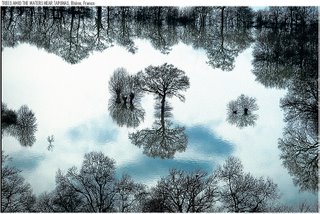
Yann Arthus-Bertrand is the photographer whose work appears below.

The "Earth from above" project is stunning. It includes over 500,000 photos, taken in 100 countries, usually from a helicopter. The accompanying captions are written by scientists who are experts in sustainable development. Portions of the project are currently on display in Amsterdam (where Kendall caught the show) and in Prague.
Earth from above is an in-depth study testifying to the geographical and historical reality of our planet from an unexpected angle. Seen from the air, the Earth reveals its striking beauty as well as the problematic traces left by the development of our societies. Seen from above, towns and country, men and beasts are suddenly one with the landscape and share in the same destiny. It is obvious to all that this portrait reflects our history and our time. And the mirror it holds is asking what we want in way of a future.

A scientific visual databank
Earth from above also aims at building up an inventory of the most significant ecosystems; after each new mission, the team works hand in hand with UNESCO in order to create a photographic databank. UNESCO owns full rights to the images for use in its scientific and pedagogical publications – such were the terms of the initial agreement.

Selected for its aesthetic and pedagogical value, each photo is then the object of a commentary written by a scientist, so as to provide the information necessary to a full understanding of the visual testimony.

In years to come, this collection progressively enriched will constitute a precious tool to reflect upon the evolution of our environment and its consequences. The work done by the team over nearly ten years is some day to be continued by other photographers.
Via Kendall

mercredi, août 30, 2006

free katie

It's not just about the ethics of retouching photographs. It's about the motives behind the retouching. Check out this gallery of retouched photos.

My first thought as I read about the Katie Couric issue was: "would they have done the same thing if it were a male host?"


CBS resizes Couric in promo pic
August 30, 2006 5:48 AM PDT
An image of Katie Couric, originally released in May by CBS, was slimmed down for reuse.
The doctored photo appears in the September issue of Watch magazine, which is owned by CBS, according to Mediabistro, which first reported on the alteration. The New York Post and several blogs soon followed with coverage.
As photo-editing software becomes more available to the general public, the public has become more conscious of altered photography. The software with which average Americans can change themselves has gotten easier to use, with many reality-altering options built into the cameras themselves. A technique, which gives the same effect as the Couric photo, is available as a "Slimming Mode" on several Hewlett Packard cameras. (See a photo gallery of doctored photos, from altered Iraq battlefield scenes to a mash-up of Jane Fonda and John Kerry.)
Couric is scheduled to begin her job as anchor and managing editor of "The CBS Evening News with Katie Couric" in September. She replaces Dan Rather in the position. (Bob Schieffer also served as interim anchor.) Couric will be "the first female solo anchor of a weekday network evening news broadcast," according to CBS.
A brief search found no stories of doctored photos or weight issues related to Couric's male predecessors.