Op-Ed Guest Columnist: It’s 2009. Do You Know Where Your Soul Is?
By BONO
Published: April 18, 2009
I AM in Midtown Manhattan, where drivers still play their car horns as if they were musical instruments and shouting in restaurants is sport.
I am a long way from the warm breeze of voices I heard a week ago on Easter Sunday.
“Glorify your name,” the island women sang, as they swayed in a cut sandstone church. I was overwhelmed by a riot of color, an emotional swell that carried me to sea.
Christianity, it turns out, has a rhythm — and it crescendos this time of year. The rumba of Carnival gives way to the slow march of Lent, then to the staccato hymnals of the Easter parade. From revelry to reverie. After 40 days in the desert, sort of ...
Carnival — rock stars are good at that.
“Carne” is flesh; “Carne-val,” its goodbye party. I’ve been to many. Brazilians say they’ve done it longest; they certainly do it best. You can’t help but contract the fever. You’ve got no choice but to join the ravers as they swell up the streets bursting like the banks of a river in a flood of fun set to rhythm. This is a Joy that cannot be conjured. This is life force. This is the heart full and spilling over with gratitude. The choice is yours ...
It’s Lent I’ve always had issues with. I gave it up ... self-denial is where I come a cropper. My idea of discipline is simple — hard work — but of course that’s another indulgence.
Then comes the dying and the living that is Easter.
It’s a transcendent moment for me — a rebirth I always seem to need. Never more so than a few years ago, when my father died. I recall the embarrassment and relief of hot tears as I knelt in a chapel in a village in France and repented my prodigal nature — repented for fighting my father for so many years and wasting so many opportunities to know him better. I remember the feeling of “a peace that passes understanding” as a load lifted. Of all the Christian festivals, it is the Easter parade that demands the most faith — pushing you past reverence for creation, through bewilderment at the idea of a virgin birth, and into the far-fetched and far-reaching idea that death is not the end. The cross as crossroads. Whatever your religious or nonreligious views, the chance to begin again is a compelling idea.
•
Last Sunday, the choirmaster was jumping out of his skin ... stormy then still, playful then tender, on the most upright of pianos and melodies. He sang his invocations in a beautiful oaken tenor with a freckle-faced boy at his side playing conga and tambourine as if it was a full drum kit. The parish sang to the rafters songs of praise to a God that apparently surrendered His voice to ours.
I come to lowly church halls and lofty cathedrals for what purpose? I search the Scriptures to what end? To check my head? My heart? No, my soul. For me these meditations are like a plumb line dropped by a master builder — to see if the walls are straight or crooked. I check my emotional life with music, my intellectual life with writing, but religion is where I soul-search.
The preacher said, “What good does it profit a man if he gains the whole world and loses his soul?” Hearing this, every one of the pilgrims gathered in the room asked, “Is it me, Lord?” In America, in Europe, people are asking, “Is it us?”
Well, yes. It is us.
Carnival is over. Commerce has been overheating markets and climates ... the sooty skies of the industrial revolution have changed scale and location, but now melt ice caps and make the seas boil in the time of technological revolution. Capitalism is on trial; globalization is, once again, in the dock. We used to say that all we wanted for the rest of the world was what we had for ourselves. Then we found out that if every living soul on the planet had a fridge and a house and an S.U.V., we would choke on our own exhaust.
Lent is upon us whether we asked for it or not. And with it, we hope, comes a chance at redemption. But redemption is not just a spiritual term, it’s an economic concept. At the turn of the millennium, the debt cancellation campaign, inspired by the Jewish concept of Jubilee, aimed to give the poorest countries a fresh start. Thirty-four million more children in Africa are now in school in large part because their governments used money freed up by debt relief. This redemption was not an end to economic slavery, but it was a more hopeful beginning for many. And to the many, not the lucky few, is surely where any soul-searching must lead us.
A few weeks ago I was in Washington when news arrived of proposed cuts to the president’s aid budget. People said that it was going to be hard to fulfill promises to those who live in dire circumstances such a long way away when there is so much hardship in the United States. And there is.
But I read recently that Americans are taking up public service in greater numbers because they are short on money to give. And, following a successful bipartisan Senate vote, word is that Congress will restore the money that had been cut from the aid budget — a refusal to abandon those who would pay such a high price for a crisis not of their making. In the roughest of times, people show who they are.
Your soul.
So much of the discussion today is about value, not values. Aid well spent can be an example of both, values and value for money. Providing AIDS medication to just under four million people, putting in place modest measures to improve maternal health, eradicating killer pests like malaria and rotoviruses — all these provide a leg up on the climb to self-sufficiency, all these can help us make friends in a world quick to enmity. It’s not alms, it’s investment. It’s not charity, it’s justice.
•
Strangely, as we file out of the small stone church into the cruel sun, I think of Warren Buffett and Bill Gates, whose now combined fortune is dedicated to the fight against extreme poverty. Agnostics both, I believe. I think of Nelson Mandela, who has spent his life upholding the rights of others. A spiritual man — no doubt. Religious? I’m told he would not describe himself that way.
Not all soul music comes from the church.
Bono, the lead singer of the band U2 and a co-founder of the advocacy group ONE, is a contributing columnist for The Times.

Affichage des articles dont le libellé est u2. Afficher tous les articles
Affichage des articles dont le libellé est u2. Afficher tous les articles
mercredi, avril 22, 2009
not all soul music comes from the church


dimanche, juin 29, 2008
quotable
"The less you know, the more you believe."
Bono aka Paul David Hewson (born 10 May 1960), musician and activist best known as the lead singer of the Irish rock band U2. Bono has been nominated for the Nobel Peace Prize, was granted an honorary knighthood by the United Kingdom, and was named as a Person of the Year by Time magazine.
vendredi, mars 30, 2007
his demigodness
Don't call him ‘sir’: U2's Bono knighted
U2 frontman receives British knighthood in joke-filled ceremony
The Associated Press
Updated: 3:51 p.m. PT March 29, 2007
DUBLIN, Ireland - Irish rock star and global humanitarian Bono became a knight of the British empire Thursday — and joked that his youngest son thought he was about to become a Jedi instead.
Bono, 46, was named a Knight Commander of the Most Excellent Order of the British Empire in an informal, laugh-filled ceremony in the Dublin home of British Ambassador David Reddaway.
“You have permission to call me anything you want — except sir, all right? Lord of lords, your demigodness, that’ll do,” he told reporters afterward.
Because he is an Irish citizen, Bono won’t have the title of “sir” before his name. That honor is reserved for citizens of the United Kingdom or British Commonwealth countries. Ireland left the Commonwealth when it became a republic in 1949.
Reddaway paid tribute to Bono’s work as a campaigner against poverty and disease in Africa — but first asked whether he was disappointed that becoming a knight no longer involves a sword or kneeling.
“Please, I wasn’t expecting you to kneel,” said Bono, his hand on the ambassador’s shoulder.
Accompanying the rocker were his wife, Ali, and their four children — Jordan, 17; Eve, 15; Elijah, 7; and John, 5. U2 guitarist The Edge and bassist Adam Clayton also attended.
John was disappointed that his dad wasn’t presented with a light saber, said Bono, whose real name is Paul Hewson. “He thought I was becoming a Jedi.”
Bono sported lapel pins for two of his previous European government awards, the Legion d’Honneur from France and the Order of Liberty from Portugal.
Such official accolades “really help me get through a few doors I wouldn’t get through. And that’s the truth, that’s the way the world is,” he said.
vendredi, janvier 05, 2007
my u2 top ten list
Inspired by Omer's Bono-mullet-bashing post, I had to think long and hard about my U2 top ten list. The top ten change every so often, but here's what I'm feeling at the moment. And, yes, I couldn't keep it to ten, once I got started.
I draw the line somewhere around here for the next tier. I didn't actually buy any albums after Zooropa (but got some as gifts) , so I'm not as familiar with the latest stuff. I'm fine with that.
- Bad (Wide Awake in America version)
- All I Want Is You (Extended b-side single version)
- Pride (In the Name of Love)
- With or Without You
- One
- Running to Stand Still
- New Year's Day
- Can't Help Falling in Love (Okay, it's a cover. But it's spine-tingling in just the right way)
- Where the Streets Have No Name
- I Still Haven't Found What I'm Looking For
- Sunday Bloody Sunday
- I Will Follow
- Bullet the Blue Sky
- Two Hearts Beat As One
- 40
- In God's Country
- Everlasting Love (cover)
- Redemption Song (cover)
- The Sweetest Thing
- Love Comes Tumbling
- Dancing Barefoot
- So Cruel
- The First Time
- Ultraviolet (Light My Way)
- Acrobat
- Angel of Harlem
- God Part II
- Heartland
- Love Rescue Me
- Stay (Faraway So Close)
- Beautiful Day
- Christmas (Baby, Please Come Home)
- Zooropa
- Numb
- The Unforgettable Fire
- Dear Prudence (cover)
- Help (cover)
- Gloria
- Seconds
- Stories for Boys
mercredi, juin 21, 2006
respect for the flag
One of my childhood rituals was putting up the flag with my dad on holidays like the fourth of July. But by the time I got to college, I was so jaded about the flag that I equated displaying it with jingoism. In short, I saw flag-waving Americans as examples of patriotism and group-think run horribly amuck.
By my sophomore year, Newt and his cronies were pushing an amendment to ban flag burning and I was pretty torqued about it. Then, on the fourth of July, my roommates and I saw a jerk using the flag as bunting on his pickup truck. I complained bitterly about it as we drove to a potluck. The next day, I was downstairs hanging out with Diana L. and my roommates took red, white, and blue streamers and decorated my room, even slapping a bowtie on Bono on one of my U2 posters.
Flash forward to 9/11 ... at that point, the flag became a symbol of national unity in the face of terrorists who hate the democratic values our flag represents. I got a grapefruit-sized lump in my throat and completely broke down as I drove past a neighborhood bar and saw a flag 100 feet wide by 60 feet tall on the side of a building the day after the attack. But that changed when we invaded Iraq. The flag was back to being a symbol for flag-waving jingoists, marching in lockstep with a misguided madman's personal vendetta falsely portrayed as a war to unseat a madman with WMDs.
 Anyhow, I've never burned a flag, but I respect the rights of those who would choose to do so as a form of (constitutionally protected) free speech. And I get my knickers in a furious twist when I see this kind of hypocrisy. (That's our fearless leader signing flags at a rally in Michigan. )
By the way, United States Code Title 4, Chapter 1, Section 8: Respect for the Flag says the following:
No disrespect should be shown to the flag of the United States of America; the flag should not be dipped to any person or thing. Regimental colors, State flags, and organization or institutional flags are to be dipped as a mark of honor.
(a) The flag should never be displayed with the union down, except as a signal of dire distress in instances of extreme danger to life or property.
(b) The flag should never touch anything beneath it, such as the ground, the floor, water, or merchandise.
(c) The flag should never be carried flat or horizontally, but always aloft and free.
(d) The flag should never be used as wearing apparel, bedding, or drapery. It should never be festooned, drawn back, nor up, in folds, but always allowed to fall free. Bunting of blue, white, and red, always arranged with the blue above, the white in the middle, and the red below, should be used for covering a speaker’s desk, draping the front of the platform, and for decoration in general.
(e) The flag should never be fastened, displayed, used, or stored in such a manner as to permit it to be easily torn, soiled, or damaged in any way.
(f) The flag should never be used as a covering for a ceiling.
(g) The flag should never have placed upon it, nor on any part of it, nor attached to it any mark, insignia, letter, word, figure, design, picture, or drawing of any nature.
(h) The flag should never be used as a receptacle for receiving, holding, carrying, or delivering anything.
(i) The flag should never be used for advertising purposes in any manner whatsoever. It should not be embroidered on such articles as cushions or handkerchiefs and the like, printed or otherwise impressed on paper napkins or boxes or anything that is designed for temporary use and discard. Advertising signs should not be fastened to a staff or halyard from which the flag is flown.
(j) No part of the flag should ever be used as a costume or athletic uniform. However, a flag patch may be affixed to the uniform of military personnel, firemen, policemen, and members of patriotic organizations. The flag represents a living country and is itself considered a living thing. Therefore, the lapel flag pin being a replica, should be worn on the left lapel near the heart.
(k) The flag, when it is in such condition that it is no longer a fitting emblem for display, should be destroyed in a dignified way, preferably by burning.
Via Slater
By my sophomore year, Newt and his cronies were pushing an amendment to ban flag burning and I was pretty torqued about it. Then, on the fourth of July, my roommates and I saw a jerk using the flag as bunting on his pickup truck. I complained bitterly about it as we drove to a potluck. The next day, I was downstairs hanging out with Diana L. and my roommates took red, white, and blue streamers and decorated my room, even slapping a bowtie on Bono on one of my U2 posters.
Flash forward to 9/11 ... at that point, the flag became a symbol of national unity in the face of terrorists who hate the democratic values our flag represents. I got a grapefruit-sized lump in my throat and completely broke down as I drove past a neighborhood bar and saw a flag 100 feet wide by 60 feet tall on the side of a building the day after the attack. But that changed when we invaded Iraq. The flag was back to being a symbol for flag-waving jingoists, marching in lockstep with a misguided madman's personal vendetta falsely portrayed as a war to unseat a madman with WMDs.
 Anyhow, I've never burned a flag, but I respect the rights of those who would choose to do so as a form of (constitutionally protected) free speech. And I get my knickers in a furious twist when I see this kind of hypocrisy. (That's our fearless leader signing flags at a rally in Michigan. )
By the way, United States Code Title 4, Chapter 1, Section 8: Respect for the Flag says the following:
No disrespect should be shown to the flag of the United States of America; the flag should not be dipped to any person or thing. Regimental colors, State flags, and organization or institutional flags are to be dipped as a mark of honor.
(a) The flag should never be displayed with the union down, except as a signal of dire distress in instances of extreme danger to life or property.
(b) The flag should never touch anything beneath it, such as the ground, the floor, water, or merchandise.
(c) The flag should never be carried flat or horizontally, but always aloft and free.
(d) The flag should never be used as wearing apparel, bedding, or drapery. It should never be festooned, drawn back, nor up, in folds, but always allowed to fall free. Bunting of blue, white, and red, always arranged with the blue above, the white in the middle, and the red below, should be used for covering a speaker’s desk, draping the front of the platform, and for decoration in general.
(e) The flag should never be fastened, displayed, used, or stored in such a manner as to permit it to be easily torn, soiled, or damaged in any way.
(f) The flag should never be used as a covering for a ceiling.
(g) The flag should never have placed upon it, nor on any part of it, nor attached to it any mark, insignia, letter, word, figure, design, picture, or drawing of any nature.
(h) The flag should never be used as a receptacle for receiving, holding, carrying, or delivering anything.
(i) The flag should never be used for advertising purposes in any manner whatsoever. It should not be embroidered on such articles as cushions or handkerchiefs and the like, printed or otherwise impressed on paper napkins or boxes or anything that is designed for temporary use and discard. Advertising signs should not be fastened to a staff or halyard from which the flag is flown.
(j) No part of the flag should ever be used as a costume or athletic uniform. However, a flag patch may be affixed to the uniform of military personnel, firemen, policemen, and members of patriotic organizations. The flag represents a living country and is itself considered a living thing. Therefore, the lapel flag pin being a replica, should be worn on the left lapel near the heart.
(k) The flag, when it is in such condition that it is no longer a fitting emblem for display, should be destroyed in a dignified way, preferably by burning.
Via Slater
mardi, janvier 24, 2006
'cause there's something in a sunday ...
As I was getting ready for work today, I searched my iTunes library for songs with "Sunday" in them.
Here's what I got:
Sunday Morning - Ani diFranco
Hated Sunday - Black Box Recorder
Sunday Girl - Blondie
Sunday Rider - David Gates
Sunday Papers - Joe Jackson
Sunday Morning Come Down - Johnny Cash
Saturday Night, Sunday Morning - Madness
Sunday (The Day Before My Birthday) - Moby
Pleasant Valley Sunday - The Monkees
Everyday is Like Sunday - Morrissey
Here's Where the Story Ends - The Sundays
Sunday Bloody Sunday - U2
Sunday Morning - Velvet Underground
Here's what I got:
Sunday Morning - Ani diFranco
Hated Sunday - Black Box Recorder
Sunday Girl - Blondie
Sunday Rider - David Gates
Sunday Papers - Joe Jackson
Sunday Morning Come Down - Johnny Cash
Saturday Night, Sunday Morning - Madness
Sunday (The Day Before My Birthday) - Moby
Pleasant Valley Sunday - The Monkees
Everyday is Like Sunday - Morrissey
Here's Where the Story Ends - The Sundays
Sunday Bloody Sunday - U2
Sunday Morning - Velvet Underground
mardi, janvier 10, 2006
about me
So I'm doing online dating for the first time in my life. This is the profile I posted.
My Self-Summary:
I'm irreverent and relevant. I literally and literarily alliterate, but don't be fooled, I'm not afraid to splice a comma if I have to. I've been told I give really good email, and I expect the same in return. I'm a former DJ, so don't try and fool me with any soulless emo. If you're talking post-industrial, you won't find me at the bar: I'll be shaking, but not stirring, my martinis on the dance floor. My dog's cool, so if you expect to get along with me, expect to get along with him. And I've got a traveling jones; I just can't wait for my next chance to go walkabout and earn some frequent flier miles. (Yes, that is an appropriate place to use a semicolon.)
The truth about me: I'm uber-literal and often way too analytical. I'm also comfortable in my own skin, direct, well educated, sincere, creative, sensual, vulnerable, and kind. I value honesty and am a good friend.
Some of my favorite things: Success, social justice, travel, politics, photography, long kisses, music, cooking, French, Spanish, living abroad, foreign films, indie films, dogs, cancer, NPR, David Sedaris, gardens, back scratches and rubs, flowers, history, dancing, tea, rain, yoga, art, reading the New York Times on Sunday mornings, organic produce from the farmer's market, the color green.
What I'm Doing With My Life
At this very moment? Frittering away time online and flirting with hedonism.
Occupation: Web diva (erstwhile lackey) by day.
Avocation: I'm a graduate student, two nights a week.
Preoccupation: Travel. I've lived abroad (France, Spain) and visited 14 countries so far. This year, I plan to see Peru and China.
I'm Really Good At
First, some things I can't do:
Hard math
Sing loudly on key
Suffer fools / tolerate willful ignorance
The same thing over and over again
Run a seven-minute mile -- yet
Thrive without social interaction
Still there?
Some things I can do:
The Hustle
Hold my own at trivia and word games
Bake/ cook from scratch
Touch my tongue to my nose
Use an incident light meter (and flash powerpack) in a difficult situation. (Need proof?)
Laugh at myself
The First Thing(s) People Usually Notice About Me
People usually comment on my sense of humor and my ability to have a conversation with most anyone about anything. And to pull in a relevant esoteric fact, unless the conversation's about the Bulgarian national soccer (sorry, futbol) team. In that case, we're all SOL.
My Favorite Books, Movies, Music, and Food are
I loathe this question, as my tastes are all over the map. But if I must ...
(a) Things I last read: This afternoon: The New Yorker and Bust magazines, this morning: The New York Times, last night: A Year in the Merde by Stephen Clarke, last week: Postsecret by Frank Warren, last month: The Partly Cloudy Patriot by Sarah Vowell
Favorite books: Me Talk Pretty One Day, Naked, Dress Your Family in Corduroy and Denim, The Power of One, The Oxford English Dictionary, The Joy of Cooking, The Professional Chef, America (Jon Stewart), Almost French, Madam Secretary, The Eyre Affair.
(b) Movies: Monsieur Ibrahim, Priscilla Queen of the Desert, Strictly Ballroom, Delicatessen, Election, Rushmore, The Royal Tennenbaums, City of God, The Big Lebowski, The Princess Bride, Big Fish, Before Sunrise, Amelie, Best in Show, The Motorcycle Diaries, Witness for the Prosecution, Amadeus, 12 Angry Men, Rear Window, The Sound of Music, Love Actually, The Shawshank Redemption, Blue, Dress to Kill, Dune (David Lynch version), High and Low, Memento, American Beauty.
(c) Music: The Divine Comedy, New Order, The Smiths, Lloyd Cole, Pulp, Ani DiFranco, Nouvelle Vague, ABBA, Queen, David Bowie, The Clash, Dido, Teenage Fanclub, Barenaked Ladies, James, Indigo Girls, Dean Martin, U2, Carla Bruni, Frank Sinatra, Frou Frou, Paul Simon, Sarah McLachlan, TMBG, Moby, Wilco, The Cure, Depeche Mode, Oingo Boingo, Johnny Cash, Madness, Elvis Costello, Elvis Presley, The Beatles, The Rolling Stones, The House of Love, Neil Diamond, Carl Orff, William Orbit, Paul Oakenfold.
(d) (Least favorite) foods: I detest avocado and sushi (I know it's heresy to say that in Southern California, but it really means more for the rest of you). I also abhor eggplant and most mushrooms. Otherwise, I'm pretty easy food-wise ...
I'm savoring:
A newfound varietal dark chocolate vice. Try the 71% ocumare sold at Trader Joe's.
The memory of a divine white slice near Grand Central Station a few weeks ago.
Finally, I wouldn't want to live if I couldn't eat sugar, salt, and garlic. (But probably not all at the same time.)
The SIX Things I Could Never Do Without
Food
Water
Oxygen
Sleep
Travel
Hope
Ten things I'd love to live without:
Self-indulgent patriotism
Fundamentalists of any religious stripe
An ignorant and apathetic electorate
The electoral college
Hate (in all its ugly manifestations)
Rampant consumerism
A pervasive sense of entitlement
The Patriot Act
Plastic people (Ashlee, Britney, Paris, and others of their ilk)
WAL-MART
I Spend a Lot of Time Thinking About
... things I plan to do before I die (which I'm not planning to do anytime soon).
Today's do-before-I-die list includes:
Finish graduate school
Run a marathon
Live abroad
Become fluent in at least two more languages
Make arrangements to donate my body to science
On a Typical Friday Night I Am
... out with friends at all the usual places (restaurants, dive bars, clubs, movie theaters, concerts, museums). Or, I might be at home, enjoying good food and drink with the aforementioned friends.
The Most Private Thing I'm Willing to Admit Here IsI'm a vapid, materialistic, selfish, and emotionally unavailable shrew who is needy, lazy, cruel, frigid, suffers from scurvy (and halitosis), and loves Ashlee Simpson. I lack any intelligence whatsovever, basic written and verbal communication skills, and am a fundamentalist who believes that a woman's place is in the home and that you should make all of the decisions for both of us. Oh, and did I mention that I'm ugly and will also hate your mother and your friends?
You should message me if:
The thought of a woman who can write, thinks quirky thoughts, can make you laugh until you cry, and might just be smarter than you makes you want to send me a ridiculously charming email.
I'm likely to respond if you're kind, literate, reasonably sane, and politically similar (read: uber-liberal; if you voted for G.W. or G.H.W. Bush, don't expect a response).
Bonus points if you're: self-confident without being arrogant, handsome but with facial quirks (not chiseled and magazine-perfect), a witty mofo, monogamous, taller than me, inclined toward some kind of art, grounded, interested in the world around you but not so hung up on politics that you can't talk about anything else, able to appreciate femininity while respecting equality, take-charge but not controlling, articulate, passionate about something, ethical, sincere, sensual, gainfully employed, fun, spontaneous, serious, fond of the smell of fabric softener, polyglot, goofy, interesting, able to handle conflict through communication, and someone with kindergarten-teacher patience.
Yeah, you do need to have a picture. I'm down with different, so it's okay if you look, think, or are different. And if you're almost eligible to join AARP, good for you -- but I'm really not interested.
My Self-Summary:
I'm irreverent and relevant. I literally and literarily alliterate, but don't be fooled, I'm not afraid to splice a comma if I have to. I've been told I give really good email, and I expect the same in return. I'm a former DJ, so don't try and fool me with any soulless emo. If you're talking post-industrial, you won't find me at the bar: I'll be shaking, but not stirring, my martinis on the dance floor. My dog's cool, so if you expect to get along with me, expect to get along with him. And I've got a traveling jones; I just can't wait for my next chance to go walkabout and earn some frequent flier miles. (Yes, that is an appropriate place to use a semicolon.)
The truth about me: I'm uber-literal and often way too analytical. I'm also comfortable in my own skin, direct, well educated, sincere, creative, sensual, vulnerable, and kind. I value honesty and am a good friend.
Some of my favorite things: Success, social justice, travel, politics, photography, long kisses, music, cooking, French, Spanish, living abroad, foreign films, indie films, dogs, cancer, NPR, David Sedaris, gardens, back scratches and rubs, flowers, history, dancing, tea, rain, yoga, art, reading the New York Times on Sunday mornings, organic produce from the farmer's market, the color green.
What I'm Doing With My Life
At this very moment? Frittering away time online and flirting with hedonism.
Occupation: Web diva (erstwhile lackey) by day.
Avocation: I'm a graduate student, two nights a week.
Preoccupation: Travel. I've lived abroad (France, Spain) and visited 14 countries so far. This year, I plan to see Peru and China.
I'm Really Good At
First, some things I can't do:
Hard math
Sing loudly on key
Suffer fools / tolerate willful ignorance
The same thing over and over again
Run a seven-minute mile -- yet
Thrive without social interaction
Still there?
Some things I can do:
The Hustle
Hold my own at trivia and word games
Bake/ cook from scratch
Touch my tongue to my nose
Use an incident light meter (and flash powerpack) in a difficult situation. (Need proof?)
Laugh at myself
The First Thing(s) People Usually Notice About Me
People usually comment on my sense of humor and my ability to have a conversation with most anyone about anything. And to pull in a relevant esoteric fact, unless the conversation's about the Bulgarian national soccer (sorry, futbol) team. In that case, we're all SOL.
My Favorite Books, Movies, Music, and Food are
I loathe this question, as my tastes are all over the map. But if I must ...
(a) Things I last read: This afternoon: The New Yorker and Bust magazines, this morning: The New York Times, last night: A Year in the Merde by Stephen Clarke, last week: Postsecret by Frank Warren, last month: The Partly Cloudy Patriot by Sarah Vowell
Favorite books: Me Talk Pretty One Day, Naked, Dress Your Family in Corduroy and Denim, The Power of One, The Oxford English Dictionary, The Joy of Cooking, The Professional Chef, America (Jon Stewart), Almost French, Madam Secretary, The Eyre Affair.
(b) Movies: Monsieur Ibrahim, Priscilla Queen of the Desert, Strictly Ballroom, Delicatessen, Election, Rushmore, The Royal Tennenbaums, City of God, The Big Lebowski, The Princess Bride, Big Fish, Before Sunrise, Amelie, Best in Show, The Motorcycle Diaries, Witness for the Prosecution, Amadeus, 12 Angry Men, Rear Window, The Sound of Music, Love Actually, The Shawshank Redemption, Blue, Dress to Kill, Dune (David Lynch version), High and Low, Memento, American Beauty.
(c) Music: The Divine Comedy, New Order, The Smiths, Lloyd Cole, Pulp, Ani DiFranco, Nouvelle Vague, ABBA, Queen, David Bowie, The Clash, Dido, Teenage Fanclub, Barenaked Ladies, James, Indigo Girls, Dean Martin, U2, Carla Bruni, Frank Sinatra, Frou Frou, Paul Simon, Sarah McLachlan, TMBG, Moby, Wilco, The Cure, Depeche Mode, Oingo Boingo, Johnny Cash, Madness, Elvis Costello, Elvis Presley, The Beatles, The Rolling Stones, The House of Love, Neil Diamond, Carl Orff, William Orbit, Paul Oakenfold.
(d) (Least favorite) foods: I detest avocado and sushi (I know it's heresy to say that in Southern California, but it really means more for the rest of you). I also abhor eggplant and most mushrooms. Otherwise, I'm pretty easy food-wise ...
I'm savoring:
A newfound varietal dark chocolate vice. Try the 71% ocumare sold at Trader Joe's.
The memory of a divine white slice near Grand Central Station a few weeks ago.
Finally, I wouldn't want to live if I couldn't eat sugar, salt, and garlic. (But probably not all at the same time.)
The SIX Things I Could Never Do Without
Food
Water
Oxygen
Sleep
Travel
Hope
Ten things I'd love to live without:
Self-indulgent patriotism
Fundamentalists of any religious stripe
An ignorant and apathetic electorate
The electoral college
Hate (in all its ugly manifestations)
Rampant consumerism
A pervasive sense of entitlement
The Patriot Act
Plastic people (Ashlee, Britney, Paris, and others of their ilk)
WAL-MART
I Spend a Lot of Time Thinking About
... things I plan to do before I die (which I'm not planning to do anytime soon).
Today's do-before-I-die list includes:
Finish graduate school
Run a marathon
Live abroad
Become fluent in at least two more languages
Make arrangements to donate my body to science
On a Typical Friday Night I Am
... out with friends at all the usual places (restaurants, dive bars, clubs, movie theaters, concerts, museums). Or, I might be at home, enjoying good food and drink with the aforementioned friends.
The Most Private Thing I'm Willing to Admit Here IsI'm a vapid, materialistic, selfish, and emotionally unavailable shrew who is needy, lazy, cruel, frigid, suffers from scurvy (and halitosis), and loves Ashlee Simpson. I lack any intelligence whatsovever, basic written and verbal communication skills, and am a fundamentalist who believes that a woman's place is in the home and that you should make all of the decisions for both of us. Oh, and did I mention that I'm ugly and will also hate your mother and your friends?
You should message me if:
The thought of a woman who can write, thinks quirky thoughts, can make you laugh until you cry, and might just be smarter than you makes you want to send me a ridiculously charming email.
I'm likely to respond if you're kind, literate, reasonably sane, and politically similar (read: uber-liberal; if you voted for G.W. or G.H.W. Bush, don't expect a response).
Bonus points if you're: self-confident without being arrogant, handsome but with facial quirks (not chiseled and magazine-perfect), a witty mofo, monogamous, taller than me, inclined toward some kind of art, grounded, interested in the world around you but not so hung up on politics that you can't talk about anything else, able to appreciate femininity while respecting equality, take-charge but not controlling, articulate, passionate about something, ethical, sincere, sensual, gainfully employed, fun, spontaneous, serious, fond of the smell of fabric softener, polyglot, goofy, interesting, able to handle conflict through communication, and someone with kindergarten-teacher patience.
Yeah, you do need to have a picture. I'm down with different, so it's okay if you look, think, or are different. And if you're almost eligible to join AARP, good for you -- but I'm really not interested.
dimanche, décembre 18, 2005
in the name of love
"For being shrewd about doing good, for rewiring politics and re-engineering justice, for making mercy smarter and hope strategic and then daring the rest of us to follow, Bill and Melinda Gates and Bono are TIME Magazine's Persons of the Year."
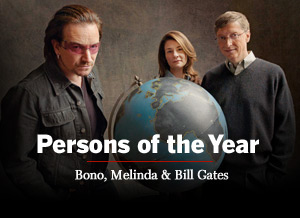
Apparently, Bono can save the world.
Apparently, Bono can save the world.
mardi, décembre 13, 2005
bono and "senator no"
 Bono dines with Jesse Helms
Rocker, senator discuss fighting AIDS in Africa
Bono and former North Carolina Sen. Jesse Helms share a greeting at a pre-concert meal at the new Charlotte Bobcats Arena in Charlotte, N.C., before U2 played to a crowd of 17,000 Monday night. Since they were introduced several years ago, the archconservative Republican known as "Senator No" and Bono have become close allies in the fight against the AIDS epidemic in Africa.
Helms, who is 84 and suffers from a number of serious health problems, arrived backstage before the show and was joined by Bono for a casual meal. On the menu: grilled chicken, roast beef and salmon.
“It was nothing fancy,” Dodd said. “They ate in the cafeteria with the roadies and the rest of the crew.”
The two men talked for a few minutes about their work and what they have been able to accomplish and what still needs to be done, Dodd said.
Bono briefed the senator on DATA — or Debt, AIDS, Trade in Africa — a nonprofit organization he helped found in 2002 with other activists to increase awareness of the crises in Africa.
Helms did not stay for the concert.
mardi, novembre 08, 2005
the maudlin politico
There's a special election today in California and my parents, bless their (conservative) hearts, are working the polls in the town where I grew up.
Anyone who knows me well will tell you that I'm an über liberal who's passionate about politics. I come by it honestly — my mother was working as a diplomat in Madrid when she and my father met. (She was the cultural attachée for the Paraguayan government, which at the time, was a junta under Alfredo Stroessner.) And my father's always been a role model of civic engagement. So you might say that politics are in my blood.
The poli sci geek in me still smiles when I think about the '5' I earned on the AP US Government & Politics exam in high school. It's no surprise that I majored in political science, history, and sociology as an undergrad. Or that I've worked the polls five times. I used to volunteer with the International Rescue Committee, helping would-be citizens practice for their US citizenship civics exams. I've phone banked for several candidates and issues. I'm a religious NPR listener, New York Times reader, and all-around political animal. I belong to the National Organization for Women and am a card-carrying member of the American Civil Liberties Union. And if I still had cable, you can bet your ass that I'd be watching Jon Stewart or Bill Maher right now.
I'm currently reading Sarah Vowell's "The Partly Cloudy Patriot," an insightful gift from a friend. As I laugh my way through the pages, I'm realizing that I'm not the only one who grew up weirdly fascinated by all things political.
When I was a little girl, I remember being very excited to go to the polls with my father. (My mother was not a citizen; therefore, she couldn't vote.) My dad's polling place was in a neighbor's garage. A large American flag was posted on the door and Popi and I would quietly wait until it was his turn to step into the booth with his ballot book and vote.
My childhood was also filled with current events. Each night, my dad would turn on the evening news and read the newspaper. Over dinner, my father and mother would talk about politics and world events and when I was old enough, I joined the discussion.
In 1987, my dad asked my mother and I where we wanted to go on our summer vacation and I said "Washington D.C., Williamsburg, and Philadelphia." My mom wanted to go to France (it was the 200th anniversary of the revolution), but that would have to wait. After all, I was a twelve-year-old on a mission to see American history first-hand and it was the 200th anniversary of the constitutional convention. That passion continued in Mike Black's US history class and I won more than a few trivia and history challenges at Cope Junior High.
By the time I reached high school, I took AP US History from Tim Knapp and AP US Government & Politics from Mike Ware. I read Supreme Court decisions with passion and debated my classmates and teachers. By my senior year, I was a raging liberal and my parents were even more conservative than they had been to begin with. Sidebar: My father is GOP or die. My mom is a fascist. I say that because her family supported Franco in the Spanish Civil War. And she's spoken fondly of the dictator's draconian policies. I should ask her about Guernica sometime ...
Anyhow, there's a moment in "The Breakfast Club" where the Anthony Michael Hall nerd character is being ridiculed for his really crappy fake ID. When asked why he has it, he says "so I can vote." Although I never got the fake ID, I can honestly say that I related to that sentiment.
I went away to college when I was seventeen. That year, I fell in love with Bill Clinton's ideas and the prospect that he and Al Gore might actually unseat George H. W. Bush and be the first Democrats in office in what seemed like forever. I got into interesting arguments with Reza Naima, who lived upstairs in my dorm and was a hardcore Libertarian and fellow U2 fan. I debated with my father, who planned to vote the party line, and with my mother, who was so disgusted with Bush that she decided to phone bank for Perot, even though she wasn't a US citizen. (Her frustration at not being able to cast her vote was what made her finally trade in her green card and become a US citizen. That, and the fact that she's always recoiled at the 'Resident Alien' label. I can't say that I blame her.)
The first time I got to vote, I was so proud that I actually got a bit dewy-eyed at the polls. I also distinctly remember a photograph on the front page of the Los Angeles Times my sophomore year, showing a snaking line of people queued up at sunset to vote in the first free elections in South Africa. The caption included a detail about how most of them had gotten in line well before sunrise. Later that year, I read about SNCC volunteers during Freedom Summer and learned the horrible fates of Emmitt Till, Michael Schwerner, James Cheney, and Andrew Goodman. Then, a few years after graduation, I recoiled in shock when I learned the inhumane way that Matthew Shepard spent the last hours of his life. Just a few months ago, I was introduced to the story of Alice Paul and the other Iron-Jawed Angels.
And that's why I'm headed to the polls today and exercising my right to vote, in spite of New York Times articles that tell me voting is a purely symbolic act. I'll do my best to keep from getting tears in my eyes when I sign the registrar's roster for my precinct. The truth is I'm secretly glad to be maudlin about it. I revel in goosebumps and feeling my heart in my throat as I step into the voting booth.
Anyone who knows me well will tell you that I'm an über liberal who's passionate about politics. I come by it honestly — my mother was working as a diplomat in Madrid when she and my father met. (She was the cultural attachée for the Paraguayan government, which at the time, was a junta under Alfredo Stroessner.) And my father's always been a role model of civic engagement. So you might say that politics are in my blood.
The poli sci geek in me still smiles when I think about the '5' I earned on the AP US Government & Politics exam in high school. It's no surprise that I majored in political science, history, and sociology as an undergrad. Or that I've worked the polls five times. I used to volunteer with the International Rescue Committee, helping would-be citizens practice for their US citizenship civics exams. I've phone banked for several candidates and issues. I'm a religious NPR listener, New York Times reader, and all-around political animal. I belong to the National Organization for Women and am a card-carrying member of the American Civil Liberties Union. And if I still had cable, you can bet your ass that I'd be watching Jon Stewart or Bill Maher right now.
I'm currently reading Sarah Vowell's "The Partly Cloudy Patriot," an insightful gift from a friend. As I laugh my way through the pages, I'm realizing that I'm not the only one who grew up weirdly fascinated by all things political.
When I was a little girl, I remember being very excited to go to the polls with my father. (My mother was not a citizen; therefore, she couldn't vote.) My dad's polling place was in a neighbor's garage. A large American flag was posted on the door and Popi and I would quietly wait until it was his turn to step into the booth with his ballot book and vote.
My childhood was also filled with current events. Each night, my dad would turn on the evening news and read the newspaper. Over dinner, my father and mother would talk about politics and world events and when I was old enough, I joined the discussion.
In 1987, my dad asked my mother and I where we wanted to go on our summer vacation and I said "Washington D.C., Williamsburg, and Philadelphia." My mom wanted to go to France (it was the 200th anniversary of the revolution), but that would have to wait. After all, I was a twelve-year-old on a mission to see American history first-hand and it was the 200th anniversary of the constitutional convention. That passion continued in Mike Black's US history class and I won more than a few trivia and history challenges at Cope Junior High.
By the time I reached high school, I took AP US History from Tim Knapp and AP US Government & Politics from Mike Ware. I read Supreme Court decisions with passion and debated my classmates and teachers. By my senior year, I was a raging liberal and my parents were even more conservative than they had been to begin with. Sidebar: My father is GOP or die. My mom is a fascist. I say that because her family supported Franco in the Spanish Civil War. And she's spoken fondly of the dictator's draconian policies. I should ask her about Guernica sometime ...
Anyhow, there's a moment in "The Breakfast Club" where the Anthony Michael Hall nerd character is being ridiculed for his really crappy fake ID. When asked why he has it, he says "so I can vote." Although I never got the fake ID, I can honestly say that I related to that sentiment.
I went away to college when I was seventeen. That year, I fell in love with Bill Clinton's ideas and the prospect that he and Al Gore might actually unseat George H. W. Bush and be the first Democrats in office in what seemed like forever. I got into interesting arguments with Reza Naima, who lived upstairs in my dorm and was a hardcore Libertarian and fellow U2 fan. I debated with my father, who planned to vote the party line, and with my mother, who was so disgusted with Bush that she decided to phone bank for Perot, even though she wasn't a US citizen. (Her frustration at not being able to cast her vote was what made her finally trade in her green card and become a US citizen. That, and the fact that she's always recoiled at the 'Resident Alien' label. I can't say that I blame her.)
The first time I got to vote, I was so proud that I actually got a bit dewy-eyed at the polls. I also distinctly remember a photograph on the front page of the Los Angeles Times my sophomore year, showing a snaking line of people queued up at sunset to vote in the first free elections in South Africa. The caption included a detail about how most of them had gotten in line well before sunrise. Later that year, I read about SNCC volunteers during Freedom Summer and learned the horrible fates of Emmitt Till, Michael Schwerner, James Cheney, and Andrew Goodman. Then, a few years after graduation, I recoiled in shock when I learned the inhumane way that Matthew Shepard spent the last hours of his life. Just a few months ago, I was introduced to the story of Alice Paul and the other Iron-Jawed Angels.
And that's why I'm headed to the polls today and exercising my right to vote, in spite of New York Times articles that tell me voting is a purely symbolic act. I'll do my best to keep from getting tears in my eyes when I sign the registrar's roster for my precinct. The truth is I'm secretly glad to be maudlin about it. I revel in goosebumps and feeling my heart in my throat as I step into the voting booth.
jeudi, octobre 13, 2005
the mp3 experiment 2.0
Ben's preparing for an adventure in the unknown this Saturday— he's doing an Improv Everywhere mission and has promised to provide a report once it's over. If only San Diego had these sorts of crazy happenings ...
Date: Saturday, October 15
Location: Sheep Meadow, Central Park (West side, mid-Park from 66th to 69th Streets: Map)
Time: The event will begin promptly at 3 p.m. Arrive early. If you are late you will miss it all. It will be over by 4 p.m.
Instructions:
1. Download the mp3.
2. Load it onto your mp3 player (iPod, etc) or burn to a CD for use with a "Discman".
3. Do not listen to the track.
4. Bring it with you to the event.
5. When you arrive at the event, SIT on the grass, anywhere in the meadow. (Bring a towel or newspaper to sit on.)
6. A man in the center of the meadow will make a siren noise with his megaphone. When this happens turn your player on and prepare to press play.
7. Around a minute later, the man will count down from 5 and then make a second siren noise. When you hear the siren, press play.
8. If available, turn on the "hold" feature on your player to prevent yourself from accidentally pressing an incorrect button during the event.
9. Remain seated until otherwise instructed.
10. Have fun.
Improv Everywhere causes scenes of chaos and joy in public places. Created in August of 2001 by Charlie Todd, Improv Everywhere has executed over 50 missions involving hundreds of undercover agents. The group is based in New York City. They staged their own U2 concert on a New York rooftop earlier this year.Ben's mission: The MP3 Experiment 2.0 (you bet your ass he's chosen to accept it)
Date: Saturday, October 15
Location: Sheep Meadow, Central Park (West side, mid-Park from 66th to 69th Streets: Map)
Time: The event will begin promptly at 3 p.m. Arrive early. If you are late you will miss it all. It will be over by 4 p.m.
Instructions:
1. Download the mp3.
2. Load it onto your mp3 player (iPod, etc) or burn to a CD for use with a "Discman".
3. Do not listen to the track.
4. Bring it with you to the event.
5. When you arrive at the event, SIT on the grass, anywhere in the meadow. (Bring a towel or newspaper to sit on.)
6. A man in the center of the meadow will make a siren noise with his megaphone. When this happens turn your player on and prepare to press play.
7. Around a minute later, the man will count down from 5 and then make a second siren noise. When you hear the siren, press play.
8. If available, turn on the "hold" feature on your player to prevent yourself from accidentally pressing an incorrect button during the event.
9. Remain seated until otherwise instructed.
10. Have fun.
mardi, octobre 04, 2005
seriously?
Ummm. Apparently, I'm not that fanatical a fan.
I didn't realize that Bono is in the running for this year's Nobel Peace Prize for his work against poverty. (Or that this is the second time he's been nominated.) And that U2 is taking over the Conan O'Brien show this Thursday night.
I didn't realize that Bono is in the running for this year's Nobel Peace Prize for his work against poverty. (Or that this is the second time he's been nominated.) And that U2 is taking over the Conan O'Brien show this Thursday night.
mardi, septembre 20, 2005
no shit
Interesting article from today's New York Times ...
Almost Before We Spoke, We Swore
Incensed by what it sees as a virtual pandemic of verbal vulgarity issuing from the diverse likes of Howard Stern, Bono of U2 and Robert Novak, the United States Senate is poised to consider a bill that would sharply increase the penalty for obscenity on the air.
By raising the fines that would be levied against offending broadcasters some fifteenfold, to a fee of about $500,000 per crudity broadcast, and by threatening to revoke the licenses of repeat polluters, the Senate seeks to return to the public square the gentler tenor of yesteryear, when seldom were heard any scurrilous words, and famous guys were not foul mouthed all day.
Yet researchers who study the evolution of language and the psychology of swearing say that they have no idea what mystic model of linguistic gentility the critics might have in mind. Cursing, they say, is a human universal. Every language, dialect or patois ever studied, living or dead, spoken by millions or by a small tribe, turns out to have its share of forbidden speech, some variant on comedian George Carlin's famous list of the seven dirty words that are not supposed to be uttered on radio or television.
Young children will memorize the illicit inventory long before they can grasp its sense, said John McWhorter, a scholar of linguistics at the Manhattan Institute and the author of "The Power of Babel," and literary giants have always constructed their art on its spine.
"The Jacobean dramatist Ben Jonson peppered his plays with fackings and "peremptorie Asses," and Shakespeare could hardly quill a stanza without inserting profanities of the day like "zounds" or "sblood" - offensive contractions of "God's wounds" and "God's blood" - or some wondrous sexual pun.
The title "Much Ado About Nothing," Dr. McWhorter said, is a word play on "Much Ado About an O Thing," the O thing being a reference to female genitalia.
Even the quintessential Good Book abounds in naughty passages like the men in II Kings 18:27 who, as the comparatively tame King James translation puts it, "eat their own dung, and drink their own piss."
In fact, said Guy Deutscher, a linguist at the University of Leiden in the Netherlands and the author of "The Unfolding of Language: An Evolutionary Tour of Mankind's Greatest Invention," the earliest writings, which date from 5,000 years ago, include their share of off-color descriptions of the human form and its ever-colorful functions. And the written record is merely a reflection of an oral tradition that Dr. Deutscher and many other psychologists and evolutionary linguists suspect dates from the rise of the human larynx, if not before.
Some researchers are so impressed by the depth and power of strong language that they are using it as a peephole into the architecture of the brain, as a means of probing the tangled, cryptic bonds between the newer, "higher" regions of the brain in charge of intellect, reason and planning, and the older, more "bestial" neural neighborhoods that give birth to our emotions.
Researchers point out that cursing is often an amalgam of raw, spontaneous feeling and targeted, gimlet-eyed cunning. When one person curses at another, they say, the curser rarely spews obscenities and insults at random, but rather will assess the object of his wrath, and adjust the content of the "uncontrollable" outburst accordingly.
Because cursing calls on the thinking and feeling pathways of the brain in roughly equal measure and with handily assessable fervor, scientists say that by studying the neural circuitry behind it they are gaining new insights into how the different domains of the brain communicate - and all for the sake of a well-venomed retort.
Other investigators have examined the physiology of cursing, how our senses and reflexes react to the sound or sight of an obscene word. They have determined that hearing a curse elicits a literal rise out of people. When electrodermal wires are placed on people's arms and fingertips to study their skin conductance patterns and the subjects then hear a few obscenities spoken clearly and firmly, participants show signs of instant arousal.
Their skin conductance patterns spike, the hairs on their arms rise, their pulse quickens, and their breathing becomes shallow.
Interestingly, said Kate Burridge, a professor of linguistics at Monash University in Melbourne, Australia, a similar reaction occurs among university students and others who pride themselves on being educated when they listen to bad grammar or slang expressions that they regard as irritating, illiterate or déclassé.
"People can feel very passionate about language," she said, "as though it were a cherished artifact that must be protected at all cost against the depravities of barbarians and lexical aliens."
Dr. Burridge and a colleague at Monash, Keith Allan, are the authors of "Forbidden Words: Taboo and the Censoring of Language," which will be published early next year by the Cambridge University Press.
Researchers have also found that obscenities can get under one's goosebumped skin and then refuse to budge. In one study, scientists started with the familiar Stroop test, in which subjects are flashed a series of words written in different colors and are asked to react by calling out the colors of the words rather than the words themselves.
If the subjects see the word "chair" written in yellow letters, they are supposed to say "yellow."
The researchers then inserted a number of obscenities and vulgarities in the standard lineup. Charting participants' immediate and delayed responses, the researchers found that, first of all, people needed significantly more time to trill out the colors of the curse words than they did for neutral terms like chair.
The experience of seeing titillating text obviously distracted the participants from the color-coding task at hand. Yet those risqué interpolations left their mark. In subsequent memory quizzes, not only were participants much better at recalling the naughty words than they were the neutrals, but that superior recall also applied to the tints of the tainted words, as well as to their sense.
Yes, it is tough to toil in the shadow of trash. When researchers in another study asked participants to quickly scan lists of words that included obscenities and then to recall as many of the words as possible, the subjects were, once again, best at rehashing the curses - and worst at summoning up whatever unobjectionable entries happened to precede or follow the bad bits.
Yet as much as bad language can deliver a jolt, it can help wash away stress and anger. In some settings, the free flow of foul language may signal not hostility or social pathology, but harmony and tranquillity.
"Studies show that if you're with a group of close friends, the more relaxed you are, the more you swear," Dr. Burridge said. "It's a way of saying: 'I'm so comfortable here I can let off steam. I can say whatever I like.' "
Evidence also suggests that cursing can be an effective means of venting aggression and thereby forestalling physical violence.
With the help of a small army of students and volunteers, Timothy B. Jay, a professor of psychology at Massachusetts College of Liberal Arts in North Adams and the author of "Cursing in America" and "Why We Curse," has explored the dynamics of cursing in great detail.
The investigators have found, among other things, that men generally curse more than women, unless said women are in a sorority, and that university provosts swear more than librarians or the staff members of the university day care center.
Regardless of who is cursing or what the provocation may be, Dr. Jay said, the rationale for the eruption is often the same.
"Time and again, people have told me that cursing is a coping mechanism for them, a way of reducing stress," he said in a telephone interview. "It's a form of anger management that is often underappreciated."
Indeed, chimpanzees engage in what appears to be a kind of cursing match as a means of venting aggression and avoiding a potentially dangerous physical clash.
Frans de Waal, a professor of primate behavior at Emory University in Atlanta, said that when chimpanzees were angry "they will grunt or spit or make an abrupt, upsweeping gesture that, if a human were to do it, you'd recognize it as aggressive."
Such behaviors are threat gestures, Professor de Waal said, and they are all a good sign.
"A chimpanzee who is really gearing up for a fight doesn't waste time with gestures, but just goes ahead and attacks," he added.
By the same token, he said, nothing is more deadly than a person who is too enraged for expletives - who cleanly and quietly picks up a gun and starts shooting.
Researchers have also examined how words attain the status of forbidden speech and how the evolution of coarse language affects the smoother sheets of civil discourse stacked above it. They have found that what counts as taboo language in a given culture is often a mirror into that culture's fears and fixations.
"In some cultures, swear words are drawn mainly from sex and bodily functions, whereas in others, they're drawn mainly from the domain of religion," Dr. Deutscher said.
In societies where the purity and honor of women is of paramount importance, he said, "it's not surprising that many swear words are variations on the 'son of a whore' theme or refer graphically to the genitalia of the person's mother or sisters."
The very concept of a swear word or an oath originates from the profound importance that ancient cultures placed on swearing by the name of a god or gods. In ancient Babylon, swearing by the name of a god was meant to give absolute certainty against lying, Dr. Deutscher said, "and people believed that swearing falsely by a god would bring the terrible wrath of that god upon them." A warning against any abuse of the sacred oath is reflected in the biblical commandment that one must not "take the Lord's name in vain," and even today courtroom witnesses swear on the Bible that they are telling the whole truth and nothing but.
Among Christians, the stricture against taking the Lord's name in vain extended to casual allusions to God's son or the son's corporeal sufferings - no mention of the blood or the wounds or the body, and that goes for clever contractions, too. Nowadays, the phrase, "Oh, golly!" may be considered almost comically wholesome, but it was not always so. "Golly" is a compaction of "God's body" and, thus, was once a profanity.
Yet neither biblical commandment nor the most zealous Victorian censor can elide from the human mind its hand-wringing over the unruly human body, its chronic, embarrassing demands and its sad decay. Discomfort over body functions never sleeps, Dr. Burridge said, and the need for an ever-fresh selection of euphemisms about dirty subjects has long served as an impressive engine of linguistic invention.
Once a word becomes too closely associated with a specific body function, she said, once it becomes too evocative of what should not be evoked, it starts to enter the realm of the taboo and must be replaced by a new, gauzier euphemism.
For example, the word "toilet" stems from the French word for "little towel" and was originally a pleasantly indirect way of referring to the place where the chamber pot or its equivalent resides. But toilet has since come to mean the porcelain fixture itself, and so sounds too blunt to use in polite company. Instead, you ask your tuxedoed waiter for directions to the ladies' room or the restroom or, if you must, the bathroom.
Similarly, the word "coffin" originally meant an ordinary box, but once it became associated with death, that was it for a "shoe coffin" or "thinking outside the coffin." The taboo sense of a word, Dr. Burridge said, "always drives out any other senses it might have had."
Scientists have lately sought to map the neural topography of forbidden speech by studying Tourette's patients who suffer from coprolalia, the pathological and uncontrollable urge to curse. Tourette's syndrome is a neurological disorder of unknown origin characterized predominantly by chronic motor and vocal tics, a constant grimacing or pushing of one's glasses up the bridge of one's nose or emitting a stream of small yips or grunts.
Just a small percentage of Tourette's patients have coprolalia - estimates range from 8 to 30 percent - and patient advocates are dismayed by popular portrayals of Tourette's as a humorous and invariably scatological condition. But for those who do have coprolalia, said Dr. Carlos Singer, director of the division of movement disorders at the University of Miami School of Medicine, the symptom is often the most devastating and humiliating aspect of their condition.
Not only can it be shocking to people to hear a loud volley of expletives erupt for no apparent reason, sometimes from the mouth of a child or young teenager, but the curses can also be provocative and personal, florid slurs against the race, sexual identity or body size of a passer-by, for example, or deliberate and repeated lewd references to an old lover's name while in the arms of a current partner or spouse.
Reporting in The Archives of General Psychiatry, Dr. David A. Silbersweig, a director of neuropsychiatry and neuroimaging at the Weill Medical College of Cornell University, and his colleagues described their use of PET scans to measure cerebral blood flow and identify which regions of the brain are galvanized in Tourette's patients during episodes of tics and coprolalia.
They found strong activation of the basal ganglia, a quartet of neuron clusters deep in the forebrain at roughly the level of the mid-forehead, that are known to help coordinate body movement along with activation of crucial regions of the left rear forebrain that participate in comprehending and generating speech, most notably Broca's area.
The researchers also saw arousal of neural circuits that interact with the limbic system, the wishbone-shape throne of human emotions, and, significantly, of the "executive" realms of the brain, where decisions to act or desist from acting may be carried out: the neural source, scientists said, of whatever conscience, civility or free will humans can claim.
That the brain's executive overseer is ablaze in an outburst of coprolalia, Dr. Silbersweig said, demonstrates how complex an act the urge to speak the unspeakable may be, and not only in the case of Tourette's. The person is gripped by a desire to curse, to voice something wildly inappropriate. Higher-order linguistic circuits are tapped, to contrive the content of the curse. The brain's impulse control center struggles to short-circuit the collusion between limbic system urge and neocortical craft, and it may succeed for a time.
Yet the urge mounts, until at last the speech pathways fire, the verboten is spoken, and archaic and refined brains alike must shoulder the blame.
Almost Before We Spoke, We Swore
Incensed by what it sees as a virtual pandemic of verbal vulgarity issuing from the diverse likes of Howard Stern, Bono of U2 and Robert Novak, the United States Senate is poised to consider a bill that would sharply increase the penalty for obscenity on the air.
By raising the fines that would be levied against offending broadcasters some fifteenfold, to a fee of about $500,000 per crudity broadcast, and by threatening to revoke the licenses of repeat polluters, the Senate seeks to return to the public square the gentler tenor of yesteryear, when seldom were heard any scurrilous words, and famous guys were not foul mouthed all day.
Yet researchers who study the evolution of language and the psychology of swearing say that they have no idea what mystic model of linguistic gentility the critics might have in mind. Cursing, they say, is a human universal. Every language, dialect or patois ever studied, living or dead, spoken by millions or by a small tribe, turns out to have its share of forbidden speech, some variant on comedian George Carlin's famous list of the seven dirty words that are not supposed to be uttered on radio or television.
Young children will memorize the illicit inventory long before they can grasp its sense, said John McWhorter, a scholar of linguistics at the Manhattan Institute and the author of "The Power of Babel," and literary giants have always constructed their art on its spine.
"The Jacobean dramatist Ben Jonson peppered his plays with fackings and "peremptorie Asses," and Shakespeare could hardly quill a stanza without inserting profanities of the day like "zounds" or "sblood" - offensive contractions of "God's wounds" and "God's blood" - or some wondrous sexual pun.
The title "Much Ado About Nothing," Dr. McWhorter said, is a word play on "Much Ado About an O Thing," the O thing being a reference to female genitalia.
Even the quintessential Good Book abounds in naughty passages like the men in II Kings 18:27 who, as the comparatively tame King James translation puts it, "eat their own dung, and drink their own piss."
In fact, said Guy Deutscher, a linguist at the University of Leiden in the Netherlands and the author of "The Unfolding of Language: An Evolutionary Tour of Mankind's Greatest Invention," the earliest writings, which date from 5,000 years ago, include their share of off-color descriptions of the human form and its ever-colorful functions. And the written record is merely a reflection of an oral tradition that Dr. Deutscher and many other psychologists and evolutionary linguists suspect dates from the rise of the human larynx, if not before.
Some researchers are so impressed by the depth and power of strong language that they are using it as a peephole into the architecture of the brain, as a means of probing the tangled, cryptic bonds between the newer, "higher" regions of the brain in charge of intellect, reason and planning, and the older, more "bestial" neural neighborhoods that give birth to our emotions.
Researchers point out that cursing is often an amalgam of raw, spontaneous feeling and targeted, gimlet-eyed cunning. When one person curses at another, they say, the curser rarely spews obscenities and insults at random, but rather will assess the object of his wrath, and adjust the content of the "uncontrollable" outburst accordingly.
Because cursing calls on the thinking and feeling pathways of the brain in roughly equal measure and with handily assessable fervor, scientists say that by studying the neural circuitry behind it they are gaining new insights into how the different domains of the brain communicate - and all for the sake of a well-venomed retort.
Other investigators have examined the physiology of cursing, how our senses and reflexes react to the sound or sight of an obscene word. They have determined that hearing a curse elicits a literal rise out of people. When electrodermal wires are placed on people's arms and fingertips to study their skin conductance patterns and the subjects then hear a few obscenities spoken clearly and firmly, participants show signs of instant arousal.
Their skin conductance patterns spike, the hairs on their arms rise, their pulse quickens, and their breathing becomes shallow.
Interestingly, said Kate Burridge, a professor of linguistics at Monash University in Melbourne, Australia, a similar reaction occurs among university students and others who pride themselves on being educated when they listen to bad grammar or slang expressions that they regard as irritating, illiterate or déclassé.
"People can feel very passionate about language," she said, "as though it were a cherished artifact that must be protected at all cost against the depravities of barbarians and lexical aliens."
Dr. Burridge and a colleague at Monash, Keith Allan, are the authors of "Forbidden Words: Taboo and the Censoring of Language," which will be published early next year by the Cambridge University Press.
Researchers have also found that obscenities can get under one's goosebumped skin and then refuse to budge. In one study, scientists started with the familiar Stroop test, in which subjects are flashed a series of words written in different colors and are asked to react by calling out the colors of the words rather than the words themselves.
If the subjects see the word "chair" written in yellow letters, they are supposed to say "yellow."
The researchers then inserted a number of obscenities and vulgarities in the standard lineup. Charting participants' immediate and delayed responses, the researchers found that, first of all, people needed significantly more time to trill out the colors of the curse words than they did for neutral terms like chair.
The experience of seeing titillating text obviously distracted the participants from the color-coding task at hand. Yet those risqué interpolations left their mark. In subsequent memory quizzes, not only were participants much better at recalling the naughty words than they were the neutrals, but that superior recall also applied to the tints of the tainted words, as well as to their sense.
Yes, it is tough to toil in the shadow of trash. When researchers in another study asked participants to quickly scan lists of words that included obscenities and then to recall as many of the words as possible, the subjects were, once again, best at rehashing the curses - and worst at summoning up whatever unobjectionable entries happened to precede or follow the bad bits.
Yet as much as bad language can deliver a jolt, it can help wash away stress and anger. In some settings, the free flow of foul language may signal not hostility or social pathology, but harmony and tranquillity.
"Studies show that if you're with a group of close friends, the more relaxed you are, the more you swear," Dr. Burridge said. "It's a way of saying: 'I'm so comfortable here I can let off steam. I can say whatever I like.' "
Evidence also suggests that cursing can be an effective means of venting aggression and thereby forestalling physical violence.
With the help of a small army of students and volunteers, Timothy B. Jay, a professor of psychology at Massachusetts College of Liberal Arts in North Adams and the author of "Cursing in America" and "Why We Curse," has explored the dynamics of cursing in great detail.
The investigators have found, among other things, that men generally curse more than women, unless said women are in a sorority, and that university provosts swear more than librarians or the staff members of the university day care center.
Regardless of who is cursing or what the provocation may be, Dr. Jay said, the rationale for the eruption is often the same.
"Time and again, people have told me that cursing is a coping mechanism for them, a way of reducing stress," he said in a telephone interview. "It's a form of anger management that is often underappreciated."
Indeed, chimpanzees engage in what appears to be a kind of cursing match as a means of venting aggression and avoiding a potentially dangerous physical clash.
Frans de Waal, a professor of primate behavior at Emory University in Atlanta, said that when chimpanzees were angry "they will grunt or spit or make an abrupt, upsweeping gesture that, if a human were to do it, you'd recognize it as aggressive."
Such behaviors are threat gestures, Professor de Waal said, and they are all a good sign.
"A chimpanzee who is really gearing up for a fight doesn't waste time with gestures, but just goes ahead and attacks," he added.
By the same token, he said, nothing is more deadly than a person who is too enraged for expletives - who cleanly and quietly picks up a gun and starts shooting.
Researchers have also examined how words attain the status of forbidden speech and how the evolution of coarse language affects the smoother sheets of civil discourse stacked above it. They have found that what counts as taboo language in a given culture is often a mirror into that culture's fears and fixations.
"In some cultures, swear words are drawn mainly from sex and bodily functions, whereas in others, they're drawn mainly from the domain of religion," Dr. Deutscher said.
In societies where the purity and honor of women is of paramount importance, he said, "it's not surprising that many swear words are variations on the 'son of a whore' theme or refer graphically to the genitalia of the person's mother or sisters."
The very concept of a swear word or an oath originates from the profound importance that ancient cultures placed on swearing by the name of a god or gods. In ancient Babylon, swearing by the name of a god was meant to give absolute certainty against lying, Dr. Deutscher said, "and people believed that swearing falsely by a god would bring the terrible wrath of that god upon them." A warning against any abuse of the sacred oath is reflected in the biblical commandment that one must not "take the Lord's name in vain," and even today courtroom witnesses swear on the Bible that they are telling the whole truth and nothing but.
Among Christians, the stricture against taking the Lord's name in vain extended to casual allusions to God's son or the son's corporeal sufferings - no mention of the blood or the wounds or the body, and that goes for clever contractions, too. Nowadays, the phrase, "Oh, golly!" may be considered almost comically wholesome, but it was not always so. "Golly" is a compaction of "God's body" and, thus, was once a profanity.
Yet neither biblical commandment nor the most zealous Victorian censor can elide from the human mind its hand-wringing over the unruly human body, its chronic, embarrassing demands and its sad decay. Discomfort over body functions never sleeps, Dr. Burridge said, and the need for an ever-fresh selection of euphemisms about dirty subjects has long served as an impressive engine of linguistic invention.
Once a word becomes too closely associated with a specific body function, she said, once it becomes too evocative of what should not be evoked, it starts to enter the realm of the taboo and must be replaced by a new, gauzier euphemism.
For example, the word "toilet" stems from the French word for "little towel" and was originally a pleasantly indirect way of referring to the place where the chamber pot or its equivalent resides. But toilet has since come to mean the porcelain fixture itself, and so sounds too blunt to use in polite company. Instead, you ask your tuxedoed waiter for directions to the ladies' room or the restroom or, if you must, the bathroom.
Similarly, the word "coffin" originally meant an ordinary box, but once it became associated with death, that was it for a "shoe coffin" or "thinking outside the coffin." The taboo sense of a word, Dr. Burridge said, "always drives out any other senses it might have had."
Scientists have lately sought to map the neural topography of forbidden speech by studying Tourette's patients who suffer from coprolalia, the pathological and uncontrollable urge to curse. Tourette's syndrome is a neurological disorder of unknown origin characterized predominantly by chronic motor and vocal tics, a constant grimacing or pushing of one's glasses up the bridge of one's nose or emitting a stream of small yips or grunts.
Just a small percentage of Tourette's patients have coprolalia - estimates range from 8 to 30 percent - and patient advocates are dismayed by popular portrayals of Tourette's as a humorous and invariably scatological condition. But for those who do have coprolalia, said Dr. Carlos Singer, director of the division of movement disorders at the University of Miami School of Medicine, the symptom is often the most devastating and humiliating aspect of their condition.
Not only can it be shocking to people to hear a loud volley of expletives erupt for no apparent reason, sometimes from the mouth of a child or young teenager, but the curses can also be provocative and personal, florid slurs against the race, sexual identity or body size of a passer-by, for example, or deliberate and repeated lewd references to an old lover's name while in the arms of a current partner or spouse.
Reporting in The Archives of General Psychiatry, Dr. David A. Silbersweig, a director of neuropsychiatry and neuroimaging at the Weill Medical College of Cornell University, and his colleagues described their use of PET scans to measure cerebral blood flow and identify which regions of the brain are galvanized in Tourette's patients during episodes of tics and coprolalia.
They found strong activation of the basal ganglia, a quartet of neuron clusters deep in the forebrain at roughly the level of the mid-forehead, that are known to help coordinate body movement along with activation of crucial regions of the left rear forebrain that participate in comprehending and generating speech, most notably Broca's area.
The researchers also saw arousal of neural circuits that interact with the limbic system, the wishbone-shape throne of human emotions, and, significantly, of the "executive" realms of the brain, where decisions to act or desist from acting may be carried out: the neural source, scientists said, of whatever conscience, civility or free will humans can claim.
That the brain's executive overseer is ablaze in an outburst of coprolalia, Dr. Silbersweig said, demonstrates how complex an act the urge to speak the unspeakable may be, and not only in the case of Tourette's. The person is gripped by a desire to curse, to voice something wildly inappropriate. Higher-order linguistic circuits are tapped, to contrive the content of the curse. The brain's impulse control center struggles to short-circuit the collusion between limbic system urge and neocortical craft, and it may succeed for a time.
Yet the urge mounts, until at last the speech pathways fire, the verboten is spoken, and archaic and refined brains alike must shoulder the blame.
dimanche, septembre 18, 2005
me, from a to z
[A is for age:] It's a state of mind. I was born in 1975.
[B is for booze of choice:] Red wine or a fruity cocktail.
[C is for career:] W is for Web diva and erstwhile lackey.
[D is for your dad's name:] I call him Popi.
[E is for essential items to bring to a party:] Alcohol, an appetizer, a GSOH, and my camera.
[F is for favorite song at the moment:] I can't pick just one. Currently in heavy rotation: Lloyd Cole, The Divine Comedy, Pulp, Teenage Fanclub, and David J.
[G is for favorite game:] Physical: Tennis. Mental: Trivial Pursuit.
[H is for hometown:] San Diego is where I've lived the longest.
[I is for instruments you play:] Once upon a time? Piano, flute, and piccolo.
[J is for jam or jelly you like:] Apple butter. Or my homemade lemon curd.
[K is for kids?] Not right now. Someday ...
[L is for living arrangements:] I live with my golden retriever. And a nice Japanese guy.
[M is for mom's name:] I don't call her.
[N is for name of your crush:] The position is presently vacant. Do Peter Krause and Bono count?
[O is for overnight hospital stays:] Yes. I beat cancer two years ago.
[P is for phobias:] Being in a swarm of insects. Just thinking about it makes my skin crawl.
[Q is for quotes you like:] What quotes don't I like?
[R is for relationship that lasted the longest] 14 years.
[S is for sexual preference:] I'm straight, but most of my friends aren't.
[T is for time you wake up:] When my bladder tells me it is full.
[U is for underwear:] Yes.
[V is for vegetables you love:] Broccoli, onions, garlic, carrots, tomatoes, orange bell peppers, potatoes, white corn on the cob. And I realize that tomatoes are a fruit. Hmm, what about peppers? I detest mushrooms and avocado.
[W is for worst habits:] I lack the typical vices. But I have been known to correct other people's grammar, care far more than I should about what others think of me, and hold others to the same standards to which I hold myself. Oh, and I'm super-literal.
[X is for x-rays you've had:] Every inch of my body has been x-rayed. See [O is for overnight hospital stays:].
[Y is for yummy food you make:] It's all good.
[Z is for zodiac sign:] Taurus.
Via Edgar
[B is for booze of choice:] Red wine or a fruity cocktail.
[C is for career:] W is for Web diva and erstwhile lackey.
[D is for your dad's name:] I call him Popi.
[E is for essential items to bring to a party:] Alcohol, an appetizer, a GSOH, and my camera.
[F is for favorite song at the moment:] I can't pick just one. Currently in heavy rotation: Lloyd Cole, The Divine Comedy, Pulp, Teenage Fanclub, and David J.
[G is for favorite game:] Physical: Tennis. Mental: Trivial Pursuit.
[H is for hometown:] San Diego is where I've lived the longest.
[I is for instruments you play:] Once upon a time? Piano, flute, and piccolo.
[J is for jam or jelly you like:] Apple butter. Or my homemade lemon curd.
[K is for kids?] Not right now. Someday ...
[L is for living arrangements:] I live with my golden retriever. And a nice Japanese guy.
[M is for mom's name:] I don't call her.
[N is for name of your crush:] The position is presently vacant. Do Peter Krause and Bono count?
)
[O is for overnight hospital stays:] Yes. I beat cancer two years ago.
[P is for phobias:] Being in a swarm of insects. Just thinking about it makes my skin crawl.
[Q is for quotes you like:] What quotes don't I like?
[R is for relationship that lasted the longest] 14 years.
[S is for sexual preference:] I'm straight, but most of my friends aren't.
[T is for time you wake up:] When my bladder tells me it is full.
[U is for underwear:] Yes.
[V is for vegetables you love:] Broccoli, onions, garlic, carrots, tomatoes, orange bell peppers, potatoes, white corn on the cob. And I realize that tomatoes are a fruit. Hmm, what about peppers? I detest mushrooms and avocado.
[W is for worst habits:] I lack the typical vices. But I have been known to correct other people's grammar, care far more than I should about what others think of me, and hold others to the same standards to which I hold myself. Oh, and I'm super-literal.
[X is for x-rays you've had:] Every inch of my body has been x-rayed. See [O is for overnight hospital stays:].
[Y is for yummy food you make:] It's all good.
[Z is for zodiac sign:] Taurus.
Via Edgar
mercredi, août 17, 2005
U2 honored
 If ever I write a personal ad, it will include a line about my desire for a partner with Bono's ardent commitment to social justice. My friend Diana put it best: "How many guys can talk about world peace and not come off like a trite Miss America contestant? He sings and speaks with passion and conviction, and that is incredibly sexy."
U2 handed top Portuguese honour
Irish rock band U2 have been awarded Portugal's highest honour for their humanitarian work. President Jorge Sampaio bestowed the Order of Liberty honour on the group hours before they went on stage for a concert in Lisbon on Sunday.
Before presenting U2 with their honours, Sampaio said: "Over the last 25 years you have shown that it is possible to combine the pleasure of artistic creation with civic and humanitarian intervention to help build a better world."
mardi, mars 29, 2005
it still gives me goosebumps

U2, as photographed by Anton Corbijn in 1987 and later used in the With or Without You single gatefold
I was thinking more about the desaparecidos and listening to Mothers of the Disappeared off "The Joshua Tree" tonight. The album looped, and I had to stop what I was doing when I heard my favorite lines of Running to Stand Still:
You got to cry without weepingPaul Hewson, Dave Evans, Adam Clayton, and Larry Mullen Jr.— thank you for making my favorite album of all time.
Talk without speaking
Scream without raising your voice, you know ...
She runs through the streets
With her eyes painted red
Under a black belly of cloud in the rain
In through a doorway she brings me
White gold and pearls stolen from the sea
She is raging
She is raging and the storm blows up in her eyes
She will suffer the needle chill
She is running to stand still.
lundi, janvier 10, 2005
the soundtrack of my life (so far)
 Okay, kids. Here's the challenge: Make a CD of 12 songs that are the soundtrack of your life. Track #13 is the song you want played at your funeral. Weighty stuff, to be sure. But a thoughtful challenge nonetheless.
I'm thinking that my childhood tunes will include:
These Are A Few of My Favorite Things (from the Sound of Music)
Rainbow Connection (from the Muppet Movie)
Theme song from the Dukes of Hazard - Waylon Jennings
And lots of other songs are racing through my mind, by these artists (to name a few): U2, Dido, James, Annie Lennox, Sting, Peter Gabriel, The Cure, Paul Simon (with and without Art Garfunkel), John Lennon, the Beatles, Sam Cooke, Gloria Gaynor, Neil Diamond, Roberta Flack, Don McLean, ABBA, and Queen and David Bowie .
Inscription à :
Articles (Atom)