“The Fringe Benefits of Failure, and the Importance of Imagination,” Copyright of JK Rowling, June 2008
President Faust, members of the Harvard Corporation and the Board of Overseers, members of the faculty, proud parents, and, above all, graduates.
The first thing I would like to say is ‘thank you.’ Not only has Harvard given me an extraordinary honour, but the weeks of fear and nausea I’ve experienced at the thought of giving this commencement address have made me lose weight. A win-win situation! Now all I have to do is take deep breaths, squint at the red banners and fool myself into believing I am at the world’s best-educated Harry Potter convention.
Delivering a commencement address is a great responsibility; or so I thought until I cast my mind back to my own graduation. The commencement speaker that day was the distinguished British philosopher Baroness Mary Warnock. Reflecting on her speech has helped me enormously in writing this one, because it turns out that I can’t remember a single word she said. This liberating discovery enables me to proceed without any fear that I might inadvertently influence you to abandon promising careers in business, law or politics for the giddy delights of becoming a gay wizard.
You see? If all you remember in years to come is the ‘gay wizard’ joke, I’ve still come out ahead of Baroness Mary Warnock. Achievable goals: the first step towards personal improvement.
Actually, I have wracked my mind and heart for what I ought to say to you today. I have asked myself what I wish I had known at my own graduation, and what important lessons I have learned in the 21 years that has expired between that day and this.
I have come up with two answers. On this wonderful day when we are gathered together to celebrate your academic success, I have decided to talk to you about the benefits of failure. And as you stand on the threshold of what is sometimes called ‘real life’, I want to extol the crucial importance of imagination.
These might seem quixotic or paradoxical choices, but please bear with me.
Looking back at the 21-year-old that I was at graduation, is a slightly uncomfortable experience for the 42-year-old that she has become. Half my lifetime ago, I was striking an uneasy balance between the ambition I had for myself, and what those closest to me expected of me.
I was convinced that the only thing I wanted to do, ever, was to write novels. However, my parents, both of whom came from impoverished backgrounds and neither of whom had been to college, took the view that my overactive imagination was an amusing personal quirk that could never pay a mortgage, or secure a pension.
They had hoped that I would take a vocational degree; I wanted to study English Literature. A compromise was reached that in retrospect satisfied nobody, and I went up to study Modern Languages. Hardly had my parents’ car rounded the corner at the end of the road than I ditched German and scuttled off down the Classics corridor.
I cannot remember telling my parents that I was studying Classics; they might well have found out for the first time on graduation day. Of all subjects on this planet, I think they would have been hard put to name one less useful than Greek mythology when it came to securing the keys to an executive bathroom.
I would like to make it clear, in parenthesis, that I do not blame my parents for their point of view. There is an expiry date on blaming your parents for steering you in the wrong direction; the moment you are old enough to take the wheel, responsibility lies with you. What is more, I cannot criticise my parents for hoping that I would never experience poverty. They had been poor themselves, and I have since been poor, and I quite agree with them that it is not an ennobling experience. Poverty entails fear, and stress, and sometimes depression; it means a thousand petty humiliations and hardships. Climbing out of poverty by your own efforts, that is indeed something on which to pride yourself, but poverty itself is romanticised only by fools.
What I feared most for myself at your age was not poverty, but failure.
At your age, in spite of a distinct lack of motivation at university, where I had spent far too long in the coffee bar writing stories, and far too little time at lectures, I had a knack for passing examinations, and that, for years, had been the measure of success in my life and that of my peers.
I am not dull enough to suppose that because you are young, gifted and well-educated, you have never known hardship or heartbreak. Talent and intelligence never yet inoculated anyone against the caprice of the Fates, and I do not for a moment suppose that everyone here has enjoyed an existence of unruffled privilege and contentment.
However, the fact that you are graduating from Harvard suggests that you are not very well-acquainted with failure. You might be driven by a fear of failure quite as much as a desire for success. Indeed, your conception of failure might not be too far from the average person’s idea of success, so high have you already flown academically.
Ultimately, we all have to decide for ourselves what constitutes failure, but the world is quite eager to give you a set of criteria if you let it. So I think it fair to say that by any conventional measure, a mere seven years after my graduation day, I had failed on an epic scale. An exceptionally short-lived marriage had imploded, and I was jobless, a lone parent, and as poor as it is possible to be in modern Britain, without being homeless. The fears my parents had had for me, and that I had had for myself, had both come to pass, and by every usual standard, I was the biggest failure I knew.
Now, I am not going to stand here and tell you that failure is fun. That period of my life was a dark one, and I had no idea that there was going to be what the press has since represented as a kind of fairy tale resolution. I had no idea how far the tunnel extended, and for a long time, any light at the end of it was a hope rather than a reality.
So why do I talk about the benefits of failure? Simply because failure meant a stripping away of the inessential. I stopped pretending to myself that I was anything other than what I was, and began to direct all my energy into finishing the only work that mattered to me. Had I really succeeded at anything else, I might never have found the determination to succeed in the one arena I believed I truly belonged. I was set free, because my greatest fear had already been realised, and I was still alive, and I still had a daughter whom I adored, and I had an old typewriter and a big idea. And so rock bottom became the solid foundation on which I rebuilt my life.
You might never fail on the scale I did, but some failure in life is inevitable. It is impossible to live without failing at something, unless you live so cautiously that you might as well not have lived at all - in which case, you fail by default.
Failure gave me an inner security that I had never attained by passing examinations. Failure taught me things about myself that I could have learned no other way. I discovered that I had a strong will, and more discipline than I had suspected; I also found out that I had friends whose value was truly above rubies.
The knowledge that you have emerged wiser and stronger from setbacks means that you are, ever after, secure in your ability to survive. You will never truly know yourself, or the strength of your relationships, until both have been tested by adversity. Such knowledge is a true gift, for all that it is painfully won, and it has been worth more to me than any qualification I ever earned.
Given a time machine or a Time Turner, I would tell my 21-year-old self that personal happiness lies in knowing that life is not a check-list of acquisition or achievement. Your qualifications, your CV, are not your life, though you will meet many people of my age and older who confuse the two. Life is difficult, and complicated, and beyond anyone’s total control, and the humility to know that will enable you to survive its vicissitudes.
You might think that I chose my second theme, the importance of imagination, because of the part it played in rebuilding my life, but that is not wholly so. Though I will defend the value of bedtime stories to my last gasp, I have learned to value imagination in a much broader sense. Imagination is not only the uniquely human capacity to envision that which is not, and therefore the fount of all invention and innovation. In its arguably most transformative and revelatory capacity, it is the power that enables us to empathise with humans whose experiences we have never shared.
One of the greatest formative experiences of my life preceded Harry Potter, though it informed much of what I subsequently wrote in those books. This revelation came in the form of one of my earliest day jobs. Though I was sloping off to write stories during my lunch hours, I paid the rent in my early 20s by working in the research department at Amnesty International’s headquarters in London.
There in my little office I read hastily scribbled letters smuggled out of totalitarian regimes by men and women who were risking imprisonment to inform the outside world of what was happening to them. I saw photographs of those who had disappeared without trace, sent to Amnesty by their desperate families and friends. I read the testimony of torture victims and saw pictures of their injuries. I opened handwritten, eye-witness accounts of summary trials and executions, of kidnappings and rapes.
Many of my co-workers were ex-political prisoners, people who had been displaced from their homes, or fled into exile, because they had the temerity to think independently of their government. Visitors to our office included those who had come to give information, or to try and find out what had happened to those they had been forced to leave behind.
I shall never forget the African torture victim, a young man no older than I was at the time, who had become mentally ill after all he had endured in his homeland. He trembled uncontrollably as he spoke into a video camera about the brutality inflicted upon him. He was a foot taller than I was, and seemed as fragile as a child. I was given the job of escorting him to the Underground Station afterwards, and this man whose life had been shattered by cruelty took my hand with exquisite courtesy, and wished me future happiness.
And as long as I live I shall remember walking along an empty corridor and suddenly hearing, from behind a closed door, a scream of pain and horror such as I have never heard since. The door opened, and the researcher poked out her head and told me to run and make a hot drink for the young man sitting with her. She had just given him the news that in retaliation for his own outspokenness against his country’s regime, his mother had been seized and executed.
Every day of my working week in my early 20s I was reminded how incredibly fortunate I was, to live in a country with a democratically elected government, where legal representation and a public trial were the rights of everyone.
Every day, I saw more evidence about the evils humankind will inflict on their fellow humans, to gain or maintain power. I began to have nightmares, literal nightmares, about some of the things I saw, heard and read.
And yet I also learned more about human goodness at Amnesty International than I had ever known before.
Amnesty mobilises thousands of people who have never been tortured or imprisoned for their beliefs to act on behalf of those who have. The power of human empathy, leading to collective action, saves lives, and frees prisoners. Ordinary people, whose personal well-being and security are assured, join together in huge numbers to save people they do not know, and will never meet. My small participation in that process was one of the most humbling and inspiring experiences of my life.
Unlike any other creature on this planet, humans can learn and understand, without having experienced. They can think themselves into other people’s minds, imagine themselves into other people’s places.
Of course, this is a power, like my brand of fictional magic, that is morally neutral. One might use such an ability to manipulate, or control, just as much as to understand or sympathise.
And many prefer not to exercise their imaginations at all. They choose to remain comfortably within the bounds of their own experience, never troubling to wonder how it would feel to have been born other than they are. They can refuse to hear screams or to peer inside cages; they can close their minds and hearts to any suffering that does not touch them personally; they can refuse to know.
I might be tempted to envy people who can live that way, except that I do not think they have any fewer nightmares than I do. Choosing to live in narrow spaces can lead to a form of mental agoraphobia, and that brings its own terrors. I think the wilfully unimaginative see more monsters. They are often more afraid.
What is more, those who choose not to empathise may enable real monsters. For without ever committing an act of outright evil ourselves, we collude with it, through our own apathy.
One of the many things I learned at the end of that Classics corridor down which I ventured at the age of 18, in search of something I could not then define, was this, written by the Greek author Plutarch: What we achieve inwardly will change outer reality.
That is an astonishing statement and yet proven a thousand times every day of our lives. It expresses, in part, our inescapable connection with the outside world, the fact that we touch other people’s lives simply by existing.
But how much more are you, Harvard graduates of 2008, likely to touch other people’s lives? Your intelligence, your capacity for hard work, the education you have earned and received, give you unique status, and unique responsibilities. Even your nationality sets you apart. The great majority of you belong to the world’s only remaining superpower. The way you vote, the way you live, the way you protest, the pressure you bring to bear on your government, has an impact way beyond your borders. That is your privilege, and your burden.
If you choose to use your status and influence to raise your voice on behalf of those who have no voice; if you choose to identify not only with the powerful, but with the powerless; if you retain the ability to imagine yourself into the lives of those who do not have your advantages, then it will not only be your proud families who celebrate your existence, but thousands and millions of people whose reality you have helped transform for the better. We do not need magic to change the world, we carry all the power we need inside ourselves already: we have the power to imagine better.
I am nearly finished. I have one last hope for you, which is something that I already had at 21. The friends with whom I sat on graduation day have been my friends for life. They are my children’s godparents, the people to whom I’ve been able to turn in times of trouble, friends who have been kind enough not to sue me when I’ve used their names for Death Eaters. At our graduation we were bound by enormous affection, by our shared experience of a time that could never come again, and, of course, by the knowledge that we held certain photographic evidence that would be exceptionally valuable if any of us ran for Prime Minister.
So today, I can wish you nothing better than similar friendships. And tomorrow, I hope that even if you remember not a single word of mine, you remember those of Seneca, another of those old Romans I met when I fled down the Classics corridor, in retreat from career ladders, in search of ancient wisdom:
As is a tale, so is life: not how long it is, but how good it is, is what matters.
I wish you all very good lives.
Thank you very much.

Affichage des articles dont le libellé est speech. Afficher tous les articles
Affichage des articles dont le libellé est speech. Afficher tous les articles
vendredi, juin 13, 2008
failure and imagination
I was very impressed by the commencement address J.K. Rowling gave at Harvard on June 5, 2008. I learned more about a woman whose creativity captured my imagination and admire the challenge she issued to Harvard's graduates.


samedi, décembre 16, 2006
adventures in online dating (Toastmasters speech #13)
Speech originally given on Dec. 14, 2006
Award: Best speaker
Last Christmas, a male friend of mine shared his dad’s advice regarding women:
Married stalkers
I know what you’re thinking. You’ve probably all heard the horror stories about internet dating. You know, the one where you date Mr. Right for a few months and then find out he's Mr. Married. Or, you meet a nice guy who seems to be really into you and then — when you tell him you're not as interested — he winds up cyberstalking you. My personal favorite was what my nana said when I told her that I was going to try online dating: "Oy, how do you know that he didn’t just get out of jail?"
For all the negatives (and there are plenty), there are also many positives to online dating:
The internet itself is a strange sociological experiment. It has changed the way in which we relate to people and we've gone from six degrees of separation to more like 2.5 degrees of separation. The internet is such an awesome source multiplier. And things that used to take weeks now take minutes.
There are three characteristics of the internet that make online dating a particularly powerful way to find your match:
OkCupid's matching system
OkCupid uses a series of fun quizzes to get a sense for what’s important to you. Here’s an example of a real question from the site:
Mr. 89%
I saw his profile and liked what he had to say about himself. He seemed sincere and intelligent, two of the qualities I find most attractive in another person. His photo didn't hurt, either.
So I sent him a quiz. It included some fun with analogies and asked about some of the foreign films/ directors we both liked.
Leo’s answers were witty and left me wanting to know more. But he wasn’t the only guy I was talking to.
Shopping around
I contacted and was contacted by several men and had e-mail and phone conversations with a few. I had 14 dates with six different guys in one month.
When I had coffee with a guy I’d met online, I did two things:
1. Verified that what he’d said about himself in his profile jived with what he was like in-person
2. Paid attention to whether or not there was chemistry between us
There was chemistry with a few, but I liked one more than the rest.
The one that kept my interest
11 months later, I’m still dating him.
He’s a pro-choice, tree-hugging, feminist agnostic who also voted for John Kerry. But to my knowledge, he’s never been a bridesmaid.
Next week, Leo and I will get on a plane to spend a week in Connecticut with his family over the holidays. And in February, we’re headed to Argentina and Uruguay.
No regrets
Am I glad I tried online dating?
You bet.
Are my friends happy that I tried online dating?
Absolutely.
In fact, one of my friends is now dating one of Leo’s buddies. When people ask how they met, they say "in a bar." That’s technically true – Leo and I introduced them at happy hour. But if you ask Leo and me how these friends met, we say that they met "internet dating by proxy."
Mr. Toastmaster.
Award: Best speaker
Last Christmas, a male friend of mine shared his dad’s advice regarding women:
"Always tell the smart ones they're pretty. And always tell the pretty ones they're smart.That's a pretty old-school way of looking at love and relationships. And after spending awhile frustrated by the traditional way of meeting men, I was over it. So, I took a new-fangled approach when I went looking for love this year: I hopped online.
And if you ever want a moment of peace and quiet, look for one who isn't pretty or smart."
Married stalkers
I know what you’re thinking. You’ve probably all heard the horror stories about internet dating. You know, the one where you date Mr. Right for a few months and then find out he's Mr. Married. Or, you meet a nice guy who seems to be really into you and then — when you tell him you're not as interested — he winds up cyberstalking you. My personal favorite was what my nana said when I told her that I was going to try online dating: "Oy, how do you know that he didn’t just get out of jail?"
For all the negatives (and there are plenty), there are also many positives to online dating:
The internet itself is a strange sociological experiment. It has changed the way in which we relate to people and we've gone from six degrees of separation to more like 2.5 degrees of separation. The internet is such an awesome source multiplier. And things that used to take weeks now take minutes.
There are three characteristics of the internet that make online dating a particularly powerful way to find your match:
- Source multiplier
Say (hypothetically speaking of course) you’re a pro-choice, tree-hugging, feminist agnostic who also happens to have been a bridesmaid in a lesbian commitment ceremony and voted for John Kerry … you probably aren’t looking to date a sexist, gun-toting, pro-life, homophobic, fundamentalist Jesus freak Republican. And if you are that pro-choice, tree-hugging feminist (okay, I'm amongst friends here. I'll admit that it's me) and you happen to live in San Diego, you might realize that it’s hard to find someone who shares your political and social values. Asking for him to be single, sexy, and for you to have mutual chemistry is even more daunting.
I’m a reasonably assertive and self-confident person, but how, exactly, do you slip in the fact that you’re a pro-choice, tree-hugging, feminist agnostic to someone whom you’ve just met at a bar? Worse yet, what if your well-intentioned friends set you up?
In my case, it was much easier to simply put all those things out there in my profile. I never had to worry about offending someone who had just bought me dinner, and I could also weed out the men whose social values were irreconcilably different from my own. - Research
How many of you have gone online to research a purchase? I routinely research everything from cookbooks to kitchen appliances. I also went online to research cars when I was in the market to buy one. I learned about all the features and narrowed down the ones that I wanted to go and see before I ever set foot in a showroom, much less took a test drive. (Note that I did not say a boyfriend is a purchase, but you just never know ... a boyfriend could turn into a long-term commitment.) - Time-saver
I’m a graduate student who also happens to be gainfully employed 40 hours a week. I have a life, lots of friends, and spend my free time writing speeches for Toastmasters.
That doesn’t exactly leave me with tons of free time. And the time that I do have tends to be after-hours, 10 minutes here, 20 minutes there ... you get the picture.
So last January, I decided to spend some time “shopping” (if you will) for someone I might want to date. It made sense to pre-screen him online before investing the time of going on dates.
OkCupid's matching system
OkCupid uses a series of fun quizzes to get a sense for what’s important to you. Here’s an example of a real question from the site:
- Do you have a problem with racist jokes?
- Yes
- No
- How would your Ideal Match answer this question?
- Yes
- No
- How important is their answer to you?
- Irrelevant
- A little important
- Somewhat important
- Very important
- Mandatory
Mr. 89%
I saw his profile and liked what he had to say about himself. He seemed sincere and intelligent, two of the qualities I find most attractive in another person. His photo didn't hurt, either.
So I sent him a quiz. It included some fun with analogies and asked about some of the foreign films/ directors we both liked.
Leo’s answers were witty and left me wanting to know more. But he wasn’t the only guy I was talking to.
Shopping around
I contacted and was contacted by several men and had e-mail and phone conversations with a few. I had 14 dates with six different guys in one month.
When I had coffee with a guy I’d met online, I did two things:
1. Verified that what he’d said about himself in his profile jived with what he was like in-person
2. Paid attention to whether or not there was chemistry between us
There was chemistry with a few, but I liked one more than the rest.
The one that kept my interest
11 months later, I’m still dating him.
He’s a pro-choice, tree-hugging, feminist agnostic who also voted for John Kerry. But to my knowledge, he’s never been a bridesmaid.
Next week, Leo and I will get on a plane to spend a week in Connecticut with his family over the holidays. And in February, we’re headed to Argentina and Uruguay.
No regrets
Am I glad I tried online dating?
You bet.
Are my friends happy that I tried online dating?
Absolutely.
In fact, one of my friends is now dating one of Leo’s buddies. When people ask how they met, they say "in a bar." That’s technically true – Leo and I introduced them at happy hour. But if you ask Leo and me how these friends met, we say that they met "internet dating by proxy."
Mr. Toastmaster.
lundi, octobre 30, 2006
owen, part II
Owen Eckblom is still connecting people.
I recently blogged about how posting a photo of a complete stranger's headstone connected me with his (estranged) daughter. It's still connecting us, and it's been interesting to learn that our lives have been on eerily similar (parallel) tracks. Read the latest in Owen's story:
I recently blogged about how posting a photo of a complete stranger's headstone connected me with his (estranged) daughter. It's still connecting us, and it's been interesting to learn that our lives have been on eerily similar (parallel) tracks. Read the latest in Owen's story:
a kiss for owen eckblom
Hi again - Jennifer here. You were so kind to respond to my post. While telling my son about this "truly Happy" coincidence, we found your blog and the follow-up posted there. He asked why I hadn't included this on MY blog ... which leads me to my request: Would you consider sending me a copy of the pic of O's headstone?
Out of curiousity - and not latent stalker tendencies - I took the liberty to read bits and pieces of your blog. I thought maybe you'd be interested to know: Owen worked in PR until he and his 3rd wife started home brewing beer and wine. They opened a store in San Diego - not sure if it is still there. I am also a Comm professional - currently teaching Speech and Mass Comm full-time at a community college near Baltimore. I've often been tempted to join a local Toastmasters group - but after listening to upwards of 600 student speeches a year, you can understand why I resist the temptation. I flex my platform muscles in meetings, in the classroom, and in my private comm consulting activities. And ... this is what prompted me to write again ... I lost my right kidney to renal cell carcinoma in 1997.
A friend who does not yet know the story of your photo emailed me today with a story about what a 'small world' it is ... I think I can trump her.
Regards - J
jeudi, mai 18, 2006
a declaration of conscience
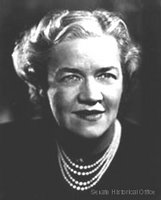 Margaret Chase Smith (December 14, 1897–May 29, 1995) was the first woman to be elected to both the U.S. House and the Senate. In 1964, she became the first woman nominated for U.S. president by a major party. She was a moderate Republican from Maine and one of the first people to speak out about Joseph R. McCarthy's smear campaign.
She did so without actually naming him in the speech. He retaliated and, violating Senate custom, removed her as a member of the Permanent Subcommittee on Investigations, giving her place to the new senator from California, Richard M. Nixon. McCarthy's allies took every occasion to smear Senator Smith. But in 1954, she had the satisfaction of casting a vote for McCarthy's censure.
Her words are frighteningly relevant today. Note: At the time of her speech, there was Democrat in the White House and Democrats controlled both houses of Congress.
This is her Declaration of Conscience.
June 1, 1950
I would like to speak briefly and simply about a serious national condition. It is a national feeling of fear and frustration that could result in national suicide and the end of everything that we Americans hold dear. It is a condition that comes from the lack of effective leadership in either the Legislative Branch or the Executive Branch of our Government.
That leadership is so lacking that serious and responsible proposals are being made that national advisory commissions be appointed to provide such critically needed leadership.
I speak as briefly as possible because too much harm has already been done with irresponsible words of bitterness and selfish political opportunism. I speak as simply as possible because the issue is too great to be obscured by eloquence. I speak simply and briefly in the hope that my words will be taken to heart.
I speak as a Republican. I speak as a woman. I speak as a United States Senator. I speak as an American.
The United States Senate has long enjoyed worldwide respect as the greatest deliberative body in the world. But recently that deliberative character has too often been debased to the level of a forum of hate and character assassination sheltered by the shield of congressional immunity.
It is ironical that we Senators can in debate in the Senate directly or indirectly, by any form of words, impute to any American who is not a Senator any conduct or motive unworthy or unbecoming an American---and without that non-Senator American having any legal redress against us---yet if we say the same thing in the Senate about our colleagues we can be stopped on the grounds of being out of order.
It is strange that we can verbally attack anyone else without restraint and with full protection and yet we hold ourselves above the same type of criticism here on the Senate Floor. Surely the United States Senate is big enough to take self-criticism and self-appraisal. Surely we should be able to take the same kind of character attacks that we "dish out" to outsiders.
I think that it is high time for the United States Senate and its members to do some soul-searching---for us to weigh our consciences---on the manner in which we are performing our duty to the people of America---on the manner in which we are using or abusing our individual powers and privileges.
I think that it is high time that we remembered that we have sworn to uphold and defend the Constitution. I think that it is high time that we remembered that the Constitution, as amended, speaks not only of the freedom of speech but also of trial by jury instead of trial by accusation.
Whether it be a criminal prosecution in court or a character prosecution in the Senate, there is little practical distinction when the life of a person has been ruined.
Those of us who shout the loudest about Americanism in making character assassinations are all too frequently those who, by our own words and acts, ignore some of the basic principles of Americanism:
The right to criticize;
The right to hold unpopular beliefs;
The right to protest;
The right of independent thought.
The exercise of these rights should not cost one single American citizen his reputation or his right to a livelihood nor should he be in danger of losing his reputation or livelihood merely because he happens to know someone who holds unpopular beliefs. Who of us doesn't? Otherwise none of us could call our souls our own. Otherwise thought control would have set in.
The American people are sick and tired of being afraid to speak their minds lest they be politically smeared as "Communists" or "Fascists" by their opponents. Freedom of speech is not what it used to be in America. It has been so abused by some that it is not exercised by others.
The American people are sick and tired of seeing innocent people smeared and guilty people whitewashed. But there have been enough proved cases such as the Amerasia case, the Hiss case, the Coplon case, the Gold case, to cause nationwide distrust and suspicion that there may be something to the unproved, sensational accusations.
As a Republican, I say to my colleagues on this side of the aisle that the Republican Party faces a challenge today that is not unlike the challenge that it faced back in Lincoln's day. The Republican Party so successfully met that challenge that it emerged from the Civil War as the champion of a united nation---in addition to being a Party that unrelentingly fought loose spending and loose programs.
Today our country is being psychologically divided by the confusion and the suspicions that are bred in the United States Senate to spread like cancerous tentacles of "know nothing, suspect everything" attitudes. Today we have a Democratic Administration that has developed a mania for loose spending and loose programs. History is repeating itself---and the Republican Party again has the opportunity to emerge as the champion of unity and prudence.
The record of the present Democratic Administration has provided us with sufficient campaign issues without the necessity to resorting to political smears. America is rapidly losing its position as leader of the world simply because the Democratic Administration has pitifully failed to provide effective leadership.
The Democratic Administration has completely confused the American people by its daily contradictory grave warnings and optimistic assurances---that show the people that our Democratic Administration has no idea of where it is going.
The Democratic Administration has greatly lost the confidence of the American people by it complacency to the threat of communism here at home and the leak of vital secrets to Russia through key officials of the Democratic Administration. There are enough proved cases to make this point without diluting our criticism with unproved charges.
Surely these are sufficient reasons to make it clear to the American people that it is time for a change and that a Republican victory is necessary to the security of this country. Surely it is clear that this nation will continue to suffer as long as it is governed by the present ineffective Democratic Administration.
Yet to displace it with a Republican regime embracing a philosophy that lacks political integrity or intellectual honesty would prove equally disastrous to this nation. The nation sorely needs a Republican victory. But I don't want to see the Republican Party ride to political victory on the Four Horsemen of Calumny---Fear, Ignorance, Bigotry, and Smear.
I doubt if the Republican Party could---simply because I don't believe the American people will uphold any political party that puts political exploitation above national interest. Surely we Republicans aren't that desperate for victory.
I don't want to see the Republican party win that way. While it might be a fleeting victory for the Republican Party, it would be a more lasting defeat for the American people. Surely it would ultimately be suicide for the Republican Party and the two-party system that has protected our American liberties from the dictatorship of a one-party system.
As members of the Minority Party, we do not have the primary authority to formulate the policy of our Government. But we do have the responsibility of rendering constructive criticism, of clarifying issues, of allaying fears by acting as responsible citizens.
As a woman, I wonder how the mothers, wives, sisters, and daughters feel about the way in which members of their families have been politically mangled in Senate debate---and I use the word "debate" advisedly.
As a United States Senator, I am not proud of the way in which the Senate has been made a publicity platform for irresponsible sensationalism. I am not proud of the reckless abandon in which unproved charges have been hurled from this side of the aisle. I am not proud of the obviously staged, undignified countercharges that have been attempted in retaliation from the other side of the aisle.
I don't like the way the Senate has been made a rendezvous for vilification, for selfish political gain at the sacrifice of individual reputations and national unity. I am not proud of the way we smear outsiders from the Floor of the Senate and hide behind the cloak of congressional immunity and still place ourselves beyond criticism on the Floor of the Senate.
As an American, I am shocked at the way Republicans and Democrats alike are playing directly into the Communist design of "confuse, divide, and conquer." As an American, I don't want a Democratic Administration "whitewash" or "coverup" any more than I want a Republican smear or witch hunt.
As an American, I condemn a Republican "Fascist" just as much as I condemn a Democrat "Communist." I condemn a Democrat "Fascist" just as much as I condemn a Republican "Communist." They are equally dangerous to you and me and to our country. As an American, I want to see our nation recapture the strength and unity it once had when we fought the enemy instead of ourselves.
It is with these thoughts that I have drafted what I call a "Declaration of Conscience." I am gratified that Senator Tobey, Senator Aiken, Senator Morse, Senator Ives, Senator Thye, and Senator Hendrickson have concurred in that declaration and have authorized me to announce their concurrence.
Via Karen Woolsey (Toastmasters)
mercredi, janvier 25, 2006
working up the nerve
Decisions, decisions: do I share this factoid at tomorrow's Toastmasters meeting or not?
Sex helps calm nerves before public speaking
Full sexual intercourse offers the best results, psychologist says
Updated: 2:53 p.m. ET Jan. 25, 2006
LONDON - Forget pretending you are talking to one person or concentrating on a single point in the audience — having sex is good way to calm nerves before giving a speech or presentation.
But Stuart Brody, a psychologist at the University of Paisley in Scotland, said it has to be full sexual intercourse to get the best results.
He studied nearly 50 men and women who recorded their sexual activities for two weeks and analyzed its impact on their blood pressure levels when under acute stress, such as when giving a speech.
Brody discovered that the volunteers who had sexual intercourse were the least stressed and had blood pressure levels that returned to normal more quickly than people who engaged in other types of sex.
But people who had abstained from sex had the highest blood pressure response to stress.
Even after taking into account stress due to work or other factors, the range of responses to stress were best explained by sexual behavior.
“The effects are not attributable simply to the short-term relief afforded by orgasm but rather, endure for at least a week,” Brody told New Scientist magazine said on Wednesday.
He believes that the release of the so-called “pair bonding” hormone oxytocin might explain the calming effect.
Sex helps calm nerves before public speaking
Full sexual intercourse offers the best results, psychologist says
Updated: 2:53 p.m. ET Jan. 25, 2006
LONDON - Forget pretending you are talking to one person or concentrating on a single point in the audience — having sex is good way to calm nerves before giving a speech or presentation.
But Stuart Brody, a psychologist at the University of Paisley in Scotland, said it has to be full sexual intercourse to get the best results.
He studied nearly 50 men and women who recorded their sexual activities for two weeks and analyzed its impact on their blood pressure levels when under acute stress, such as when giving a speech.
Brody discovered that the volunteers who had sexual intercourse were the least stressed and had blood pressure levels that returned to normal more quickly than people who engaged in other types of sex.
But people who had abstained from sex had the highest blood pressure response to stress.
Even after taking into account stress due to work or other factors, the range of responses to stress were best explained by sexual behavior.
“The effects are not attributable simply to the short-term relief afforded by orgasm but rather, endure for at least a week,” Brody told New Scientist magazine said on Wednesday.
He believes that the release of the so-called “pair bonding” hormone oxytocin might explain the calming effect.
samedi, janvier 21, 2006
loose lips sink relationships
My friend Bill gave a great speech at last week's Toastmasters meeting. It was on kissing and had the entire room in stitches; two-thirds of the room was actually crying by the end of the speech.
He was kind enough to send me the outline yesterday, so here's the essence of what he (a forty-something single guy) had to say ...
The facts: Most men are afraid of marriage, bad cooks, and bad kissers. Most men are aware of the first two facts, but completely in the dark on the last. According to the group of women Bill surveyed, only 20% of men are good kissers, which means that 4 out of 5 are doing things the wrong way. All of this becomes even more important when you consider the group's other observation -- if the first kiss sucks, you might not get a second chance.
Some things to keep in mind: For women, kissing is often an end unto itself. But for men, kissing is often the means to an end.
Ways men go wrong / problematic kissing styles:
- The Dead Cod (not enough pressure / traction)
- The Slobberer (too much lubrication)
- The Washing Machine (too much 360 movement)
- The Dentist (too much floss action)
- The Engulfer (stick to her lips, and don't include everything from her nose to her chin)
- The Reptile (too much tongue flicking)
Other things to keep in mind:
- No hair pulling
- No vacuum
- No biting
Finally, these are Bill's tips for success:
- moisturize
- relax
- watch body language
He was kind enough to send me the outline yesterday, so here's the essence of what he (a forty-something single guy) had to say ...
The facts: Most men are afraid of marriage, bad cooks, and bad kissers. Most men are aware of the first two facts, but completely in the dark on the last. According to the group of women Bill surveyed, only 20% of men are good kissers, which means that 4 out of 5 are doing things the wrong way. All of this becomes even more important when you consider the group's other observation -- if the first kiss sucks, you might not get a second chance.
Some things to keep in mind: For women, kissing is often an end unto itself. But for men, kissing is often the means to an end.
Ways men go wrong / problematic kissing styles:
- The Dead Cod (not enough pressure / traction)
- The Slobberer (too much lubrication)
- The Washing Machine (too much 360 movement)
- The Dentist (too much floss action)
- The Engulfer (stick to her lips, and don't include everything from her nose to her chin)
- The Reptile (too much tongue flicking)
Other things to keep in mind:
- No hair pulling
- No vacuum
- No biting
Finally, these are Bill's tips for success:
- moisturize
- relax
- watch body language
jeudi, novembre 17, 2005
quotable
"There's nothing new under the sun. The difference is how the furniture is arranged."
-My friend (and fellow Toastmaster) Teresa Jache
-My friend (and fellow Toastmaster) Teresa Jache
dimanche, septembre 25, 2005
my toastmasters speech archive
Adventures in Online Dating: How I went from no dates to 14 dates with six different guys in one month to finding the love of my life.
The Maudlin Politico: About my weird fascination with all things political and why I get goosebumps and feel my heart in my throat each time I step into the voting booth.
No Such Thing as a Bad Day: Why cancer is the best thing that ever happened to me
C&L manual, speech #10: Inspire your audience
How to Lose 60 IQ Points: My many miscommunications while traveling / living abroad
C&L manual, speech #6: Vocal variety
Video Games Will Rot Your Mind: About being a Jeopardy! contestant
C&L manual, speech #2: Organize your speech
Happily Ever After: How I got my name
C&L manual, speech #1: Icebreaker speech
The Key to Understanding Me: My biography, as represented by my keychain
C&L manual, speech #4: How to say it
Doing Strange Things to Their Dogs With Forks: A speech about hallucinating French people, art, and bread
C&L manual, speech #7: Research your topic
Chasing Away the Predators: Women's rights — or the lack thereof— worldwide
C&L manual, speech #9: Persuade with power
Touching Things Up: What touch means across cultures
C&L manual, speech #5: Your body speaks
Taming the Dragon: Dragons across cultures
C&L manual, speech #8: Visual aids
The 10 C's: My moviegoing experiences
C&L manual, speech #3: Get to the point
The Maudlin Politico: About my weird fascination with all things political and why I get goosebumps and feel my heart in my throat each time I step into the voting booth.
No Such Thing as a Bad Day: Why cancer is the best thing that ever happened to me
C&L manual, speech #10: Inspire your audience
How to Lose 60 IQ Points: My many miscommunications while traveling / living abroad
C&L manual, speech #6: Vocal variety
Video Games Will Rot Your Mind: About being a Jeopardy! contestant
C&L manual, speech #2: Organize your speech
Happily Ever After: How I got my name
C&L manual, speech #1: Icebreaker speech
The Key to Understanding Me: My biography, as represented by my keychain
C&L manual, speech #4: How to say it
Doing Strange Things to Their Dogs With Forks: A speech about hallucinating French people, art, and bread
C&L manual, speech #7: Research your topic
Chasing Away the Predators: Women's rights — or the lack thereof— worldwide
C&L manual, speech #9: Persuade with power
Touching Things Up: What touch means across cultures
C&L manual, speech #5: Your body speaks
Taming the Dragon: Dragons across cultures
C&L manual, speech #8: Visual aids
The 10 C's: My moviegoing experiences
C&L manual, speech #3: Get to the point
jeudi, septembre 08, 2005
no such thing as a bad day
Toastmasters CTM speech originally given on Sept. 8, 2005.
Award: Best speaker
Gentlemen, please count off, and will every second man please stand up? (Remain standing.) Ladies, please count off, and will every third woman please stand up? (Remain standing.) I've asked you to do this to visualize the following: The American Cancer Society estimates that one in two men and one in three women will develop cancer in their lifetime. When I was 28 years old, I became one of those Americans.
(Please be seated.)
Like many people, I made a New Year's resolution in 2003 to get healthy and lose some weight. I started exercising several times a week, taking Pilates, water aerobics, and other classes. That year, I also learned that my 31-year-old friend Vanessa had been diagnosed with breast cancer. So I decided to combine my desire to get healthy with a way to help cancer research and signed up for the Breast Cancer 3-Day walk.
I didn’t know it at the time, but that decision saved my life.
Doctor Smiley
I had waited months for my appointment with the specialist. Dr. Smiley – his real name – was a very matter-of-fact man. As he examined me, he asked me why I had come to his office and if I'd recently experienced any aches, pains, or changes in weight.
I told him that I'd felt a nagging pain in the lower right quadrant of my abdomen while exercising. He asked if I'd had any back or flank pain recently and I said that I'd had quite a bit of back pain after a five-mile training walk with my 3-Day teammates the week before. Then he said, "Let's go into my office, I want to show you something."
The "something" was a CT scan taken a few weeks earlier.
He explained that the images in front of me were cross-sections of my body and that there was something very wrong with my right kidney. And then he said the most horrible words I've ever heard. He said that he was very sorry, but in his professional opinion, I had renal cell carcinoma, more commonly known as kidney cancer.
My mind reeling, I stared dumbly as he explained that the good news was that it looked like the cancer hadn't invaded my lymph nodes and that the gerota fascia (the sack in which each kidney is encapsulated) was distended, but had held.
Choices
He then said that I had a few decisions to make about my treatment. I needed to have surgery. Would I prefer a partial or radical (complete) nephrectomy? Laprascopic or open surgery?
I asked about the advantages and disadvantages of each procedure and what he would do if he were a patient with my diagnosis. He recommended the radical nephrectomy, because I had good kidney function and there was less risk of post-operative complication if they removed the whole kidney rather than just the area surrounding the tumor.
He also recommended the open surgery (despite the four- to six-week recovery time) because it meant that my doctors would be able to do a visual and tactile inspection of my lymph nodes and ensure that the cancer had not metastasized to the rest of my body.
He then ushered me out to see his nurse, who gave me the paperwork needed to get my surgery scheduled. Still in shock, I mustered a question – did they have any pamphlets on my condition? He did not but offered to lend me some medical texts. His nurse then said these magic words: "Call the American Cancer Society. They can help."
'Meet me at home, right now.'
I left the office and took my cell phone out to try and reach my husband, Eric. Choking on the words, I said "Meet me at home, right now." I then got into my car and drove the four miles home and called Vanessa, my friend who had been battling breast cancer for the past year. She calmly got online with me and we googled "renal cell carcinoma" and read about it until Eric got home.
He asked all kinds of questions I couldn’t answer and we cried together before calling our families that afternoon to tell them the news. It didn’t get any easier to say the word "cancer" each time I repeated it.
Then, we called the American Cancer Society. They were incredibly helpful, and referred me to the Kidney Cancer Association, which sent me information about what to expect during my surgery and other treatments.
The next few weeks were a blur of emotions and doctor's appointments, lab work, and doing what I could to get ready for my surgery.
I'm remarkable
I've learned that the "typical" kidney cancer patient is male, age 40-60, has been a heavy smoker most of his life, has been overweight for much of his life, and is of African-American or Scandinavian descent.
You do the math. With the exception of battling my weight for much of my life, I’m none of those things.
I'm what you might call a statistical outlier, the exception to the rule. I'm also what you might call lucky.
I'm also lucky because I got a lot wiser about myself and the life I wanted to live at age 28.
Right after my surgery, I picked up Lance Armstrong’s book, "It's Not About The Bike: My Journey Back to Life." In it, Armstrong writes about making the most of one's survivorship. His survivorship has centered on the LIVESTRONG campaign, which has raised awareness and millions of dollars for cancer survivorship.
I also read Hamilton Jordan's book. A three-time cancer survivor, he was President Jimmy Carter’s chief of staff. His memoir, "No Such Thing As A Bad Day," pretty much sums up my attitude.
Those two books inspired me to think about what I would do with my survivorship and how I wanted to change my life. And boy did I change it … in the past two years, I've beaten cancer, survived a divorce, and lived in Paris. I've advanced in my career by changing jobs and employers, bought my first home, and become a graduate student.
What I can't do
There are lots of things I can't do because of my medical history. I can't join the foreign service or the Peace Corps. I can't get life insurance. I can't take calcium or vitamin C supplements. I can't take Advil or most pain medication. And I can never be self-employed, because getting medical insurance is pretty much out of the question with a pre-existing condition like mine. [Update: Thank goodness for the Affordable Care Act.]
What I can do
But there are even more things that I do precisely because of my medical history:
I do all of these things because I got the gift of perspective when I was 28. I took the time to decide what I wanted from life and what I wanted out of my life. If I’ve learned anything, it’s that we all should take the time to take care of ourselves and our relationships. I think of it this way: my new year’s resolution was really a goal, a promise that I made to myself to get healthy in 2003. That goal literally saved my life. So I ask you:
Award: Best speaker
Gentlemen, please count off, and will every second man please stand up? (Remain standing.) Ladies, please count off, and will every third woman please stand up? (Remain standing.) I've asked you to do this to visualize the following: The American Cancer Society estimates that one in two men and one in three women will develop cancer in their lifetime. When I was 28 years old, I became one of those Americans.
(Please be seated.)
Like many people, I made a New Year's resolution in 2003 to get healthy and lose some weight. I started exercising several times a week, taking Pilates, water aerobics, and other classes. That year, I also learned that my 31-year-old friend Vanessa had been diagnosed with breast cancer. So I decided to combine my desire to get healthy with a way to help cancer research and signed up for the Breast Cancer 3-Day walk.
I didn’t know it at the time, but that decision saved my life.
Doctor Smiley
I had waited months for my appointment with the specialist. Dr. Smiley – his real name – was a very matter-of-fact man. As he examined me, he asked me why I had come to his office and if I'd recently experienced any aches, pains, or changes in weight.
I told him that I'd felt a nagging pain in the lower right quadrant of my abdomen while exercising. He asked if I'd had any back or flank pain recently and I said that I'd had quite a bit of back pain after a five-mile training walk with my 3-Day teammates the week before. Then he said, "Let's go into my office, I want to show you something."
The "something" was a CT scan taken a few weeks earlier.
He explained that the images in front of me were cross-sections of my body and that there was something very wrong with my right kidney. And then he said the most horrible words I've ever heard. He said that he was very sorry, but in his professional opinion, I had renal cell carcinoma, more commonly known as kidney cancer.
My mind reeling, I stared dumbly as he explained that the good news was that it looked like the cancer hadn't invaded my lymph nodes and that the gerota fascia (the sack in which each kidney is encapsulated) was distended, but had held.
Choices
He then said that I had a few decisions to make about my treatment. I needed to have surgery. Would I prefer a partial or radical (complete) nephrectomy? Laprascopic or open surgery?
I asked about the advantages and disadvantages of each procedure and what he would do if he were a patient with my diagnosis. He recommended the radical nephrectomy, because I had good kidney function and there was less risk of post-operative complication if they removed the whole kidney rather than just the area surrounding the tumor.
He also recommended the open surgery (despite the four- to six-week recovery time) because it meant that my doctors would be able to do a visual and tactile inspection of my lymph nodes and ensure that the cancer had not metastasized to the rest of my body.
He then ushered me out to see his nurse, who gave me the paperwork needed to get my surgery scheduled. Still in shock, I mustered a question – did they have any pamphlets on my condition? He did not but offered to lend me some medical texts. His nurse then said these magic words: "Call the American Cancer Society. They can help."
'Meet me at home, right now.'
I left the office and took my cell phone out to try and reach my husband, Eric. Choking on the words, I said "Meet me at home, right now." I then got into my car and drove the four miles home and called Vanessa, my friend who had been battling breast cancer for the past year. She calmly got online with me and we googled "renal cell carcinoma" and read about it until Eric got home.
He asked all kinds of questions I couldn’t answer and we cried together before calling our families that afternoon to tell them the news. It didn’t get any easier to say the word "cancer" each time I repeated it.
Then, we called the American Cancer Society. They were incredibly helpful, and referred me to the Kidney Cancer Association, which sent me information about what to expect during my surgery and other treatments.
The next few weeks were a blur of emotions and doctor's appointments, lab work, and doing what I could to get ready for my surgery.
I'm remarkable
I've learned that the "typical" kidney cancer patient is male, age 40-60, has been a heavy smoker most of his life, has been overweight for much of his life, and is of African-American or Scandinavian descent.
You do the math. With the exception of battling my weight for much of my life, I’m none of those things.
I'm what you might call a statistical outlier, the exception to the rule. I'm also what you might call lucky.
- Lucky because most kidney cancer patients are diagnosed at stage 3 or 4, when there's almost nothing that can be done to help them. (I was stage 1 when diagnosed.)
- Lucky because I had been exercising a great deal and was healthy going into surgery, so I bounced back in a matter of weeks, rather than months.
- Lucky because my treatment was pretty straightforward: surgery, recovery, and five years of close monitoring with periodic lab work, CT scans, and X-rays.
- Lucky because my five-year survival rate (when I'll be considered 'cured') is 60-98 percent.
- Lucky because my left kidney is healthy and functioning normally.
- Lucky because this week, I am two years years cancer-free.
I'm also lucky because I got a lot wiser about myself and the life I wanted to live at age 28.
Right after my surgery, I picked up Lance Armstrong’s book, "It's Not About The Bike: My Journey Back to Life." In it, Armstrong writes about making the most of one's survivorship. His survivorship has centered on the LIVESTRONG campaign, which has raised awareness and millions of dollars for cancer survivorship.
I also read Hamilton Jordan's book. A three-time cancer survivor, he was President Jimmy Carter’s chief of staff. His memoir, "No Such Thing As A Bad Day," pretty much sums up my attitude.
Those two books inspired me to think about what I would do with my survivorship and how I wanted to change my life. And boy did I change it … in the past two years, I've beaten cancer, survived a divorce, and lived in Paris. I've advanced in my career by changing jobs and employers, bought my first home, and become a graduate student.
What I can't do
There are lots of things I can't do because of my medical history. I can't join the foreign service or the Peace Corps. I can't get life insurance. I can't take calcium or vitamin C supplements. I can't take Advil or most pain medication. And I can never be self-employed, because getting medical insurance is pretty much out of the question with a pre-existing condition like mine. [Update: Thank goodness for the Affordable Care Act.]
What I can do
But there are even more things that I do precisely because of my medical history:
- I take much better care of the body that I've been given. Since my diagnosis, I've lost nearly 80 pounds. I exercise at least four times a week. And I do my best to eat right and buy organic foods whenever I can.
- Every day, I tell people how much I love and appreciate them. I also make time for those I love. The result: I am rich in experiences and friends.
- I am mindful of leaving a legacy, and making the world better for having been here. In short, I do all that I can to make a difference now.
- I do my best to avoid negativity and negative people because both are poisonous.
- I focus on what's in my power to change for the better. And have learned to live with the things I can't influence.
- I don't put off doing things that matter to me, like traveling. And I've made a point to expand my worldview, to live abroad, and to travel extensively.
- I constantly take classes and seek knowledge.
- I seek balance in my work and personal lives and safeguard my mental and emotional health.
- I take more risks and am more spontaneous.
- I live passionately and joyfully.
I do all of these things because I got the gift of perspective when I was 28. I took the time to decide what I wanted from life and what I wanted out of my life. If I’ve learned anything, it’s that we all should take the time to take care of ourselves and our relationships. I think of it this way: my new year’s resolution was really a goal, a promise that I made to myself to get healthy in 2003. That goal literally saved my life. So I ask you:
- Are you living the life you want?
- And are you focusing on the light, rather than the darkness?
- What promises will you make to yourself (and keep), starting today?
jeudi, juin 23, 2005
taming the dragon
Toastmasters speech (Taming the Dragon) originally given on June 23, 2005
Award: Most improved speaker
"Challenge is a dragon with a gift in its mouth … tame the dragon and the gift is yours." - Noela Evans
Until last week, I had no interest whatsoever in dragons. In fact, the only dragon I'd ever heard of was the Komodo Dragon. After hearing this quote, I saw a travel special in Asia on an airline called DragonAir. Then, I saw a story about medieval manuscripts with dragons on them currently on display in France.
At that point, I starting doing some research on the monster that appears in so many cultures.
While investigating this topic, I asked what dragons are and what they symbolize. I found the answers varied across cultures, often in surprising ways.
Let's take a moment and have you tell me what comes to mind when you hear the word "dragon."
A predatory mélange
David Jones, author of Instinct for Dragons, argues that dragons are a mix of the three great predators of primates in prehistoric time: the feline, the serpent, and the predatory bird. Jones contends that aspects of these three greatest threats were combined into one great fearsome beast - the dragon.
For thousands of years, the symbol of a dragon has been used to strike fear into the hearts of man.
Persian soldiers would often drive into battle behind immense dragon figures to frighten their opposition.
The vikings also used dragons to scare their enemies. When sailing and terrorizing much of Europe's northern coastline and major rivers, they moved in boats. They would carve the prows of their ships in the shape of dragons. Imagine being a villager in the early morning, when the mist and fog was rising from the river and seeing a dragon gliding silently over the water. Then, to your horror, fierce warriors would pour off the dragon and plunder your town before disappearing back into the night. It's no wonder that dragons were synonymous with death and destruction and that they were so hated and feared in Northern and Western Europe.
Dragon cred.
Dragons were also used by peoples and dynasties to legitimize their political and social power:
By the Middle Ages, the Christian church portrayed the dragon as a symbol of evil. The Bible describes the archangel Saint Michael fighting the dragon in the sky during the apocalypse.
Saint George, the patron saint of England, is said to have killed a dragon. But by this time, the dragon no longer symbolized malevolence, but paganism, which the Christian soldier eradicates, becoming a martyr in the process.
And don't forget Saint Margaret. Her story goes something like this: The Roman Governor Olybrius saw her and fell in love with her. He was ready to marry her, until he found out that she was a Christian. In characteristic Roman treatment of Christians at the time, Olybrius tortured Margaret and flung her into prison. While in prison she prayed to the Lord to make visible to her the fiend that had fought with her. Then, poof, a horrible dragon appeared and attacked her. The dragon swallowed her whole and while in its stomach she made the sign of the cross which caused the dragon to burst and she came out of his body unharmed.
But the dragon is also seen as a protector by the Christian church. It is used on the outsides of cathedrals, helmets, and shields to give strength and courage to warriors. Dragons and other stylized reptiles were also used to decorate arms and jewellery in Europe.
East vs. West
Let's move away from Europe and consider another view of dragons. If I were to ask the same question of an audience in Asia, we'd have a very different flipchart. That's because when we move from West to East, the image of the dragon changes. But dragons aren't universally feared. In fact, dragons are loved in certain cultures. The fact is that the Chinese and the Japanese are especially fond of dragons.
In China, dragons are generally thought of as peaceful and lucky. Dragons have been accepted by the Chinese people, who love, revere, and (most of all) respect them for their awesome wisdom and power. Dragons are said to control the waters and rain, help with fertility, and their justice is swift. They are a sign of good luck and happiness and are used in processions to mark the New Year.
In Japan, where earthquakes and volcanic eruptions are an ever-present threat, the dragon is a more ambivalent figure, a protector and representation of the anger of the earth. The dragon is a creature of the sky and the earth and unites the fundamental constituents of the universe: fire, water, sky and earth. And the Emperor Hirohito even traced his ancestry over 125 generations back to the Dragon King's daughter.
Shift your perspective
So I'll ask you again, what are dragons? Do you believe in the European view of dragons as fierce, malevolent creatures? Or do you prefer the Eastern perspective, where a dragon is a powerful, wise, and fair creature?
Consider the quote in front of you again: "Challenge is a dragon with a gift in its mouth … tame the dragon and the gift is yours." I dare to use the Eastern perspective as you seek to tame the challenges (or if you will, the dragons) of your own life.
Award: Most improved speaker
"Challenge is a dragon with a gift in its mouth … tame the dragon and the gift is yours." - Noela Evans
Until last week, I had no interest whatsoever in dragons. In fact, the only dragon I'd ever heard of was the Komodo Dragon. After hearing this quote, I saw a travel special in Asia on an airline called DragonAir. Then, I saw a story about medieval manuscripts with dragons on them currently on display in France.
At that point, I starting doing some research on the monster that appears in so many cultures.
While investigating this topic, I asked what dragons are and what they symbolize. I found the answers varied across cultures, often in surprising ways.
Let's take a moment and have you tell me what comes to mind when you hear the word "dragon."
A predatory mélange
David Jones, author of Instinct for Dragons, argues that dragons are a mix of the three great predators of primates in prehistoric time: the feline, the serpent, and the predatory bird. Jones contends that aspects of these three greatest threats were combined into one great fearsome beast - the dragon.
For thousands of years, the symbol of a dragon has been used to strike fear into the hearts of man.
Persian soldiers would often drive into battle behind immense dragon figures to frighten their opposition.
The vikings also used dragons to scare their enemies. When sailing and terrorizing much of Europe's northern coastline and major rivers, they moved in boats. They would carve the prows of their ships in the shape of dragons. Imagine being a villager in the early morning, when the mist and fog was rising from the river and seeing a dragon gliding silently over the water. Then, to your horror, fierce warriors would pour off the dragon and plunder your town before disappearing back into the night. It's no wonder that dragons were synonymous with death and destruction and that they were so hated and feared in Northern and Western Europe.
Dragon cred.
Dragons were also used by peoples and dynasties to legitimize their political and social power:
- The N. Iroquois and Central Algonquian Indians claim to be descendants
of the great serpent and dragon. - The story of Alexander the Great includes an interesting detail: that his mother, Olympias, conceived him with the god Zeus disguised as a dragon.
- In the British Isles, the leaders of clans were called Dragons and their kings were Pendragons (i.e., the Pendragon Cycle - The Story of King Arthur). In this sense, to slay a king or clan leader was to slay a dragon.
By the Middle Ages, the Christian church portrayed the dragon as a symbol of evil. The Bible describes the archangel Saint Michael fighting the dragon in the sky during the apocalypse.
Saint George, the patron saint of England, is said to have killed a dragon. But by this time, the dragon no longer symbolized malevolence, but paganism, which the Christian soldier eradicates, becoming a martyr in the process.
And don't forget Saint Margaret. Her story goes something like this: The Roman Governor Olybrius saw her and fell in love with her. He was ready to marry her, until he found out that she was a Christian. In characteristic Roman treatment of Christians at the time, Olybrius tortured Margaret and flung her into prison. While in prison she prayed to the Lord to make visible to her the fiend that had fought with her. Then, poof, a horrible dragon appeared and attacked her. The dragon swallowed her whole and while in its stomach she made the sign of the cross which caused the dragon to burst and she came out of his body unharmed.
But the dragon is also seen as a protector by the Christian church. It is used on the outsides of cathedrals, helmets, and shields to give strength and courage to warriors. Dragons and other stylized reptiles were also used to decorate arms and jewellery in Europe.
East vs. West
Let's move away from Europe and consider another view of dragons. If I were to ask the same question of an audience in Asia, we'd have a very different flipchart. That's because when we move from West to East, the image of the dragon changes. But dragons aren't universally feared. In fact, dragons are loved in certain cultures. The fact is that the Chinese and the Japanese are especially fond of dragons.
In China, dragons are generally thought of as peaceful and lucky. Dragons have been accepted by the Chinese people, who love, revere, and (most of all) respect them for their awesome wisdom and power. Dragons are said to control the waters and rain, help with fertility, and their justice is swift. They are a sign of good luck and happiness and are used in processions to mark the New Year.
In Japan, where earthquakes and volcanic eruptions are an ever-present threat, the dragon is a more ambivalent figure, a protector and representation of the anger of the earth. The dragon is a creature of the sky and the earth and unites the fundamental constituents of the universe: fire, water, sky and earth. And the Emperor Hirohito even traced his ancestry over 125 generations back to the Dragon King's daughter.
Shift your perspective
So I'll ask you again, what are dragons? Do you believe in the European view of dragons as fierce, malevolent creatures? Or do you prefer the Eastern perspective, where a dragon is a powerful, wise, and fair creature?
Consider the quote in front of you again: "Challenge is a dragon with a gift in its mouth … tame the dragon and the gift is yours." I dare to use the Eastern perspective as you seek to tame the challenges (or if you will, the dragons) of your own life.
jeudi, juin 16, 2005
how to lose 60 iq points
Toastmasters speech (How to Lose 60 IQ Points) originally given on June 16, 2005
Award: Most improved speaker
Have you have ever tried to learn a foreign language?
Or travelled to a country where English is not the official language?
These are two situations where opportunities for miscommunication are rampant, and where I have had to accept that I sound less than intelligent.
I'm fortunate enough to have visited fourteen countries. Each time I go abroad, I try to learn enough of the local language to say "hello" and "goodbye," "please" and "thank you," "restroom," and "how much does this cost?" It's my own way of learning more about the culture and doing my best to counteract the well-founded stereotype of the Ugly American. I have found that people are nicer to me if I make an effort to be polite in their language. I've also discovered that I am prone to miscommunication when I interact with Italians and the French.
Ordering, Italian style
Here's one example that happened five years ago in Italy. I was warned ahead of time that (while it is possible to use sign language to get what I needed,) I ought to be careful about how I used certain gestures. With that in mind, I made an effort to use my phrasebook and not have to "resort" to gestures. But one night at dinner, the words on the menu were nowhere in my phrasebook — if I wanted to know what I was ordering before it was served to me, I would have to actually try and communicate with the waiter.
I said "Scuzi, parla anglais o spagnolo?" And he said "No, parla portoghese?" I said "No, parlez français?" He said no and asked me if I spoke German. Finally, I just started pointing at the word I didn't understand on the menu, saying "no capito." ("I don't understand.") He made the sign of a large, round animal and snorted. I realized that the word must have meant pig or boar and said "no" and pointed to another item on the menu. The waiter drew himself up tall and used his index fingers to make horns and pawed the ground with his right foot. When I pointed to the next item, he made the sign of a bird flapping its wings. I said "si, grazie!" and my companion said "due, per favore." The matter was settled and all of us had a big laugh together.
After using a phrasebook for four weeks in Italy, I decided that I would learn some French before visiting France. I already speak two languages pretty fluently (English and Spanish). And for the last three years, I've been studying French. I can now speak some really killer 'Franglais' (French + English), but I often lapse into 'Spench' (a weird combination of Spanish and French).
I have to admit that I'm a reasonably self-confident woman and I consider myself an excellent communicator. That is, until I open my mouth to speak French in front of a native speaker. The fact is, I know enough French to have a conversation with a second grader.
Putting myself on the menu
Last Saturday night, I was on a date at an art gallery. At the gallery, my date (Harry) introduced me to an acquaintance named Sandy. It turned out that Sandy and her friend Barbara are French. After a few minutes of conversation in English, Harry made a comment about me practicing my French. I nodded "yes" but continued in English. At that point, Barbara said "Parlez-vous français?" And I responded "Oui, je parle un petit peu." ("I speak a little French.") She asked if I'd been to France, and I replied "Je suis allée en France deux fois l'annee dernier et j'ai habité à Paris par un mois." ("I went to France twice last year and lived in Paris for a month.") At that point, I was rescued by Harry, who speaks no French and who steered the conversation back to English. Things continued that way until I stepped away to use the restroom.
When I came back, I jumped into the conversation mid-sentence, just in time to sound like a moron. The conversation was about bare midriffs and backs. In my haste to clarify what that meant for the French speakers, I lapsed into Spench. Thinking of the Spanish words for kidneys (los riñónes), I referred to les reignones and gestured to the small of my back, near my kidneys.
At this point, the two Frenchwomen, who had barely cracked a smile all evening long, burst into laughter so hard that they were nearly crying. Barbara and Sandy both doubled over, cackling loudly at my gaffe. Sandy choked out an explanation between gasps: "You, how you say, used a word for food."
My cheeks burned with humiliation as I realized that I had referred to my body as something that would be ordered on a menu, like chicken livers.
Going underground
There are also times when I know enough French to fool a native speaker into thinking I'm actually competent in her language. On my first day in Paris, I was looking for the metro and stopped to ask a Parisienne for directions. When I asked "Où est le métro?" she pointed downward, as if to say "don't you know that the metro is underground?"
I was embarassed and at that point, I clarified and asked "Où est le plus proche arrêt du métro?" ("Where's the closest metro stop?") She paused, then rattled off rapid-fire directions. I only understood the first six words words out of her mouth, something about two lefts and a right. But I smiled, thanked her, and walked away. Needless to say, I got lost on the way to the stop. But my pride was intact.
All of these miscommunications resulted in me feeling like I'd lost about 60 IQ points. In the first instance, words failed me completely but I still was able to order dinner. In the second, I overestimated my verbal abilities and literally served myself up for criticism. And in the last, the person speaking to me was far too generous in her assessment of my language skills. But in the end, I'm willing to sound like a redneck toddler for the sake of goodwill between cultures. Frankly, it's the smart thing to do.
Award: Most improved speaker
Have you have ever tried to learn a foreign language?
Or travelled to a country where English is not the official language?
These are two situations where opportunities for miscommunication are rampant, and where I have had to accept that I sound less than intelligent.
I'm fortunate enough to have visited fourteen countries. Each time I go abroad, I try to learn enough of the local language to say "hello" and "goodbye," "please" and "thank you," "restroom," and "how much does this cost?" It's my own way of learning more about the culture and doing my best to counteract the well-founded stereotype of the Ugly American. I have found that people are nicer to me if I make an effort to be polite in their language. I've also discovered that I am prone to miscommunication when I interact with Italians and the French.
Ordering, Italian style
Here's one example that happened five years ago in Italy. I was warned ahead of time that (while it is possible to use sign language to get what I needed,) I ought to be careful about how I used certain gestures. With that in mind, I made an effort to use my phrasebook and not have to "resort" to gestures. But one night at dinner, the words on the menu were nowhere in my phrasebook — if I wanted to know what I was ordering before it was served to me, I would have to actually try and communicate with the waiter.
I said "Scuzi, parla anglais o spagnolo?" And he said "No, parla portoghese?" I said "No, parlez français?" He said no and asked me if I spoke German. Finally, I just started pointing at the word I didn't understand on the menu, saying "no capito." ("I don't understand.") He made the sign of a large, round animal and snorted. I realized that the word must have meant pig or boar and said "no" and pointed to another item on the menu. The waiter drew himself up tall and used his index fingers to make horns and pawed the ground with his right foot. When I pointed to the next item, he made the sign of a bird flapping its wings. I said "si, grazie!" and my companion said "due, per favore." The matter was settled and all of us had a big laugh together.
After using a phrasebook for four weeks in Italy, I decided that I would learn some French before visiting France. I already speak two languages pretty fluently (English and Spanish). And for the last three years, I've been studying French. I can now speak some really killer 'Franglais' (French + English), but I often lapse into 'Spench' (a weird combination of Spanish and French).
I have to admit that I'm a reasonably self-confident woman and I consider myself an excellent communicator. That is, until I open my mouth to speak French in front of a native speaker. The fact is, I know enough French to have a conversation with a second grader.
Putting myself on the menu
Last Saturday night, I was on a date at an art gallery. At the gallery, my date (Harry) introduced me to an acquaintance named Sandy. It turned out that Sandy and her friend Barbara are French. After a few minutes of conversation in English, Harry made a comment about me practicing my French. I nodded "yes" but continued in English. At that point, Barbara said "Parlez-vous français?" And I responded "Oui, je parle un petit peu." ("I speak a little French.") She asked if I'd been to France, and I replied "Je suis allée en France deux fois l'annee dernier et j'ai habité à Paris par un mois." ("I went to France twice last year and lived in Paris for a month.") At that point, I was rescued by Harry, who speaks no French and who steered the conversation back to English. Things continued that way until I stepped away to use the restroom.
When I came back, I jumped into the conversation mid-sentence, just in time to sound like a moron. The conversation was about bare midriffs and backs. In my haste to clarify what that meant for the French speakers, I lapsed into Spench. Thinking of the Spanish words for kidneys (los riñónes), I referred to les reignones and gestured to the small of my back, near my kidneys.
At this point, the two Frenchwomen, who had barely cracked a smile all evening long, burst into laughter so hard that they were nearly crying. Barbara and Sandy both doubled over, cackling loudly at my gaffe. Sandy choked out an explanation between gasps: "You, how you say, used a word for food."
My cheeks burned with humiliation as I realized that I had referred to my body as something that would be ordered on a menu, like chicken livers.
Going underground
There are also times when I know enough French to fool a native speaker into thinking I'm actually competent in her language. On my first day in Paris, I was looking for the metro and stopped to ask a Parisienne for directions. When I asked "Où est le métro?" she pointed downward, as if to say "don't you know that the metro is underground?"
I was embarassed and at that point, I clarified and asked "Où est le plus proche arrêt du métro?" ("Where's the closest metro stop?") She paused, then rattled off rapid-fire directions. I only understood the first six words words out of her mouth, something about two lefts and a right. But I smiled, thanked her, and walked away. Needless to say, I got lost on the way to the stop. But my pride was intact.
All of these miscommunications resulted in me feeling like I'd lost about 60 IQ points. In the first instance, words failed me completely but I still was able to order dinner. In the second, I overestimated my verbal abilities and literally served myself up for criticism. And in the last, the person speaking to me was far too generous in her assessment of my language skills. But in the end, I'm willing to sound like a redneck toddler for the sake of goodwill between cultures. Frankly, it's the smart thing to do.
jeudi, mai 19, 2005
touching things up
Toastmasters speech (Your body speaks) originally given on May 19, 2005
Award: Best speaker
Don't touch me.
Keep in touch.
You're so touchy!
Real out and touch someone.
Put the finishing touches on something.
I found your story very touching.
Touch base with me before you leave.
You didn't touch your food.
The flowers had white petals touched with pink.
Our culture has its own vocabulary about touching. It's not what the words actually mean, it's their connotation that has so much power. The American Heritage(r) Dictionary lists 16 different meanings for the word "touch."
Language is a reflection of our interaction and our values and these sayings evoke very specific feelings precisely because they are about connection with one another. In this sense, I think the word "touch" means so many things because touch is critical to who we are as human beings. In the next few minutes, I'll explain how touch impacts us and how it means different things across cultures.
Touch symbolizes a great deal. It can be a loving gesture, a sign of affection. A lover's touch is electrifying. For some, the sense of touch is a primary way of interacting with the world. But touch can also be a very bad thing if it's done with too much force.
The Touch Research Institutes at the University of Miami in Florida study the effects of touch therapy. They are researching how massage affects everyone from newborns to senior citizens. They have found that massage
1. Helps premature babies gain weight faster
2. Reduces stress hormones
3. Alleviates depressive symptoms
4. Reduces pain
5. Improves immune function
6. Alters EEG in the direction of heightened awareness
I confess, I love a good massage. But I also know that I love being touched. Perhaps it's because I grew up in a very touchy-feely family. When I greet a friend, I usually touch that person, either with a hug, kiss, or handshake. I kiss my French friends hello and goodbye on the cheek three times. And just this week, a Mexican friend said goodbye by gently squeezing my forearm and saying "buenas noches." That got me thinking about how touch means different things across cultures.
Touch means different things across cultures
Bedouins touch noses together three times when greeting one another, as a sign of friendship and respect.
In India, you can apologize to someone by tapping their shoulder to get her attention and then tapping your forehead twice.
But in Thailand, you never want to tap someone on the shoulder, because it's rude to pat someone else's back.
And then there's the whole concept of personal space. In Europe and North America, it's generally considered rude if you stand closer than 8 inches to the person to whom you're speaking. There's a whole Seinfeld episode about "close talkers" and we get uncomfortable around close talkers, even if they are friends. The closer we get to touching, the more intimate we are with the person.
But in the Middle East and Asia, the concept of personal space is very different. Friends not only stand close together, they often touch while talking. It's not uncommon to see Arab men, even government officials and military officers, holding hands as they walk together or otherwise converse with one another.
And in China, there is often pushing and shoving in stores or on public transportation, but no apologies are offered or expected. It may be odd to us, but it's just how things are done there.
While doing research on touching across cultures, I found an odd news story. I know that this week's theme is "tall tales," but this is a bonafide news story that I came across a few days ago on wired.com.
Stroke a chicken
Researchers at the National University of Singapore have developed a system that allows physical interaction over the internet. Right now, the technology is being used to stroke chickens. That's right. You can pet a chicken halfway around the world using this technology.
Here's how it works: You pet a hollow, chicken-shaped doll that has sensors inside. Those sensors use radio signals to send the information to a computer, which then sends the information to another computer on the internet. The second computer receives the data and triggers tiny motors in a lightweight jacket on the chicken. The chicken then feels your touch in the exact places the replica did.
"This is the first human-poultry interaction system ever developed," said professor Adrian David Cheok, the leader of the team, who has been developing the technology for nearly two years.
"We understand the perceived eccentricity of developing a system for humans to interact with poultry remotely, but this work has a much wider significance," he added.
At first I thought that what the scientists were doing was bizarre: What in the world would compel them to spend years of their lives working on a way for humans to pet a chicken remotely? But when I stop and think about it, these scientists aren't completely mad. Today, they are putting a vest on a chicken as a proof of concept. Two years from now, they hope to make it possible to hug someone thousands of miles away. And in the end, they are using technology to replicate the most basic form of human interaction -- the connection that happens when we touch someone else.
Award: Best speaker
Don't touch me.
Keep in touch.
You're so touchy!
Real out and touch someone.
Put the finishing touches on something.
I found your story very touching.
Touch base with me before you leave.
You didn't touch your food.
The flowers had white petals touched with pink.
Our culture has its own vocabulary about touching. It's not what the words actually mean, it's their connotation that has so much power. The American Heritage(r) Dictionary lists 16 different meanings for the word "touch."
Language is a reflection of our interaction and our values and these sayings evoke very specific feelings precisely because they are about connection with one another. In this sense, I think the word "touch" means so many things because touch is critical to who we are as human beings. In the next few minutes, I'll explain how touch impacts us and how it means different things across cultures.
Touch symbolizes a great deal. It can be a loving gesture, a sign of affection. A lover's touch is electrifying. For some, the sense of touch is a primary way of interacting with the world. But touch can also be a very bad thing if it's done with too much force.
The Touch Research Institutes at the University of Miami in Florida study the effects of touch therapy. They are researching how massage affects everyone from newborns to senior citizens. They have found that massage
1. Helps premature babies gain weight faster
2. Reduces stress hormones
3. Alleviates depressive symptoms
4. Reduces pain
5. Improves immune function
6. Alters EEG in the direction of heightened awareness
I confess, I love a good massage. But I also know that I love being touched. Perhaps it's because I grew up in a very touchy-feely family. When I greet a friend, I usually touch that person, either with a hug, kiss, or handshake. I kiss my French friends hello and goodbye on the cheek three times. And just this week, a Mexican friend said goodbye by gently squeezing my forearm and saying "buenas noches." That got me thinking about how touch means different things across cultures.
Touch means different things across cultures
Bedouins touch noses together three times when greeting one another, as a sign of friendship and respect.
In India, you can apologize to someone by tapping their shoulder to get her attention and then tapping your forehead twice.
But in Thailand, you never want to tap someone on the shoulder, because it's rude to pat someone else's back.
And then there's the whole concept of personal space. In Europe and North America, it's generally considered rude if you stand closer than 8 inches to the person to whom you're speaking. There's a whole Seinfeld episode about "close talkers" and we get uncomfortable around close talkers, even if they are friends. The closer we get to touching, the more intimate we are with the person.
But in the Middle East and Asia, the concept of personal space is very different. Friends not only stand close together, they often touch while talking. It's not uncommon to see Arab men, even government officials and military officers, holding hands as they walk together or otherwise converse with one another.
And in China, there is often pushing and shoving in stores or on public transportation, but no apologies are offered or expected. It may be odd to us, but it's just how things are done there.
While doing research on touching across cultures, I found an odd news story. I know that this week's theme is "tall tales," but this is a bonafide news story that I came across a few days ago on wired.com.
Stroke a chicken
Researchers at the National University of Singapore have developed a system that allows physical interaction over the internet. Right now, the technology is being used to stroke chickens. That's right. You can pet a chicken halfway around the world using this technology.
Here's how it works: You pet a hollow, chicken-shaped doll that has sensors inside. Those sensors use radio signals to send the information to a computer, which then sends the information to another computer on the internet. The second computer receives the data and triggers tiny motors in a lightweight jacket on the chicken. The chicken then feels your touch in the exact places the replica did.
"This is the first human-poultry interaction system ever developed," said professor Adrian David Cheok, the leader of the team, who has been developing the technology for nearly two years.
"We understand the perceived eccentricity of developing a system for humans to interact with poultry remotely, but this work has a much wider significance," he added.
At first I thought that what the scientists were doing was bizarre: What in the world would compel them to spend years of their lives working on a way for humans to pet a chicken remotely? But when I stop and think about it, these scientists aren't completely mad. Today, they are putting a vest on a chicken as a proof of concept. Two years from now, they hope to make it possible to hug someone thousands of miles away. And in the end, they are using technology to replicate the most basic form of human interaction -- the connection that happens when we touch someone else.
mardi, mai 17, 2005
talking with my hands
Hand Gestures Linked To Better Speaking
Can't find the right word? You might want to start moving your hands. New research at the University of Alberta suggests that gesturing while you talk may improve your access to language.
Mind & Brain
Dr. Elena Nicoladis and her research colleagues observed the hand gestures of bilingual children as they told the same story twice, first in one language and then the other. The researchers were surprised by what they saw.
"The children used gestures a lot more when telling the story in what they considered to be their stronger language," said Nicoladis, a psychologist at the U of A. "These results seemed counter-intuitive to us. We thought the children would be more inclined to use gestures to help them communicate in their weaker language."
Based on these results and the results of earlier studies, Nicoladis believes there is a connection between language and memory access and gesturing.
"What we think is going on here," Nicoladis said, "is that the very fact of moving your hands around helps you recall parts of the story--the gestures help you access memory and language so that you can tell more of the story."
"Initially, we thought gestures were related to meaning--that they meant something on their own. But now we believe they are more related to language," she added.
Nicoladis also pointed to another study she and her colleagues conducted that showed Chinese women who spoke English at a higher level than Chinese men also exhibited more hand gestures when talking English than the men did.
The researchers also have preliminary results to show that 8 to 10 year-old girls use more hand gestures and were able to retell more of the story of a cartoon they had just watched than their male coevals were able to. Nicoladis added that it is well-documented that girls develop language skills faster than boys.
She speculates that all of this knowledge may come in handy for people who have difficulty speaking, such as ESL students and some elderly people.
"If you're in a situation where it's important to get the language out and you're having difficulty, it may help to start making gestures," said Nicoladis, who conducts most of her research on hand gestures with Dr. Paula Marentette of the University of Alberta Augustana College.
"There's certainly a lot more work that needs to be done before we can understand everything about gestures and why we make them," Nicoladis added. "But the results so far have given us a lot to think about."
jeudi, avril 21, 2005
the key to understanding me
Toastmasters speech (How to say it) originally given on April 21, 2005
Award: Best speaker
Take your keys out of your pocket and count how many are on the ring.
What does your keychain say about you?
Does it have a fob that says you're the #1 dad?
Are you a minimalist with just a few keys?
Or is it large and jangly, because you like to have everything in one place?
My keychain includes four keys, an alarm fob, a pill case, and a mini Eiffel Tower. And in many ways, it's a reflection of the life events I've experienced in the past year and half.
The newest key
Last Monday, I added the newest key. It's the key to my new condo, the first home I've ever bought. When I got the key, it was so anticlimactic. Here it was, this simple piece of brass and nickel plating that had literally cost me $300 grand. I don't know why, but I somehow expected it to be gold or platinum. Anyhow, as I added the key to the ring, I took a long look at the rest of the keys and began to think about how they are a time capsule of sorts, a snapshot of what my life is today and what it has been recently.
The pill case
The case holds a few vitamins that I take during the day. The vitamins are antioxidants, because antioxidants contain powerful cancer-fighting properties. To make a long story short, I was diagnosed with kidney cancer nearly two years ago. I was lucky — my friends kept pushing me to go to the doctor when I complained about pain I had while exercising. A stage one diagnosis was followed by surgery to remove my entire right kidney in September 2003. Nowadays, I exercise six days a week and the only pain I have is minor muscle soreness from pushing myself that extra 15 minutes on the elliptical trainer or adding another 5 pounds to the bicep curl.
The big black key
The key to my Toyota Camry has a coat of green nail polish in the center. That's because I used to have two identical-looking Camry keys on the ring— one for my green Camry and one for my now ex-husband's grey Camry. I spent fourteen years with Eric, my high school sweetheart. We dated from the time we were 15, moved in together when we graduated from college, and then got married at age 25. Last year, we decided to separate and a good friend helped me figure out that Paris was as good a place as any to contemplate whether or not I wanted to be married.
Enter the Eiffel Tower.
This mini version of la tour eiffel is a reflection of my love of all things French. It's so cheesy, but so perfectly cool. I'm mad for the French language, cooking, films, and yes, even the people. You might say that I got to know them pretty well, because I spent six weeks in France last year on two separate visits. I've spent three years studying the language and my current goal is to learn enough French to have a decent conversation with someone older than a second grader. I'm working hard to become fluent because my five-year plan is to move abroad, ideally to Paris.
Why five years?
French labor laws make it hard to get a work permit unless you have a very specialized skill set and I determined that getting an MBA is the best way to improve my odds of becoming gainfully employed in France. Once I made the decision to get a graduate degree, I started looking for an employer that would pay for graduate school. I chose to apply for a job at _______ last September because they give their employees two free classes a semester.
I've been there for 5 months now, and I can honestly say that I love my job. The politics are challenging, my boss and colleagues are super smart, and I'm learning to trust myself professionally more and more every day. My commute is one third less time than my old drive to ________, I make more money, earn way more vacation, get two free classes a semester, and yes, I even have two keys to the building. Last week, I submitted my application for the MBA program. I haven't heard if I'm in yet, but I'm hoping for the best. And for another key to add to my keychain.
This seemingly mudane keyring says so much about my past, my present, and my future.
In the past year and half, I've beaten cancer, survived a divorce, and lived abroad. I've advanced in my career, applied for graduate school, and bought my first home. And today, my popi and I will move all my things into my new home. This Sunday, I'll celebrate my thirtieth birthday by having a housewarming party with my friends.
Take a moment and feel your keychain again.
Turn it over in your hands and think about this:
How are your keys a reflection of who you are?
What story do they tell about you?
Award: Best speaker
Take your keys out of your pocket and count how many are on the ring.
What does your keychain say about you?
Does it have a fob that says you're the #1 dad?
Are you a minimalist with just a few keys?
Or is it large and jangly, because you like to have everything in one place?
My keychain includes four keys, an alarm fob, a pill case, and a mini Eiffel Tower. And in many ways, it's a reflection of the life events I've experienced in the past year and half.
The newest key
Last Monday, I added the newest key. It's the key to my new condo, the first home I've ever bought. When I got the key, it was so anticlimactic. Here it was, this simple piece of brass and nickel plating that had literally cost me $300 grand. I don't know why, but I somehow expected it to be gold or platinum. Anyhow, as I added the key to the ring, I took a long look at the rest of the keys and began to think about how they are a time capsule of sorts, a snapshot of what my life is today and what it has been recently.
The pill case
The case holds a few vitamins that I take during the day. The vitamins are antioxidants, because antioxidants contain powerful cancer-fighting properties. To make a long story short, I was diagnosed with kidney cancer nearly two years ago. I was lucky — my friends kept pushing me to go to the doctor when I complained about pain I had while exercising. A stage one diagnosis was followed by surgery to remove my entire right kidney in September 2003. Nowadays, I exercise six days a week and the only pain I have is minor muscle soreness from pushing myself that extra 15 minutes on the elliptical trainer or adding another 5 pounds to the bicep curl.
The big black key
The key to my Toyota Camry has a coat of green nail polish in the center. That's because I used to have two identical-looking Camry keys on the ring— one for my green Camry and one for my now ex-husband's grey Camry. I spent fourteen years with Eric, my high school sweetheart. We dated from the time we were 15, moved in together when we graduated from college, and then got married at age 25. Last year, we decided to separate and a good friend helped me figure out that Paris was as good a place as any to contemplate whether or not I wanted to be married.
Enter the Eiffel Tower.
This mini version of la tour eiffel is a reflection of my love of all things French. It's so cheesy, but so perfectly cool. I'm mad for the French language, cooking, films, and yes, even the people. You might say that I got to know them pretty well, because I spent six weeks in France last year on two separate visits. I've spent three years studying the language and my current goal is to learn enough French to have a decent conversation with someone older than a second grader. I'm working hard to become fluent because my five-year plan is to move abroad, ideally to Paris.
Why five years?
French labor laws make it hard to get a work permit unless you have a very specialized skill set and I determined that getting an MBA is the best way to improve my odds of becoming gainfully employed in France. Once I made the decision to get a graduate degree, I started looking for an employer that would pay for graduate school. I chose to apply for a job at _______ last September because they give their employees two free classes a semester.
I've been there for 5 months now, and I can honestly say that I love my job. The politics are challenging, my boss and colleagues are super smart, and I'm learning to trust myself professionally more and more every day. My commute is one third less time than my old drive to ________, I make more money, earn way more vacation, get two free classes a semester, and yes, I even have two keys to the building. Last week, I submitted my application for the MBA program. I haven't heard if I'm in yet, but I'm hoping for the best. And for another key to add to my keychain.
This seemingly mudane keyring says so much about my past, my present, and my future.
In the past year and half, I've beaten cancer, survived a divorce, and lived abroad. I've advanced in my career, applied for graduate school, and bought my first home. And today, my popi and I will move all my things into my new home. This Sunday, I'll celebrate my thirtieth birthday by having a housewarming party with my friends.
Take a moment and feel your keychain again.
Turn it over in your hands and think about this:
How are your keys a reflection of who you are?
What story do they tell about you?
jeudi, mars 24, 2005
doing strange things to their dogs with forks
Toastmasters speech (Research your topic) originally given on March 24, 2005
Award: Most improved speaker (overtime DQ)
Raise your hand if you like bread.
Now take a minute and think -- how many sandwiches have you eaten in the last month? 1? 3? 10?
Did you know that you could get ergotism from eating a sandwich?
Ergotism (also known as ergot poisoning), is a caused by ergot, a fungus that grows on rye.
...
In 1951, many residents of a small town in France named Pont St-Esprit developed a burning sensation in their limbs, began to hallucinate that they could fly, and did "strange things to their dogs with forks." You might say they were acting a bit, well, weird.
The survivors reported these symptoms...
- Sensing thousands of pin pricks in their arms and head
- Feeling as though insects were crawling under their skin
- Seeing all sorts of deformed animals
- Having visions of fire and blood running down the walls
- Experiencing violent convulsions
One survivor summed it up by saying: "I had a feeling that my body was not mine."
What had happened to their town?
They were experiencing something that had happened hundreds of times before to thousands of people. They had all been poisoned by something they ate. But this wasn't an ordinary type of food poisoning. It was a mild case of ergotism.
There was only one bakery in Pont St-Esprit and everyone bought bread from it until strange things started happening. The scientific cause: the bread had been made with moldy rye flour. But the townspeople were so convinced that the bakery was actually possessed by the devil that the local bishop exorcised it.
It is not hard to imagine how an outbreak of ergot poisoning could lead to paranoid behavior by the victim, as well. The good people of Pont St-Esprit reported "being chased or attacked by horrible beasts," "terror of dark," and burning sensations in their extremities and scalp.
Historian John Grant Fuller actually traces the development of the werewolf legend to an ongoing low level of ergot contamination. The hallucination of being pursued by horrible beasts is one classic element of the story. The tingling and loss of sensation in the extremities may also have been interpreted as the consequence of shape shifting.
It's really not so odd to think of something or someone as possessed. The most famous episode of this hysteria in our own country: the Salem Witch Trials. The women initially accused of witchcraft had hallucinations, convulsions, and behaved oddly. A recent episode of NOVA on KPBS explains why these women were acting weirdly -- the climate conditions, geological record, and firsthand accounts all point to these women having had a mild case of ergot poisoning.
But what happens when you have a not-so-mild case of ergot poisoning?
Ergotism is characterized by constriction of blood vessels, resulting in numbness and the development of gangrene in extremities; it may also affect the nervous system. The common name for ergotism is St. Anthony's Fire.
St. Anthony is the patron saint of lost causes and is associated with diseases such as the plague and miraculous cures because of the manner in which he was tortured by the devil. In the middle ages, hospitals were built all over Europe to honor St. Anthony.
Those with extreme cases of ergotism came to the Hospital of St. Anthony in
Isenheim, Germany. There, they sought the only life-saving treatment available for their rotting limbs. Before undergoing the operation, they would visit the chapel and see the Isenheim altarpiece.
Isenheim Altarpiece by Mathias Grünewald, c. 1515, Oil on wood. Musee d'Unterlinden, Colmar, France.
St. Anthony's suffering --and the faith that kept him alive -- was the inspiration for the Renaissance artwork before you. The altarpiece is a painting in many panels that opens like a cabinet. Note that Christ is slightly off-center, such that when the altarpiece is opened, one of his arms is severed. The smaller image of Christ lying down after being crucified is also off-center, and when the altarpiece opens, his legs are amputated just below the knee. The work would have been a clear message to those suffering from ergotism. The message: pain brings you closer to God -- endure the pain, maintain faith in God, and know that Christ suffered as you are. Do these things and you'll receive the same reward that St. Anthony did -- eternal salvation.
But those were the Middle Ages -- what about ergot today?
Did you know that ergot is the source of LSD? The hallucinations experienced by the residents of Pont St.-Esprit were essentially a very bad acid trip.
I googled "ergot" and learned that it is also used to create medicines that alleviate migraine headaches and stop hemorrhaging. It is used to treat circulatory disorders where muscle fibers of the arteries constrict, causing spasms. And it was actually used by seventeenth century midwives to stop bleeding after childbirth.
Look up "ergot" on the Internet and you'll learn lots about how the contamination of rye flour lead to thousands of deaths from ergot poisoning in the Middle Ages. You'll also learn that in the 6th century B.C.E., the Assyrians used ergot for bioterrorism, poisoning enemy wells with rye ergot.
...
Nowadays, you can get pastrami on rye just about anywhere. The fact is, you're probably never going to worry that you're becoming a werewolf or that you'll do strange things to your dogs with a fork after eating rye bread.
But what about those of you who don't eat rye bread?
Let's take a look at the ingredient label for this super-healthy organic sprouted 7-grain bread I bought at Trader Joe's last night: "Organic sprouted wheat berries, organic sprouted oats, organic sprouted rye ..."
I'll bet you never look at a sandwich or bread the same way again.
Award: Most improved speaker (overtime DQ)
Raise your hand if you like bread.
Now take a minute and think -- how many sandwiches have you eaten in the last month? 1? 3? 10?
Did you know that you could get ergotism from eating a sandwich?
Ergotism (also known as ergot poisoning), is a caused by ergot, a fungus that grows on rye.
...
In 1951, many residents of a small town in France named Pont St-Esprit developed a burning sensation in their limbs, began to hallucinate that they could fly, and did "strange things to their dogs with forks." You might say they were acting a bit, well, weird.
The survivors reported these symptoms...
- Sensing thousands of pin pricks in their arms and head
- Feeling as though insects were crawling under their skin
- Seeing all sorts of deformed animals
- Having visions of fire and blood running down the walls
- Experiencing violent convulsions
One survivor summed it up by saying: "I had a feeling that my body was not mine."
What had happened to their town?
They were experiencing something that had happened hundreds of times before to thousands of people. They had all been poisoned by something they ate. But this wasn't an ordinary type of food poisoning. It was a mild case of ergotism.
There was only one bakery in Pont St-Esprit and everyone bought bread from it until strange things started happening. The scientific cause: the bread had been made with moldy rye flour. But the townspeople were so convinced that the bakery was actually possessed by the devil that the local bishop exorcised it.
It is not hard to imagine how an outbreak of ergot poisoning could lead to paranoid behavior by the victim, as well. The good people of Pont St-Esprit reported "being chased or attacked by horrible beasts," "terror of dark," and burning sensations in their extremities and scalp.
Historian John Grant Fuller actually traces the development of the werewolf legend to an ongoing low level of ergot contamination. The hallucination of being pursued by horrible beasts is one classic element of the story. The tingling and loss of sensation in the extremities may also have been interpreted as the consequence of shape shifting.
It's really not so odd to think of something or someone as possessed. The most famous episode of this hysteria in our own country: the Salem Witch Trials. The women initially accused of witchcraft had hallucinations, convulsions, and behaved oddly. A recent episode of NOVA on KPBS explains why these women were acting weirdly -- the climate conditions, geological record, and firsthand accounts all point to these women having had a mild case of ergot poisoning.
But what happens when you have a not-so-mild case of ergot poisoning?
Ergotism is characterized by constriction of blood vessels, resulting in numbness and the development of gangrene in extremities; it may also affect the nervous system. The common name for ergotism is St. Anthony's Fire.
St. Anthony is the patron saint of lost causes and is associated with diseases such as the plague and miraculous cures because of the manner in which he was tortured by the devil. In the middle ages, hospitals were built all over Europe to honor St. Anthony.
Those with extreme cases of ergotism came to the Hospital of St. Anthony in
Isenheim, Germany. There, they sought the only life-saving treatment available for their rotting limbs. Before undergoing the operation, they would visit the chapel and see the Isenheim altarpiece.
Isenheim Altarpiece by Mathias Grünewald, c. 1515, Oil on wood. Musee d'Unterlinden, Colmar, France.
St. Anthony's suffering --and the faith that kept him alive -- was the inspiration for the Renaissance artwork before you. The altarpiece is a painting in many panels that opens like a cabinet. Note that Christ is slightly off-center, such that when the altarpiece is opened, one of his arms is severed. The smaller image of Christ lying down after being crucified is also off-center, and when the altarpiece opens, his legs are amputated just below the knee. The work would have been a clear message to those suffering from ergotism. The message: pain brings you closer to God -- endure the pain, maintain faith in God, and know that Christ suffered as you are. Do these things and you'll receive the same reward that St. Anthony did -- eternal salvation.
But those were the Middle Ages -- what about ergot today?
Did you know that ergot is the source of LSD? The hallucinations experienced by the residents of Pont St.-Esprit were essentially a very bad acid trip.
I googled "ergot" and learned that it is also used to create medicines that alleviate migraine headaches and stop hemorrhaging. It is used to treat circulatory disorders where muscle fibers of the arteries constrict, causing spasms. And it was actually used by seventeenth century midwives to stop bleeding after childbirth.
Look up "ergot" on the Internet and you'll learn lots about how the contamination of rye flour lead to thousands of deaths from ergot poisoning in the Middle Ages. You'll also learn that in the 6th century B.C.E., the Assyrians used ergot for bioterrorism, poisoning enemy wells with rye ergot.
...
Nowadays, you can get pastrami on rye just about anywhere. The fact is, you're probably never going to worry that you're becoming a werewolf or that you'll do strange things to your dogs with a fork after eating rye bread.
But what about those of you who don't eat rye bread?
Let's take a look at the ingredient label for this super-healthy organic sprouted 7-grain bread I bought at Trader Joe's last night: "Organic sprouted wheat berries, organic sprouted oats, organic sprouted rye ..."
I'll bet you never look at a sandwich or bread the same way again.
mercredi, janvier 26, 2005
the 10 C's (Toastmasters speech #3)
Speech originally given on Jan. 27, 2005
Award: Most improved speaker
Nanny (my grandmother) told me of the days when she'd drop her boys off at the movies for the day when she needed to get some errands done. She'd give them a dime for the double feature and a nickel each for popcorn and a drink. They would spend the whole day in the theatre, watching the same films over and over again. The old newsreels would run in between and they would have a ball seeing epics like "Ben Hur," musicals like "West Side Story," and great science fiction like "The Day the Earth Stood Still."
When I was a kid, I loved going to the movies and getting lost in a story on the screen. My parents and I usually went to movies at Norton Air Force Base, where my father was stationed. Movies were $1.25 for adults and 75 cents for kids. A box of milk duds cost 50 cents, a ginormous bag of popcorn was 50 cents, and for a dollar, you got the popcorn and two drinks. The best part for me was that my dad paid for everything!
Today, things are different, and I'd like to share my top ten peeves about going to the movies.
1.) Cost
I remember my first instance of movie sticker shock -- in high school when I paid the exhorbitant sum of $4.25 for a matinee at the mall. I had no idea what a bargain I was getting.
Nowadays, I happen to be a student and I gladly flash my student ID anytime I can to get a discount. But a regular movie is nearly $10 and $7.50 is the going rate for students and seniors.
2.) Crinkly wrappers
The movie candy people already take the time to specially package everything from sweettarts to red vines in movie theater-size portions, but they haven't perfected a space-age polymer that is less noisy in the theatre.
3.) Compromise
Its so frustrating to get to AMC 18 at Fashion Valley two and half hours early for a movie, only to find that it is sold out. If there are more than two people, that's usually followed by the Compromise, a horrible negotiation where one person has already seen my second choice or where I invariably dislike the actress in their second choice.
And, yes, I know that I can buy my tickets in advance using the internet, but I usually don't buy online because I don't get my student discount.
4.) Commercials before the previews
I really enjoy seeing trailers for coming attractions. But I don't need to be sold on the new Coke, Dove moisturing body wash, or those zoom zoom zoom Madza cars.
5.) Crying babies
I generally like babies. There are only two situations where I cringe when I see them. One is when I'm boarding an airplane. I'm sure you can figure out the other one.
I have several friends who are new parents and I really feel for them, but that sympathy ends once we're in a theatre.
Just this week, I was in a movie theatre when a baby started wailing. My friend turned to me and said "You have got to be kidding." Thankfully, the parent got up and took her baby for a little walk, and the infant calmed down.
6.) Cramping: Long films with no intermission
I saw "The Aviator" a few weeks ago and realized that my legs, feet, and bum had all fallen asleep because I'd been sitting still for so long. And I won't even tell you how my bladder felt. That film was nearly three hours long. Don't get me wrong- I was mesmerized by the costumes and completely lost in the story. But three hours in a movie equals a cramp in my side. Even a three hour plane ride includes a visit to the head and a lap around the plane to stretch my legs.
Contrast that to when I saw "My Fair Lady" last year. I loved the film for many reasons. And I think it held my attention partially because there was an intermission, when I could visit the ladies' room and clear my mind before hitting the concession stand for an overpriced bottle of water.
7.) Cell phones
I find it amusing that advertisers have figured out how royally annoying it is to hear a cell phone go off during a movie. So now we have fake previews to remind us to shut off our ringers. First, there was the buffalo hunt gone bad and now there's a clever one about a cheerleading championship lost all because some jerk in the audience forgot to set his phone to vibrate.
8.) Chair kickers
Once in a very great while, I make the mistake of sitting in front of a fidgety child or adult. And I spend the entire film shooting dirty looks in the dark at that poor person who is probably cramped from sitting still for so long.
9.) Craning
It seems that no matter where I sit, Kareem Abdul Jabar (or his body double) sit right in front of me two minutes into the previews. (There's no stadium seating at Landmark theatres, so I suffer for my art when I see foreign or independent films there.
10.) Chatty people
If I'm paying $10 to see a film, I'm not there to listen to others talk about what's happening. I'll confess that I do make the occassional comment to my friend (sitting right next to me), but I don't broadcast it to everyone. There are a few occasions when a talker is a welcome break, though, like in a horror movie when teenage boys are so scared that they crack jokes to break the tension.
And there are some movies where the audience is encouraged to talk back, like the "Rocky Horror Picture Show" or my personal favorite, the "Sound of Music" Singalong, where the audience shouts warnings to the characters and belts out "Doe A Dee-ya, a female Dee-ya" at the top of its lungs.
In spite of all of these things, I will gladly suspend my disbelief to lose myself in someone else's world. I love a compelling story and the tears that come from "Schindler's List" or the bellyaching laughter of "There's Something About Mary." I'm inspired by the beautiful landscapes of "The Lord of the Rings" trilogy and find myself rooting for Seabiscuit.
And that's why I'm at a theatre three, maybe four times a month. In my mind, there's no better way to spend a rainy Sunday or a sweltering summer afternoon than how I did when I was a little girl, going to the movies with my parents.
Award: Most improved speaker
Nanny (my grandmother) told me of the days when she'd drop her boys off at the movies for the day when she needed to get some errands done. She'd give them a dime for the double feature and a nickel each for popcorn and a drink. They would spend the whole day in the theatre, watching the same films over and over again. The old newsreels would run in between and they would have a ball seeing epics like "Ben Hur," musicals like "West Side Story," and great science fiction like "The Day the Earth Stood Still."
When I was a kid, I loved going to the movies and getting lost in a story on the screen. My parents and I usually went to movies at Norton Air Force Base, where my father was stationed. Movies were $1.25 for adults and 75 cents for kids. A box of milk duds cost 50 cents, a ginormous bag of popcorn was 50 cents, and for a dollar, you got the popcorn and two drinks. The best part for me was that my dad paid for everything!
Today, things are different, and I'd like to share my top ten peeves about going to the movies.
1.) Cost
I remember my first instance of movie sticker shock -- in high school when I paid the exhorbitant sum of $4.25 for a matinee at the mall. I had no idea what a bargain I was getting.
Nowadays, I happen to be a student and I gladly flash my student ID anytime I can to get a discount. But a regular movie is nearly $10 and $7.50 is the going rate for students and seniors.
2.) Crinkly wrappers
The movie candy people already take the time to specially package everything from sweettarts to red vines in movie theater-size portions, but they haven't perfected a space-age polymer that is less noisy in the theatre.
3.) Compromise
Its so frustrating to get to AMC 18 at Fashion Valley two and half hours early for a movie, only to find that it is sold out. If there are more than two people, that's usually followed by the Compromise, a horrible negotiation where one person has already seen my second choice or where I invariably dislike the actress in their second choice.
And, yes, I know that I can buy my tickets in advance using the internet, but I usually don't buy online because I don't get my student discount.
4.) Commercials before the previews
I really enjoy seeing trailers for coming attractions. But I don't need to be sold on the new Coke, Dove moisturing body wash, or those zoom zoom zoom Madza cars.
5.) Crying babies
I generally like babies. There are only two situations where I cringe when I see them. One is when I'm boarding an airplane. I'm sure you can figure out the other one.
I have several friends who are new parents and I really feel for them, but that sympathy ends once we're in a theatre.
Just this week, I was in a movie theatre when a baby started wailing. My friend turned to me and said "You have got to be kidding." Thankfully, the parent got up and took her baby for a little walk, and the infant calmed down.
6.) Cramping: Long films with no intermission
I saw "The Aviator" a few weeks ago and realized that my legs, feet, and bum had all fallen asleep because I'd been sitting still for so long. And I won't even tell you how my bladder felt. That film was nearly three hours long. Don't get me wrong- I was mesmerized by the costumes and completely lost in the story. But three hours in a movie equals a cramp in my side. Even a three hour plane ride includes a visit to the head and a lap around the plane to stretch my legs.
Contrast that to when I saw "My Fair Lady" last year. I loved the film for many reasons. And I think it held my attention partially because there was an intermission, when I could visit the ladies' room and clear my mind before hitting the concession stand for an overpriced bottle of water.
7.) Cell phones
I find it amusing that advertisers have figured out how royally annoying it is to hear a cell phone go off during a movie. So now we have fake previews to remind us to shut off our ringers. First, there was the buffalo hunt gone bad and now there's a clever one about a cheerleading championship lost all because some jerk in the audience forgot to set his phone to vibrate.
8.) Chair kickers
Once in a very great while, I make the mistake of sitting in front of a fidgety child or adult. And I spend the entire film shooting dirty looks in the dark at that poor person who is probably cramped from sitting still for so long.
9.) Craning
It seems that no matter where I sit, Kareem Abdul Jabar (or his body double) sit right in front of me two minutes into the previews. (There's no stadium seating at Landmark theatres, so I suffer for my art when I see foreign or independent films there.
10.) Chatty people
If I'm paying $10 to see a film, I'm not there to listen to others talk about what's happening. I'll confess that I do make the occassional comment to my friend (sitting right next to me), but I don't broadcast it to everyone. There are a few occasions when a talker is a welcome break, though, like in a horror movie when teenage boys are so scared that they crack jokes to break the tension.
And there are some movies where the audience is encouraged to talk back, like the "Rocky Horror Picture Show" or my personal favorite, the "Sound of Music" Singalong, where the audience shouts warnings to the characters and belts out "Doe A Dee-ya, a female Dee-ya" at the top of its lungs.
In spite of all of these things, I will gladly suspend my disbelief to lose myself in someone else's world. I love a compelling story and the tears that come from "Schindler's List" or the bellyaching laughter of "There's Something About Mary." I'm inspired by the beautiful landscapes of "The Lord of the Rings" trilogy and find myself rooting for Seabiscuit.
And that's why I'm at a theatre three, maybe four times a month. In my mind, there's no better way to spend a rainy Sunday or a sweltering summer afternoon than how I did when I was a little girl, going to the movies with my parents.
vendredi, décembre 24, 2004
video games will rot your mind (Toastmasters speech #2)
Update:
I was on Jeopardy in 1999. (Show #3316 - Monday, January 25, 1999) People always ask "What's Alex Trebek like?"
------------------------
Speech originally given on Dec. 23, 2004
Award: Best speaker
Jeopardy theme song (5 seconds)
My palms were sweating as I stood at the podium. The audience was a hushed blur to my left. The house lights, that moments ago had been blinding in their brightness, were now dark. As the music wound down in slow motion, I desperately gripped the pen and wrote my answer (in the form of a question, of course).
You see, I've always been pretty good at trivia. For some reason, there's a slot in my brain for the stuff. And when I was 23, I hit the trivia jackpot - I was a Jeopardy! contestant.
But let me tell you how I got there.
As a kid, I really wanted to play video games, but my mother said: "Video games will rot your mind." She was wrong, of course, but we wouldn't know that until years later. She didn't care if I read books, though. So I immersed myself in the worlds of Jules Verne, Robert Louis Stevenson, Daniel Defoe, and Laura Ingalls Wilder. All that reading helped my vocabulary and would come in handy later in life.
The first time it paid off was in sixth grade. My teacher, Mr. Arlie Hubbard, had been a Marine in the Korean war. And once a month, the drill sergeant in him split the class into two teams, pulled out "the blue book," and asked us rapid-fire questions:
"Name the third planet from the sun."
"Which President wore dentures?"
For the first time, my classmates were actually cheering me on for being smart. There was another really smart person in the class: my arch-nemesis, Danny Padilla. He was just as smart as I was, but he downplayed it well enough to be the most popular kid in school. It was only a matter of time before he and I would go head to head in an all-out blue book battle.
Then it happened. One day, Mr. Hubbard took out the blue book, split the class in half, and we were off.
"Name the lowest place in North America."
"Where do the Norse gods live?"
On and on we went, Danny and I, one point separating his team and mine, until we reached a double overtime tiebreaker. It was our team's turn and Mr. Hubbard barked:
"How many sides has a hexagon?" I faltered and said "5?"
Mr. Hubbard said "no - team B- how many sides has a hexagon?"
Danny said "6" and Mr. Hubbard declared him the winner.
That night, I wandered into the living room after dinnerand saw that my parents were watching a show called "Jeopardy!" that was just like blue book, but for adults. I started watching it with them once or twice a week.
The habit continued into high school, and I was able to shout out more and more of the answers each year. One day, my mom suggested that I try out for the show. She sent in a postcard with my name on it and I was invited to audition for Teen Jeopardy in LA. I didn't make it.
Then, during my senior year in college, my friend David Radwin invited me to go and audition with him for college jeopardy. Neither of us made the cut.
Two years later, my boyfriend and I were watching Jeopardy when I commented that the regular game was so much easier than the college game. As if on cue, the television flashed a Web address for people interested in auditioning. A month later, we went to LA. We sat in the Jeopardy audience and took a written test.
This time, I was one of six people who passed the test. We played a mock game and did a one-minute interview, just like Alex does on the show. The hardest part was waiting for the question to be read and not blurting out the answers. I filled out a form and they said "don't call us, we'll call you."
I got the call three weeks later. After going through hair and make-up, I walked onto the stage with two guys. The uber-geek looked about 35 years old. The other one looked about 28 years old. I was feeling pretty nervous, and the contestant wranglers reviewed the rules with us:
Rule #1: The show is taped in real time, so there will be starts and stops.
Rule #2: Wait until Alex finishes reading the question before hitting the buzzer. If we didn't wait, we'd get locked out for one second, which was bad because there are only two seconds from the time he finishes reading to when the timeout buzzer rings.
We practiced with the buzzers, but both of the guys kept beating me to the punch. I suspected their mothers had let them play video games as kids.
By the time tape rolled, I was calm and ready to play.
At the first commercial break, Alex reported the scores and announced "And Happy is Happy because she was as much money as her two opponents combined." We continued in single Jeopardy and I even got the daily double right. I finished that round pretty strong, and then we cut to a commercial break.
In double jeopardy, I couldn't beat the guys on the buzzer and they caught up with me. It was anyone's game going into final jeopardy. But in final jeopardy, there is no buzzer, it's do or die. And I had the distinct feeling I would die when I saw "Crime Writers" as the category for final jeopardy.
I thought about my dad's advice to bet everything but a dollar, realized that I had nothing to lose, and did it. Then, we cut to a break.
We were back in a blink of an eye. The answer was displayed and the music started to play. I wracked my brain, but I couldn't think of the either of the names of the two women authors who were in the House of Lords in 1998.
Jeopardy theme (2 seconds). I scribbled my answer and then the game ended. One of the other guys got it right and then the game was over, and I was shaking hands with Alex and the other contestants.
When the show aired on Jan. 25, 1999, my mom called to say that she had just gotten a call from Mr. Hubbard, asking if that was the same Happy who'd been his blue book champion all those years ago.
I thought of the blue book and Danny Padilla and just didn't have the heart to tell my mother that things might have been different if she had let me play those video games, after all.
I was on Jeopardy in 1999. (Show #3316 - Monday, January 25, 1999) People always ask "What's Alex Trebek like?"
At the time, I was 23 years old. I had watched the show almost nightly for years and tried out (unsuccessfully) for teen Jeopardy! and college Jeopardy!
Over time, my impression of Trebek shifted from 'he's really smart!' to 'he's really condescending' to 'why is he so smug, especially to women?'
As a college sophomore, I was making smalltalk with a male college professor in his 60s and he asked me -- "don't you think he's sexist?" It's odd, but a comment from an older white male authority figure was what it took for my 18-year-old self to be able to put the icky feeling about Trebek's smug, smarmy manner into words and call it what it is: sexist.
All of that was in the back of my mind when I finally got selected for the show. As a contestant, you also submit 4-5 blurbs about yourself that can be used for the contestant interview banter. I was really surprised that the producers picked this blurb:
"I am full of apparent contradictions: I consider myself a feminist, yet I also subscribe to Martha Stewart Living."
Alex said I could be both and I enthusiastically agreed. He asked how I planned to spend my winnings and I answered that I wanted to fund my graduate studies. He asked what I planned to study and I said second wave feminism. He abruptly turned and moved on to the next contestant. My boyfriend commented later that Alex couldn't get away from me fast enough.
I had one other moment with him that I considered odd -- the smalltalk at the end. He shut me out of the conversations, focusing all of his comments on my two male competitors until he turned to me and made an odd comment about a question in the Double jeopardy! round -- how was it that I knew what a rod and piston were and that I beat two other contestants -- men -- to the buzzer on this question about an internal combustion engine?
In a gas engine the connecting rods transfer the motion of these to the crankshaft
Answer: "What are pistons?"
Before I could answer, the cameras stopped, the lights came up, and he walked away.
Speech originally given on Dec. 23, 2004
Award: Best speaker
Jeopardy theme song (5 seconds)
My palms were sweating as I stood at the podium. The audience was a hushed blur to my left. The house lights, that moments ago had been blinding in their brightness, were now dark. As the music wound down in slow motion, I desperately gripped the pen and wrote my answer (in the form of a question, of course).
You see, I've always been pretty good at trivia. For some reason, there's a slot in my brain for the stuff. And when I was 23, I hit the trivia jackpot - I was a Jeopardy! contestant.
But let me tell you how I got there.
As a kid, I really wanted to play video games, but my mother said: "Video games will rot your mind." She was wrong, of course, but we wouldn't know that until years later. She didn't care if I read books, though. So I immersed myself in the worlds of Jules Verne, Robert Louis Stevenson, Daniel Defoe, and Laura Ingalls Wilder. All that reading helped my vocabulary and would come in handy later in life.
The first time it paid off was in sixth grade. My teacher, Mr. Arlie Hubbard, had been a Marine in the Korean war. And once a month, the drill sergeant in him split the class into two teams, pulled out "the blue book," and asked us rapid-fire questions:
"Name the third planet from the sun."
"Which President wore dentures?"
For the first time, my classmates were actually cheering me on for being smart. There was another really smart person in the class: my arch-nemesis, Danny Padilla. He was just as smart as I was, but he downplayed it well enough to be the most popular kid in school. It was only a matter of time before he and I would go head to head in an all-out blue book battle.
Then it happened. One day, Mr. Hubbard took out the blue book, split the class in half, and we were off.
"Name the lowest place in North America."
"Where do the Norse gods live?"
On and on we went, Danny and I, one point separating his team and mine, until we reached a double overtime tiebreaker. It was our team's turn and Mr. Hubbard barked:
"How many sides has a hexagon?" I faltered and said "5?"
Mr. Hubbard said "no - team B- how many sides has a hexagon?"
Danny said "6" and Mr. Hubbard declared him the winner.
That night, I wandered into the living room after dinnerand saw that my parents were watching a show called "Jeopardy!" that was just like blue book, but for adults. I started watching it with them once or twice a week.
The habit continued into high school, and I was able to shout out more and more of the answers each year. One day, my mom suggested that I try out for the show. She sent in a postcard with my name on it and I was invited to audition for Teen Jeopardy in LA. I didn't make it.
Then, during my senior year in college, my friend David Radwin invited me to go and audition with him for college jeopardy. Neither of us made the cut.
Two years later, my boyfriend and I were watching Jeopardy when I commented that the regular game was so much easier than the college game. As if on cue, the television flashed a Web address for people interested in auditioning. A month later, we went to LA. We sat in the Jeopardy audience and took a written test.
This time, I was one of six people who passed the test. We played a mock game and did a one-minute interview, just like Alex does on the show. The hardest part was waiting for the question to be read and not blurting out the answers. I filled out a form and they said "don't call us, we'll call you."
I got the call three weeks later. After going through hair and make-up, I walked onto the stage with two guys. The uber-geek looked about 35 years old. The other one looked about 28 years old. I was feeling pretty nervous, and the contestant wranglers reviewed the rules with us:
Rule #1: The show is taped in real time, so there will be starts and stops.
Rule #2: Wait until Alex finishes reading the question before hitting the buzzer. If we didn't wait, we'd get locked out for one second, which was bad because there are only two seconds from the time he finishes reading to when the timeout buzzer rings.
We practiced with the buzzers, but both of the guys kept beating me to the punch. I suspected their mothers had let them play video games as kids.
By the time tape rolled, I was calm and ready to play.
At the first commercial break, Alex reported the scores and announced "And Happy is Happy because she was as much money as her two opponents combined." We continued in single Jeopardy and I even got the daily double right. I finished that round pretty strong, and then we cut to a commercial break.
In double jeopardy, I couldn't beat the guys on the buzzer and they caught up with me. It was anyone's game going into final jeopardy. But in final jeopardy, there is no buzzer, it's do or die. And I had the distinct feeling I would die when I saw "Crime Writers" as the category for final jeopardy.
I thought about my dad's advice to bet everything but a dollar, realized that I had nothing to lose, and did it. Then, we cut to a break.
We were back in a blink of an eye. The answer was displayed and the music started to play. I wracked my brain, but I couldn't think of the either of the names of the two women authors who were in the House of Lords in 1998.
Jeopardy theme (2 seconds). I scribbled my answer and then the game ended. One of the other guys got it right and then the game was over, and I was shaking hands with Alex and the other contestants.
When the show aired on Jan. 25, 1999, my mom called to say that she had just gotten a call from Mr. Hubbard, asking if that was the same Happy who'd been his blue book champion all those years ago.
I thought of the blue book and Danny Padilla and just didn't have the heart to tell my mother that things might have been different if she had let me play those video games, after all.
Inscription à :
Articles (Atom)