I've gone back and forth on Google lately, from professing my desire to have Google's baby to recoiling at the company's tacit complicity with China's efforts to silence free speech. I'm still conflicted, but here's one more data point:
In defense of digital books and Google
... we absolutely must think beyond today. We know that these digital copies may be the only versions of work that survive into the future. We also know that every book in our library, regardless of its copyright status today, will eventually fall into the public domain and be owned by society. As a public university, we have the unique task to preserve them all, and we will.
As Thomas Jefferson well knew with his family fire, there are few more irreparable property losses than vanished books. Nature, politics, and war have always been the mortal enemies of written works.
Most recently, Hurricane Katrina dealt a blow to the libraries of the Gulf Coast. At Tulane University, the main librarysat in nine feet of water—water that soaked the valuable Government Documents collection: more than 750,000 items … one of the largest holdings of government materials in Louisiana … 90 percent of it now lost.
In the 1970s, the Khmer Rouge regime in Cambodia decimated cultural institutions throughout the country. Khmer Rouge fighters took over the National Library, throwing books into the street and burning them, while using the empty stacks as a pigsty. Less than 20 percent of the library—home for Cambodia's rich cultural heritage—survived.
I know we cannot and should not imagine something like this happening in the U.S. But history tells us that such events have happened. The International Federation of Library Associations calls the Cambodia assault "one of the most complete destructions known in world history."
Now, with Google, the University of Michigan is involved in one of the most extensive preservation projects in world history.
Remember, we believed in this forever. We have been a leader in preservation and will continue to do so—I expect nothing less of Michigan. By digitizing today's books, through our own efforts and in partnership with others, we are protecting the written word for all time.

lundi, mars 13, 2006


leftovers
Today, I had leftovers for lunch. But not just any leftovers. We're talking Leo's sea bass, veracruz style. After three separate people commented on the "amazing smell" in kitchen, I promised to post the recipe.
Note to self: Keep capers and green olives in stock in my pantry at all times.
Note to self: Keep capers and green olives in stock in my pantry at all times.
sea bass, veracruz style
Prep time: 20 minutes
Cook time: 30 minutes
Serves: 6
Sea Bass, Veracruz Style
Pescado a la Veracruzana
1 28-ounce can diced tomatoes in juice, well drained, juices reserved
1/4 cup extra virgin olive oil
1/4 cup finely chopped white onion
3 large garlic cloves, chopped
3 small bay leaves
2 tablespoons chopped fresh parsley
1 teaspoon dried Mexican oregano
1/4 cup chopped pitted green olives
2 tablespoons raisins
2 tablespoons drained capers
Six 4- to 5-ounce sea bass (or red snapper) fillets
Place drained tomatoes in medium bowl. Using potato masher, crush tomatoes to coarse puree. Drain again, reserving juices.
Heat oil in heavy large skillet over medium-high heat. Add onion and stir 30 seconds. Add garlic and stir 30 seconds. Add tomato puree and cook 1 minute. Add bay leaves, parsley, oregano, and 1/4 cup reserved tomato juices. Simmer until sauce thickens, about 3 minutes. Add olives, raisins, capers, and all remaining reserved tomato juices. Simmer until sauce thickens again, stirring occasionally, about 8 minutes. Season sauce to taste with salt and pepper. (Can be made 1 day ahead. Cover and refrigerate.)
Preheat oven to 425°F. Spread 3 tablespoons sauce in bottom of 15x10x2-inch glass baking dish. Arrange fish atop sauce. Sprinkle fish lightly with salt and pepper. Spoon remaining sauce over. Bake uncovered until fish is just opaque in center, about 18 minutes. Using long spatula, transfer fish with sauce to plates.
Via epicurious / Bon Appétit, May 2003
Cook time: 30 minutes
Serves: 6
Sea Bass, Veracruz Style
Pescado a la Veracruzana
1 28-ounce can diced tomatoes in juice, well drained, juices reserved
1/4 cup extra virgin olive oil
1/4 cup finely chopped white onion
3 large garlic cloves, chopped
3 small bay leaves
2 tablespoons chopped fresh parsley
1 teaspoon dried Mexican oregano
1/4 cup chopped pitted green olives
2 tablespoons raisins
2 tablespoons drained capers
Six 4- to 5-ounce sea bass (or red snapper) fillets
Place drained tomatoes in medium bowl. Using potato masher, crush tomatoes to coarse puree. Drain again, reserving juices.
Heat oil in heavy large skillet over medium-high heat. Add onion and stir 30 seconds. Add garlic and stir 30 seconds. Add tomato puree and cook 1 minute. Add bay leaves, parsley, oregano, and 1/4 cup reserved tomato juices. Simmer until sauce thickens, about 3 minutes. Add olives, raisins, capers, and all remaining reserved tomato juices. Simmer until sauce thickens again, stirring occasionally, about 8 minutes. Season sauce to taste with salt and pepper. (Can be made 1 day ahead. Cover and refrigerate.)
Preheat oven to 425°F. Spread 3 tablespoons sauce in bottom of 15x10x2-inch glass baking dish. Arrange fish atop sauce. Sprinkle fish lightly with salt and pepper. Spoon remaining sauce over. Bake uncovered until fish is just opaque in center, about 18 minutes. Using long spatula, transfer fish with sauce to plates.
Via epicurious / Bon Appétit, May 2003
samedi, mars 11, 2006
capable of driving grown men to unnatural acts
No matter how you feel about Southern California, there's no changing the fact that some really great things come from this place. One of my favorites is Trader Joe's.
I was lucky enough to grow up less than 5 minutes from the Redlands Trader Joe's. Since the supermarket lockout of 2003, I've pretty much abandoned the traditional grocers in favor of the farmer's market, Henry's, and TJ's.
I'm thinking my next career should be as a member of the tasting panel. That's a job I could really love.
For Trader Joe's, a New York Taste Test
By JULIA MOSKIN Monrovia, Calif.
IN an industrial park somewhere in Los Angeles, the pieces of the puzzle come together.
I was lucky enough to grow up less than 5 minutes from the Redlands Trader Joe's. Since the supermarket lockout of 2003, I've pretty much abandoned the traditional grocers in favor of the farmer's market, Henry's, and TJ's.
I'm thinking my next career should be as a member of the tasting panel. That's a job I could really love.
For Trader Joe's, a New York Taste Test
By JULIA MOSKIN Monrovia, Calif.
IN an industrial park somewhere in Los Angeles, the pieces of the puzzle come together.
One crew, using rakes, turns 525 pounds of newly roasted peanuts trucked in from Texas. Another adds a heavy shower of dried whole chilies, lemon grass fibers, curry leaves and cane sugar imported from a producer in Thailand whose identity is a closely kept secret.
"No one except us knows all the parts of the operation," said Matt Sloan, vice president for merchandising for the Trader Joe's food stores, whose popularity took off in California in the 1970's and whose first store in New York City is opening on March 17. "In that way it's like a conspiracy." Long before Trader Joe's went national, its inexpensive but unusual products — things like wild blueberry juice, Sicilian extra-virgin olive oil and frozen chicken-lemon grass spring rolls — inspired an intense following among American food lovers, rarely seen in the aisles of a supermarket.
The stores are small, the selection is uneven and the corporate culture can be described as dorky. But because its products are often not available anywhere else; because they mysteriously appear, disappear, then reappear on the shelves; or perhaps simply because they often taste very, very good, Trader Joe's has become tremendously popular among Americans who like to be entertained and educated by what they eat, as well as nourished by it.
To protect its house-brand products, the company is notoriously secretive. But it opened slightly to this reporter recently, for the first time allowing an outsider into the daily critique conducted by the company's best-trained palates, a group known as "the tasting panel."
"The tasting panel is what takes us from having good products to having addictive products," said Doug Rauch, the president.
Like Trader Joe's Thai Lime & Chili Peanuts, for example: rich, spicy, fragrant, sweet and not quite like anything else on the mass market. They represent the end of a long process of travel, research, argument and experimentation. "You can drive yourself crazy in this job, like a cat chasing its tail, and sometimes you never get there," said Lori Latta, who buys dried fruit and nuts for the company and has been on the tasting panel for 20 years.
More than a buyer, Ms. Latta adds in the skills of chef, advocate, food scientist and nutritionist. Her job, and those of the 14 other "category leaders," is to perpetually travel the world visiting all kinds of food businesses — restaurants, farmers' markets, artisanal pasta makers, street stalls and supermarkets — and then translate their finds to the stores. When a category leader was served an ideal tiramisù at a small restaurant on the Amalfi coast of Italy, he spent months working with the chef on a version that could be mass-produced, frozen, exported to the United States and sold for $6.99 in freezer cases from San Diego to Boston. But first it had to pass the tasting panel.
In the case of the peanuts, "I tasted that snack in a Thai airport, but it was stale and too salty and full of MSG," Ms. Latta said. With a California manufacturer, she recreated it, omitting artificial additives and using American peanuts (to avoid high import tariffs) and Thai seasonings (for authentic flavor). She then repeatedly presented it to the tasting panel, adjusting flavors until the whole group agreed that the proper balance of salt, spice, citrus and heat had been achieved.
The panel is sufficiently focused to spend long minutes discussing, for example, the different effects of fine sea salt, coarse sea salt, coarse kosher salt and medium kosher salt on roasted walnuts. Getting the panel's approval can take months, even years.
Once approved, new products line up next to the popular peanut-butter-stuffed pretzels, chocolate-covered espresso beans and green chili tamales, all of them additive-free, all-natural and capable of driving grown men to unnatural acts.
"Before we got our Trader Joe's I used to drive up to Chicago every couple of months to stock up on those pretzels," said Kevin Messina, a lawyer in Creve Coeur, Mo., near St. Louis. "It's about five hours each way, but hey, it's a straight shot."
The products that make it through but do not find a loyal customer base meet an implacable fate. "It's like at General Electric under Jack Welch," said Mr. Sloan, the vice president for merchandising. "The bottom 10 percent is always being rotated out. It's painful but necessary, because it ensures that we always have new products for our customers to get interested in."
There is nothing quite like the chain anywhere else on the American food landscape. "Trader Joe's is radically different in many ways from other food retailers," said Stephen Dowdell, editor in chief of Progressive Grocer magazine. "The stores are small, they don't rely on national brands, you can't do price comparisons and they definitely don't offer one-stop shopping. But every product has a story."
The Polynesian-themed chain was established by Joe Coulombe in Pasadena, Calif., in the 1960's, in an attempt to rescue his convenience stores after 7-Eleven came to town. "We decided to go in the other direction — to appeal to people who are well-educated, well-traveled and underpaid," Mr. Coulombe said. (He sold his final interest in the company in 1989, but many of his innovations are still in place.)
In the 1970's, he said, after the stores stopped selling things like Twinkies, magazines and batteries and focused on food and wine, the business took off. "For years, we were the country's largest importer of Dijon mustard. Of capers. Of arborio rice. Of everything like that you can think of."
The chain's expansion is of recent vintage: the first store outside California opened in 1993. Today, each of the 250 stores still carries only about 3,000 items (a large supermarket will stock 55,000 or more), in proportions that invert the industry norm: a tiny selection of canned soup, for example, but case after case of French ice cream confections and frozen Indian entrees. About 80 percent of the items carry the Trader Joe's label, many imported from small producers in Europe and Asia, and all free of artificial colors, preservatives, flavors and MSG.
"With those parameters, some things — ramen noodles come to mind — are almost impossible for us to make," Mr. Sloan said. "So generally we just don't have them."
Fans of the chain find such quirks endearing. All employees wear Hawaiian shirts at work, whether they are shelvers or the chief executive. "It helps us keep a sense of humor about what we do," said Mr. Sloan, who, like many senior staff members, began working for the company as a college student — that was in 1993 — and never left.
All this has helped build the Trader Joe's mystique into a full-scale food cult. It will soon be clear whether the cult will take hold in New York City, where scores of local retailers specialize in top-quality imported house-brand products (among them Zabar's, Sahadi's, or Agata & Valentina).
The chain has a strong health food streak, making the new Manhattan store competitive with the much larger Whole Foods just down the block. A stunning amount of shelf space is devoted to trail mixes (dark antioxidant-rich berries are hot, as are raw nuts rich in omega-3's) and energy bars like LäraBar and Clif, which the chain discounts deeply. "You should have seen it a few years ago," Ms. Latta said. "The bars almost took over the store."
Trader Joe's has also guided its customers into the world of prepared food and precut vegetables — what Mr. Rauch, the president, calls "speed scratch" cooking. "Trader Joe's customers are people who really care about cooking," he said, "but like everyone else in America, they don't feel like they have time to chop all the vegetables, cook the chicken and make the dessert — but they want to be in the kitchen." The stores stock lots of things like precut butternut squash and beets, "simmer sauces" that make quick stews, and marinated salmon fillets packaged with fresh herbs in oven-ready cooking bags. "We are very careful about marinades," Mr. Sloan said solemnly. "Dill can be very polarizing."
About 40 percent of salad greens in American supermarkets are sold already separated, washed and bagged. At Trader Joe's, the proportion is close to 100 percent.
"Who buys head lettuce anymore?" Ms. Latta said, surveying a produce case stuffed with bags of organic baby arugula, herb salad and sugar snap peas at the original Trader Joe's, on Arroyo Parkway in Pasadena. There was not a vegetable in sight that was not packed in plastic. "The whole food business is now trying to figure out how to keep people cooking," Mr. Rauch said. "We pull in things from all over the world that work for our customers."
One February afternoon at the headquarters in Monrovia, near Pasadena (yes, even the receptionists wear Hawaiian shirts), the tasting panel members, most well into their 40's or older, crowded cheerfully into the test kitchen. (This reporter was allowed in on condition that individual members — many of whom negotiate with vendors for changes in products — not be quoted by name on the opinions they expressed.) The pasta buyer had boiled up six different Italian brands of whole-grain pasta and tossed them in plain olive oil.
The group fell silent and began chewing intently. Immediately, comments flew. "Interesting nutty flavors on No. 1." ... "This one has a cardboardy texture at the end." ... "What about the omega-3's on this one?" Eventually, a favorite was determined by a show of hands and a plan sketched for the step ahead: persuading the supplier to make refinements and solve problems.
Next, aged goat cheeses. Then truffled cheeses. ("Like dirty socks." ... "I think people want to see those black flecks." ... "I worry that we're just too far ahead of the curve with these.") Toasted walnuts, then granola clusters. ("How are these not cookies?" the house nutritionist asked.) And finally a new category: trail-mix-based cereals. The group poured milk and chewed. "I am not happy to get a whole almond in my bowl of cereal," one said forcefully.
That kind of passionate, focused attention to food is clearly sensed by Trader Joe's customers. "This sounds crazy, but you feel like the company likes food even more than they like money," said Marcy Benfiglio, who lives near the branch in Larchmont, N.Y. "You don't feel that at the supermarket."
vendredi, mars 10, 2006
typos, tattoos, and the taquito moment
I spent much of my early romantic life trying to change my partner. It wasn't fair to him or to me. At this point, I've learned to accept people "as is." I'm not interested in changing the men I date or the friends I make. If they want to change themselves, so be it.
Because I have no illusions about changing the other person, I've found that I'm even more selective about the people I'm willing to date or spend my time with. Having said that, we all have our limits. And our quirks. Mine include typos and tattoos.
I recently did some online dating. Poor grammar and abundant typos (although not as bad as being a sexist, gun-toting, pro-life, anti-gay, pro-death penalty, fundamentalist Jesus freak Republican) were near the top of my list of instant dealbreakers. In that context, I would expect a person to be presenting the very best of himself. A poorly written profile and typos made me assume two things: the person was uneducated and careless. After all, if this is your advert to the world, wouldn't you want it to be the best representation of yourself? I know, if you're a bad typist like me (I cringe when I find a typo on this blog, often months later), perhaps putting a profile out with typos is the best representation of yourself. But it often killed my attraction to a person.
Then there are tattoos. Not every tattoo is a dealbreaker per-se. But I have no patience for lame / "it seemed like a good idea at the time" tattoos. One suitor had a tattoo that I hated. I patiently listened to the story of why he had it, but I couldn't turn off what I thought it meant about him as a person. Each time there was the remotest possibility of seeing it, I caught myself literally closing my eyes to avoid looking at it. But the damage had been done -- I couldn't stop seeing it in my mind's eye. So I stopped seeing him instead.
Because I have no illusions about changing the other person, I've found that I'm even more selective about the people I'm willing to date or spend my time with. Having said that, we all have our limits. And our quirks. Mine include typos and tattoos.
I recently did some online dating. Poor grammar and abundant typos (although not as bad as being a sexist, gun-toting, pro-life, anti-gay, pro-death penalty, fundamentalist Jesus freak Republican) were near the top of my list of instant dealbreakers. In that context, I would expect a person to be presenting the very best of himself. A poorly written profile and typos made me assume two things: the person was uneducated and careless. After all, if this is your advert to the world, wouldn't you want it to be the best representation of yourself? I know, if you're a bad typist like me (I cringe when I find a typo on this blog, often months later), perhaps putting a profile out with typos is the best representation of yourself. But it often killed my attraction to a person.
Then there are tattoos. Not every tattoo is a dealbreaker per-se. But I have no patience for lame / "it seemed like a good idea at the time" tattoos. One suitor had a tattoo that I hated. I patiently listened to the story of why he had it, but I couldn't turn off what I thought it meant about him as a person. Each time there was the remotest possibility of seeing it, I caught myself literally closing my eyes to avoid looking at it. But the damage had been done -- I couldn't stop seeing it in my mind's eye. So I stopped seeing him instead.
Picky, Picky: In the Outlet Mall of Love, Finding A Good Fit Can Mean Lots of Returns
By Libby Copeland
Falling in love has never had a reputation for making much sense. Dante glimpsed Beatrice a few times and wouldn't shut up about her for decades.
Why should not-falling-in-love be any more rational?
It comes down to the deterrent power of a Phil Collins CD in a woman's car. Or, a guy who habitually sticks his tongue out while eating, like a lapping dog. His girlfriend returns him to his cage, permanently.
Centuries from now, scientists may point to this as the moment in time when the pickiness gene became dominant. In the end, it will come down to one really old, lonely guy and his list.
"She must have blue eyes. She should like animals, but not in a weird way. No thin lips. No lawyers," he'll be writing, just before he keels over and the human race comes to an end.
* * *
As the measure of a relationship, the taquito is greasy and capricious. But there it was late one night, warmed over countless times, poised to destroy a budding romance.
They'd been out with friends at a few bars. She was hungry. She wanted 7-Eleven.
"She said, 'They've got the best taquitos in the world,' " says Joe Peters. "I said, 'Are you serious?' "
Peters, 28, is not a 7-Eleven kind of guy. More of a distance-cycling, marathoning, healthy meals kind of guy. She insisted. He accompanied her in.
"She even said, "Pick out any one, it's on me,' " Peters recalls of the incident, which wasn't even really a date, and acquired great meaning only afterward, after everything else had happened, with the mayonnaise and the brie. But anyway, there he was.
"It's 3 o'clock in the morning. You can tell these taquitos have been the taquitos nobody wanted and they've been sitting out all day."
He chooses one despite himself — jalapeno and cream cheese, if memory serves. He takes a few bites and throws the thing away in disgust. She devours hers with evident relish.
This was the beginning (and the beginning of the end) of Peters's brief romance with a woman who "just liked the worst food in the world." Then Peters, a program analyst for the federal government, took her out to dinner, and that's when things really deteriorated. She started talking about mayonnaise.
"Some people are mayonnaise people, I completely understand it. But I. Hate. Mayonnaise," Peters says. He thinks it's a texture thing. "I just find it to be the most repulsive thing in the world. And she's just going on and on about how great mayonnaise is and how you can eat all these things and my stomach is just curdling."
There was one more incident. They went to grab a quick bite and she got a roast beef and brie sandwich, heated up. The brie was "oozing."
"I mean, when it's hot and running all over, it looked terrible, and in light of the taquito and mayonnaise stories, I was just like, I can't take it anymore," Peters says.
He stopped calling her. He knows this sounds really bad.
"Feel free to put in there what a shallow [bleep] I am," he says.
But is it really so shallow? Or is it merely efficient, given all the available women in the world Peters might have to date to find someone perfect? It's like shoe shopping; you can't buy the first pair you try on.
Besides, when you push Peters, you discover there was something else about the girl, something too "small-town," too "old-fashioned and motherlike" for him. You start to wonder if the taquito-and-mayonnaise-and-brie thing is just a convenient explanation for something too subtle for words.
After all, Peters is perfectly willing to accept certain imperfections.
"My ex-girlfriend loved Celine Dion," he says.
* * *
There is a difference between an obvious deterrent — a problem that most people would condemn in a date, like bad breath — and what we might call the Taquito Moment.
A great many of us would agree on the following reasons for dismissal of a suitor:
Excessive lateness. Excessive neck hair. Rudeness toward wait staff. Multiple mentions of an ex. Starting a sentence with, "Now, my third marriage wasn't my fault."
The Taquito Moment is more interesting. It reveals as much about the person who despises taquitos as it does about the one who keeps them close to her heart. Often it reveals, in shorthand, something we can't quite pinpoint about the other person, or ourselves. It's a proxy for taboos, or regrets about past failed relationships. It's a proxy for class concerns or cultural differences, because most people want someone who looks and sounds and smells as they do.
The Taquito Moment comes to represent a moment of clarity, the thing you fasten onto later when explaining why you could never go out with that person again. So you broke up with a girl because of her arm hair? Fine. Love, like mayonnaise, is a texture thing. But maybe, on some essential level, the girl just didn't do it for you, because if she had, those would have been the arms of the girl you loved.
There is something peculiarly modern about this phenomenon, something aligned with our dark privilege of too much, this consumeriffic culture in which jeans and houses and breasts and ring tones are customizable. Consider it all: geographical dislocation, cities filled with singles, extended childhoods and postponed childbearing, speed-dating, the growing sense that the dating pool is as vast as the 454 men-seeking-women between the ages of 29 and 31 within five miles of your Zip code on Yahoo Personals.
In a world of infinite possibilities, the notion of falling in love, of finding The One, seems itself like the taquito girl, small-town and old-fashioned. Once upon a time, The One would've lived in your village or another one like it. Now, she could be this sweet girl across from you at the dinner table, but she could also be someone you haven't yet met. What if there's another woman somewhere in the world, like this girl, but better? Someone who will snowboard with you, and doesn't do that strange throat-clearing thing?
"When I was buying a computer, there were so many features that for six months I didn't buy a computer," says Jillian Straus, 33, whose book "Unhooked Generation," due out Feb. 8, chronicles why people her age have trouble deciding on mates. The people in their twenties and thirties who Straus interviewed "see commitment to one person as a narrowing of lifestyle choices."
And through all of it, the prospect of happiness always just ahead, if only we could find the right person, the perfect person. Happiness, that sly, flitting creature we somehow convinced ourselves was ours to keep.
Online, people attempt to custom-order mates with the awesome specificity of children at a Build-a-Bear Workshop. In the personal section of Craigslist, a man describes his dream woman: "you are very feminine but also a tad clumsy. you are short, but you love high heels . . . you have long dark hair and big eyes. you like to wear mascara and other eye make-up, and/or you have long lashes."
TV writers lampoon our impossible standards. On "Sex and the City," Charlotte once broke up with a guy because she didn't like his taste in china. On his show, Jerry Seinfeld torpedoed a relationship because a woman had "man hands."
On the MTV reality show "NEXT," one person is set up on five dates in rapid succession, dismissing each potential suitor with the word next . Thus, a young woman nexts a guy within nine seconds for having ugly teeth, and a young man nexts a date because she's vegetarian. He loves cheeseburgers too much, he says.
The Taquito Moment is the test you didn't know you were giving until the other person failed. Sometimes, it's an impossible test.
"I say, hurl," Wayne advises Garth in "Wayne's World." "If you blow chunks and she comes back, she's yours. But if you spew and she bolts, it was never meant to be."
* * *
So here follows, in no particular order, several lifetimes' worth of irritations and perceived warning signs — a window into the modern limitation of extreme pickiness brought on by too much choice:
Dates with bad grammar. Yankees fans. Actors. Indecisive dates. ("Where do you want to go?" "I dunno, you?") A man who wears a backpack, or socks with his sandals. A woman who can't give good directions to her house. A man who likes pink drinks. A woman who drives a black Pontiac Grand Am with gold rims. A man who kisses you and says, "Yummy!" A woman who wears a tight leopard-print top.
"Any girl that orders a salad as her meal at dinner," says Koonal Gandhi, 27, who shares a place with Joe Peters in upper Northwest Washington. That's an indication she is "very self-conscious about either how she looks or eating in front of other people."
"I do have one guy who I actually stopped dating 'cause he didn't know what paella was," says Jenn Lee, a pediatrician who used to live in New York and now lives in Sterling. The gap in knowledge was a sign to her, she says, "that the guy wasn't cultured. How could you live in New York for 10 years and not experience paella?"
Denisa Canales has had a number of breakups; one because a guy was allergic to her cats, and one because she didn't trust a guy's pit bull. More recently, she left a guy over a crucial difference of opinion concerning her shoes.
They'd been dating for two weeks, and the truth is, things weren't perfect. The guy could be kind of critical, she says, and he seemed to think he knew her better than he did. Anyway, they were out for lunch and she wore the shoes, gold mules with a little heel and lots of beading. She recalls that she'd paid $60 for them and had taken some time picking them out, choosing just exactly what she wanted. The perfect style, The One.
"I call them my pixie shoes," says Canales, 23. "Those shoes exemplify everything that I am. . . . They're so, like, fun and they're kinda dangerous."
She'd worn them to a job interview earlier in the day, and the guy had the audacity to remark that he didn't think they were quite right for an interview. She asked if he liked the shoes and he said in fact, he didn't.
She finished her sushi and stood up.
"Don't call me again," she said, and walked out.
And, as a matter of fact, he never did.
Via Leo
jeudi, mars 09, 2006
more on molecular gastronomy
The natural follow-up to the liquid nitrogen ice cream post ...
I'm a big fan of Alton Brown. As Leo put it the other day, "he's the Bill Nye (the Science Guy) of the culinary world." In that sense, Alton is the layperson's gateway into the world of Molecular Gastronomy. Oh, and did I mention that he also was the DP (director of photography) for REM's "The One I Love" video?
Here are some other resources, courtesy of 101 cookbooks:
Mark Powell's Food Hacking site
Also big on the food science front: Louisa Chu
A Molecular Gastronomy Resource List
For the cook that really has everything: the anti-griddle
Finally, The book and The man
I'm a big fan of Alton Brown. As Leo put it the other day, "he's the Bill Nye (the Science Guy) of the culinary world." In that sense, Alton is the layperson's gateway into the world of Molecular Gastronomy. Oh, and did I mention that he also was the DP (director of photography) for REM's "The One I Love" video?
Here are some other resources, courtesy of 101 cookbooks:
Mark Powell's Food Hacking site
Also big on the food science front: Louisa Chu
A Molecular Gastronomy Resource List
For the cook that really has everything: the anti-griddle
Finally, The book and The man
liquid nitrogen ice cream
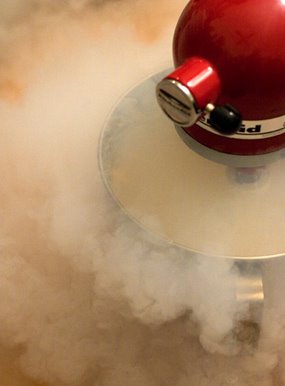 First, a disclaimer. I found this on 101cookbooks.com and haven't made it yet.
Having said that, the idea appeals to the science geek and the cook in me. Let me know if you're up for trying the experiment at my place. Or if you have a four foot tank of liquid nitrogen handy (or the ability to liberate one).
Liquid Nitrogen Ice Cream/Gelato Base
Serves 6.
heidi notes: This is a nice, creamy gelato-type base. Infuse it, add stuff, get creative. I wrote this recipe a few years back - I tend to use arrowroot instead of cornstarch as a thickener in recipes that need it (it is usually less-processed than cornstarch). But because I haven't tested arrowroot in this base, I'll give you the cornstarch version. If you use this as a base for liquid nitrogen ice cream, please read up on the safety precautions that must be observed when handling LN2.
4 cups whole organic milk
1 vanilla bean, split
1 cup sugar
3 tablespoons plus 2 teaspoons cornstarch
1 teaspoon vanilla extract
Place three cups of the milk in a saucepan with the vanilla bean over medium-low heat.
Meanwhile, pour the remaining 1 cup milk into a large glass measuring cup. Add the sugar and the cornstarch. Mix well.
When the milk starts to simmer, remove it from the heat and pour in the cornstarch mixture, stirring the whole time. Return the saucepan to medium-low and stir, stir, stir, until things start thickening up, 10 to 12 minutes. It should end up thicker than, say, a runny milkshake, but thinner than a frosty one.
Pour the mixture through a strainer into a mixing bowl, whisk in the vanilla extract, and let it cool on the counter for 20 minutes or so. I like to then chill it in the refrigerator for a few hours or overnight until it is completely chilled.
Now you are ready to place this mixture in a metal-bowl mixer and do the liquid nitrogen thing * or you can just freeze this using the manufacturer's instructions on a standard ice-cream maker.
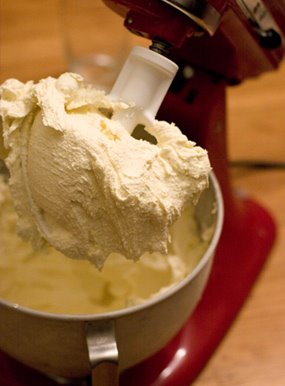 * Liquid Nitrogen Ice Cream: play-by-play
To make liquid nitrogen ice cream you start with an ice cream base in a metal mixing bowl. Fire up the mixer (Kitchen-Aid was in use here) at low-med speed. Pour the liquid nitrogen into the bowl a bit at a time as the mixer is running. It freezes up ever so creamy and beautifully.
Will I die if I eat it? I asked that. I also asked a host of other questions. Are those plumes of Halloween-looking smoke coming off the bowl going to gobble up all the oxygen in the room? Are we all going to go to sleep and never wake up? You really, really, need to be careful with this stuff - do your homework and really get up to speed on the proper way to handle it. You need to treat it as seriously as you would a deep fryer filled with hot oil and the like. You like your fingers, right? LN2 can cause them to shatter. Imagine what it could go if you got it in your eyes.
Via 101cookbooks
mercredi, mars 08, 2006
quotable
"Nothing is more compelling than silence. Ask a star or the moon.
Nothing is more important than love. Ask me. I mistook it for grief."
-Gordon Parks (November 30, 1912 – March 7, 2006) , groundbreaking African American photographer, musician, poet, novelist, journalist, activist, and film director.
Nothing is more important than love. Ask me. I mistook it for grief."
-Gordon Parks (November 30, 1912 – March 7, 2006) , groundbreaking African American photographer, musician, poet, novelist, journalist, activist, and film director.
mardi, mars 07, 2006
omer's spiritual awakening
"... on the daily web news were photos that should prove to any atheist that there is a God:
Via Omer

Via Omer
barbarie antisémite
 The facts:
 - France has the most jews and muslims of any European country.
- France was known for its antisemitism, even before the days of the Vichy collaborators.
- The headscarf controversy and persistent racism against those of Arab and African descent boiled over last fall, when the country exploded with violence due to a disaffected and impoverished (primarily muslim) underclass.
- The government can no longer ignore the rising tension between jews and muslims.
The story turned my stomach, but the outraged response of thousands of decent people reminds me that although people are sometimes awful, persons can make a difference. About 100,000 marched peacefully in his memory on Feb. 26.
Torture and Death of Jew Deepen Fears in France

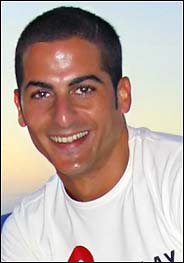
BAGNEUX, France, March 3 — Two strips of red-and-white police tape bar the entrance to the low-ceilinged pump room where a young Jewish man, Ilan Halimi, spent the last weeks of his life, tormented and tortured by his captors and eventually splashed with acid in an attempt to erase any traces of their DNA.
The floor of the concrete room, in the cellar of 4, rue Serge-Prokofiev, is bare except for a few packets of rat poison, a slowly drying wet mark and a dozen small circles drawn and numbered in white chalk, presumably marking the spots where the police retrieved evidence of Mr. Halimi's ordeal.
Mr. Halimi, 23, died Feb. 13, shortly after he was found near a train station 15 miles away by passers-by, after crawling out of the wooded area where he was dumped. He was naked and bleeding from at least four stab wounds to his throat, his hands bound and adhesive tape covering his mouth and eyes. According to the initial autopsy report, burns, apparently from the acid, covered 60 percent of his body.
"I knew they had someone down there," said a young French-Arab man, loitering in the doorway of a building adjacent to the one where Mr. Halimi was held. He claimed to live upstairs from the makeshift dungeon but would not give his name or say whether he knew then that the man was a Jew. "I didn't know they were torturing him," he said. "Otherwise, I would have called the police."
But it is clear that plenty of people did know, both that Mr. Halimi was being tortured and that he was Jewish. The police, according to lawyers with access to the investigation files, think at least 20 people participated in his abduction and the subsequent, amateurish negotiations for ransom. His captors told his family that if they did not have the money, they should "go and get it from your synagogue," and later contacted a rabbi, telling him, "We have a Jew."
The horrifying death has stunned France, which has Europe's largest Muslim and largest Jewish populations. Last weekend, tens of thousands of people marched against racism and anti-Semitism in Paris, joined by the interior minister, Nicholas Sarkozy, and smaller marches took place in several other French cities, including Marseille.
In the wake of the riots that broke out in the immigrant-heavy Paris suburbs last fall, the case seems to embody the social problems of immigration, race and class that France has been facing with so much uncertainty. The emerging details raise deep fears of virulent anti-Semitism within the hardening underclass, and point to the decaying social fabric in which that underclass lives.
Those that the police say kidnapped and killed Mr. Halimi called themselves the Barbarians, and included people of different backgrounds: the children of blacks from sub-Saharan Africa and the Caribbean, of Arabs from North Africa, of at least one Persian from Iran, and of whites from Portugal and France.
The gang's leader was a tall, charismatic young man named Youssouf Fofana, 25, one of five children born in Paris to at least nominally Muslim immigrants from Ivory Coast. When he was a teenager, the family moved to the bleak neighborhood of 12-story concrete apartment blocks where Mr. Halimi was held.
the geopolitics of sexual frustration
Demographers have been warning us that a dramatic gender imbalance will cause major problems in Asia for a while. But this article really hammered home the consequences.
On the flip side -- it might actually slow down overpopulation. But it will also reinforce women's status as chattel -- the kidnappings and brothels are just the tip of the iceberg. In that context, is there any way to make women and female children more valued (eventually)?
On the flip side -- it might actually slow down overpopulation. But it will also reinforce women's status as chattel -- the kidnappings and brothels are just the tip of the iceberg. In that context, is there any way to make women and female children more valued (eventually)?
The Geopolitics of Sexual FrustrationVia Leo
Asia has too many boys. They can’t find wives, but they just might find extreme nationalism instead. It’s a dangerous imbalance for a region already on edge.
The lost boys of Prof. Albert Macovski are upon us. Twenty years ago, the ultrasound scanning machine came into widespread use in Asia. The invention of Macovski, a Stanford University researcher, the device quickly gave pregnant women a cheap and readily available means to determine the sex of their unborn children. The results, by the million, are now coming to maturity in Bangladesh, China, India, and Taiwan. By choosing to give birth to males—and to abort females—millions of Asian parents have propelled the region into an extraordinary experiment in the social effects of gender imbalance.
Back in 1990, Nobel Prize-winning Indian economist Amartya Sen was one of the first to call attention to the phenomenon of an estimated 100 million “missing women” in Asia. Nearly everywhere else, women outnumber men, in Europe by 7 percent, and in North America by 3.4 percent. Concern now is shifting to the boys for whom these missing females might have provided mates as they reach the age that Shakespeare described as nothing but stealing and fighting and “getting of wenches with child.”
Now there are too few wenches. Thanks in large part to the introduction of the ultrasound machine, Mother Nature’s usual preference for about 105 males to 100 females has grown to around 120 male births for every 100 female births in China. The imbalance is even higher in some locales—136 males to 100 females on the island of Hainan, an increasingly prosperous tourist resort, and 135 males to 100 females in central China’s Hubei Province. Similar patterns can be found in Taiwan, with 119 boys to 100 girls; Singapore, 118 boys to 100 girls; South Korea, 112 boys to 100 girls; and parts of India, 120 boys to 100 girls.
China, India, and other nations have outlawed the use of prenatal diagnostic techniques to select the sex of an unborn child. But bribery and human ingenuity have made it easy for prospective parents to skirt the law; a suitably compensated ultrasound technician need only smile or frown at the expectant mother.
Many of the excess boys will be poor and rootless, a lumpenproletariat without the consolations of sexual partners and family. Prostitution, sex tourism, and homosexuality may ease their immediate urges, but Asian societies are witnessing far more dramatic solutions. Women now risk being kidnapped and forced not only into prostitution but wedlock. Chinese police statistics recorded 65,236 arrests for female trafficking in 1990–91 alone. Updated numbers are hard to come by, but it’s apparent that the problem remains severe. In September 2002, a Guangxi farmer was executed for abducting and selling more than 100 women for $120 to $360 each. Mass sexual frustration is thus adding a potent ingredient to an increasingly volatile regional cocktail of problems that include surging economic growth, urbanization, drug abuse, and environmental degradation.
Understanding the effect of the testosterone overload may be most important in China, the rising Asian superpower. Prompted by expert warnings, the Chinese authorities are already groping for answers. In 2004, President Hu Jintao asked 250 of the country’s senior demographers to study whether the country’s one-child policy—which sharply accentuates the preference for males—should be revised. Beijing expects that it may have as many as 40 million frustrated bachelors by 2020. The regime, always nervous about social control, fears that they might generate social and political instability.
Brigham Young University political scientist Valerie Hudson—the leading scholar on the phenomenon of male overpopulation in Asia—sees historical evidence for these concerns. In 19th-century northern China, drought, famine, and locust invasions apparently provoked a rash of female infanticide. According to Hudson, the region reached a ratio of 129 men to every 100 women. Roving young men organized themselves into bandit gangs, built forts, and eventually came to rule an area of some 6 million people in what was known as the Nien Rebellion. No modern-day rebellion appears to be on the horizon, but China watchers are already seeing signs of growing criminality.
The state’s response to crime and social unrest could prove to be a defining factor for China’s political future. The CIA asked Hudson to discuss her dramatic suggestion that “in 2020 it may seem to China that it would be worth it to have a very bloody battle in which a lot of their young men could die in some glorious cause.” Other experts aren’t so alarmed. Military observers point out that China is moving from a conscription army to a leaner, professional military. And other scholars contend that China’s population is now aging so fast that the elderly may well balance the surge of frustrated young males to form a calmer and more peaceful nation.
It would be reassuring to assume that China’s economic growth will itself solve the problem, as prosperity removes the traditional economic incentives for poor peasants to have sons who can work the land rather than daughters who might require costly dowries. But the numbers don’t support that theory. Indeed, the steepest imbalance between male and female infants is found in more prosperous regions, such as Hainan Island. And census data from India suggest that slum-dwellers and the very poor tend to raise a higher proportion of female children than more prosperous families.
The long-term implications of the gender imbalance are largely guesswork because there is no real precedent for imbalances on such a scale. Some Chinese experts speculate, off the record, that there might be a connection between the shortage of women and the spread of open gay life since 2001, when homosexuality was deleted from the official Classification of Mental Disorders. It is possible to dream up all kinds of scenarios: Mumbai and Shanghai may soon rival San Francisco as gay capitals. A Beijing power struggle between cautious old technocrats and aggressive young nationalists may be decided by mobs of rootless young men, demanding uniforms, rifles, and a chance to liberate Taiwan. More likely, the organized crime networks that traffic in women will shift their deliveries toward Asia and build a brothel culture large enough to satisfy millions of sexually frustrated young men.
Whatever the outcome, the consequences of Albert Macovski’s useful invention will be with us for some time. When they called him “the most inventive person at Stanford,” they didn’t know the half of it.
far outside the mainstream of america
Note to self: Never live in South Dakota.
South Dakota bans most abortions
South Dakota Gov. Mike Rounds signed a bill Monday that bans nearly all abortions in the state, legislation in direct conflict with the Supreme Court's Roe v. Wade decision that legalized abortion in 1973.
The new law defines life as originating "at the time of conception."
Although the law -- intended as a constitutional challenge to Roe v. Wade -- is set to take effect July 1, Rounds said in the statement that he expects legal action will prevent that. He added that a settlement of the issue could take years and might ultimately be decided by the nation's highest court.
"The reversal of a Supreme Court opinion is possible," Rounds said, pointing to the 1954 Brown v. Board of Education decision that reversed the 1896 ruling that states could segregate public facilities by race if equal facilities were offered.
The bill "will give the United States Supreme Court a similar opportunity to reconsider an earlier opinion."
The Planned Parenthood Federation of America, as well as its chapter that covers Minnesota, North Dakota and South Dakota, has said it plans to fight the legislation in court.
The national group said 10 states are considering similar bills.
"These abortion bans, and the politicians supporting them, are far outside the mainstream of America," Planned Parenthood President Cecile Richards said in a written statement.
"Planned Parenthood will fight these attacks in court, in the state houses, and at the ballot boxes, to ensure that women, with their doctors and families, continue to be able to make personal health care decisions without government interference."
The bill signed by Rounds allows doctors to perform abortions only to save the lives of pregnant women, but even then encourages them to exercise "reasonable medical efforts" to both save mothers and continue pregnancies.
Anyone who performs an abortion under any other circumstance -- even in a case of rape or incest -- can be charged with a felony punishable by up to five years in prison. The mother cannot be charged.
In his statement, however, Rounds pointed out that the bill does not prohibit doctors from prescribing contraceptive drugs before a pregnancy is determined, such as in a rape or incest case.
State lawmakers had rejected proposed amendments that would have made exceptions for rape or incest.
lundi, mars 06, 2006
my fellow americans are sheep
 I am Lisa Simpson.
 Like Lisa, I have the naive belief that all people care about the things that matter. And like Lisa, I am sad when I learn the hard truth that other people just can't be bothered to make the time or the effort to focus on the important things.
Call me crazy, but I have this radical notion that Americans might actually know/ care about the most fundamental of our rights. Naturally, this study scares the living shit out of me. And it just confirms that most Americans are not like Lisa (or me).
For the record, I think Matt Groening is a genius. It's time for him to do an episode (or forty) on the Constitution.
D’oh! More know Simpsons than Constitution
Study: America more familiar with cartoon family than First Amendment
Updated: 1:22 a.m. ET March 1, 2006
CHICAGO - Americans apparently know more about “The Simpsons” than they do about the First Amendment.
Only one in four Americans can name more than one of the five freedoms (Freedom of speech, religion, press, assembly and petition for redress of grievances) guaranteed by the First Amendment.
But more than half can name at least two members of the cartoon family, according to a survey.
The study by the new McCormick Tribune Freedom Museum found that 22 percent of Americans could name all five Simpson family members, compared with just one in 1,000 people who could name all five First Amendment freedoms.
Joe Madeira, director of exhibitions at the museum, said he was surprised by the results.
“Part of the survey really shows there are misconceptions, and part of our mission is to clear up these misconceptions,” said Madeira, whose museum will be dedicated to helping visitors understand the First Amendment when it opens in April. “It means we have our job cut out for us.”
The survey found more people could name the three “American Idol” judges than identify three First Amendment rights. They were also more likely to remember popular advertising slogans.
It also showed that people misidentified First Amendment rights. About one in five people thought the right to own a pet was protected, and 38 percent said they believed the right against self-incrimination contained in the Fifth Amendment was a First Amendment right, the survey found.
The telephone survey of 1,000 adults was conducted Jan. 20-22 by the research firm Synovate and had a margin of error of plus or minus 3 percentage points.
dimanche, mars 05, 2006
busy
This weekend, I:

- Caught Leo's cold.
- Ate well.
- Friday: Dinner at Dao Son with Leo, Cass, Nolan, and Mike.
- Saturday: Dana's birthday at Wine Steals and her place with Leo, Ash, James, and Jason.
- Sunday: Dinner and the Oscars at my house, including broiled mustard and dill pork loin with molasses and rum-glazed sweet potatoes.
- Studied and did research for a group project in marketing.
- Hiked Torrey Pines State Reserve with Leo, Ash, James, Chris, and Michiko.
- Lost water in my kitchen. (Neither my sink nor my dishwasher are working at the moment.)
samedi, mars 04, 2006
quotable
"Man cannot discover new oceans unless he has the courage to lose sight of the shore."
- André Paul Guillaume Gide (1869-1951), French author and winner of the 1947 Nobel prize in literature.
- André Paul Guillaume Gide (1869-1951), French author and winner of the 1947 Nobel prize in literature.
vendredi, mars 03, 2006
spirited compassion
I had a nice conversation about family with Leo last night and woke up with this thought:
I got mother's spirit and my father's compassion. I'm grateful for both.
I got mother's spirit and my father's compassion. I'm grateful for both.
like crack, only more addictive
My colleague Lori brought my Girl Scout cookie order to work today. Being halfway through a tube of room-temperature thin mints (it's not even lunch yet) prompted this exchange:
H: "Save me from myself."
Lori: "Save you from yourself? I can't even save me from myself."
H: "Save me from myself."
Lori: "Save you from yourself? I can't even save me from myself."
seeking grace
They say that scent is the most powerful trigger of memory. I disagree.
Music is what unlocks my subconscious. For better or for worse, I will forever associate certain songs with the people and places of my past.
Modern Love: Now I Need a Place to Hide Away By Ann Hood
It is difficult to hide from the Beatles. After all these years they are still regularly in the news. Their songs play on oldies stations, countdowns and best-ofs. There is always some Beatles anniversary: the first No. 1 song, the first time in the United States, a birthday, an anniversary, a milestone, a Broadway show.
But hide from the Beatles I must. Or, in some cases, escape. One day in the grocery store, when "Eight Days a Week" came on, I had to leave my cartful of food and run out. Stepping into an elevator that's blasting a peppy Muzak version of "Hey Jude" is enough to send me home to bed.
Of course it wasn't always this way. I used to love everything about the Beatles. As a child I memorized their birthdays, their tragic life stories, the words to all of their songs. I collected Beatles trading cards in bubble gum packs and wore a charm bracelet of dangling Beatles' heads and guitars.
For days my cousin Debbie and I argued over whether "Penny Lane" and its flip side, "Strawberry Fields Forever," had been worth waiting for. I struggled to understand "Sergeant Pepper"; I marveled over the brilliance of the White Album.
My cousins and I used to play Beatle wives. We all wanted to be married to Paul, but John was O.K. too. None of us wanted Ringo. Or even worse, George.
It was too easy to love Paul. Those bedroom eyes. That mop of hair. Classically cute. When I was 8, I asked my mother if she thought I might someday marry Paul McCartney.
"Well, honey," she said, taking a long drag on her Pall Mall. "Somebody will. Maybe it'll be you."
In fifth grade, in a diary in which I mostly wrote, It is so boring here, or simply, Bored, only one entry stands out: I just heard on the radio that Paul got married. Oh, please, God, don't let it be true.
It was true, and I mourned for far too long.
Of course by the time I was in high school, I understood my folly. John was the best Beatle: sarcastic, funny, interesting looking. That long thin nose. Those round wire-rimmed glasses. By then I didn't want to be anybody's wife. But I did want a boy like John, someone who spoke his mind, got into trouble, swore a lot and wrote poetry.
WHEN I did get married and then had children, it was Beatles' songs I sang to them at night. As one of the youngest of 24 cousins, I had never held an infant or baby-sat. I didn't know any lullabies, so I sang Sam and Grace to sleep with "I Will" and "P.S. I Love You." Eventually Sam fell in love with Broadway musicals and abandoned the Beatles.
But not Grace. She embraced them with all the fervor that I had. Her taste was quirky, mature.
"What's the song where the man is standing, holding his head?" she asked, frowning, and before long I had unearthed my old "Help!" album, and the two of us were singing, "Here I stand, head in hand."
For Grace's fourth Christmas, Santa brought her all of the Beatles' movies on video, a photo book of their career and "The Beatles 1" tape. Before long, playing "Eight Days a Week" as loud as possible became our anthem. Even Sam sang along and admitted that it was arguably the best song ever written.
Best of all about my daughter the Beatles fan was that by the time she was 5, she already had fallen for John. Paul's traditional good looks did not win her over. Instead she liked John's nasally voice, his dark side. After watching the biopic "Downbeat," she said Stu was her favorite. But since he was dead, she would settle for John. Once I overheard her arguing with a first-grade boy who didn't believe that there had been another Beatle.
"There were two other Beatles," Grace told him, disgusted. "Stu and Pete Best." She rolled her eyes and stomped off in her glittery shoes.
Sometimes, before she fell asleep, she would make me tell her stories about John's mother dying, how the band met in Liverpool and how when Paul wrote the tune for "Yesterday," he sang the words "scrambled eggs" to it.
After I would drop Sam off at school and continue with Grace to her kindergarten, she'd have me play one of her Beatles tapes. She would sing along the whole way there: "Scrambled eggs, all my troubles seemed so far away."
On the day George Harrison died, Grace acted as if she had lost a friend, walking sad and teary-eyed around the house, shaking her head in disbelief. She asked if we could play just Beatles music all day, and we did. That night we watched a retrospective on George. Feeling guilty, I confessed that he was the one none of us wanted to marry.
"George?" Grace said, stunned. "But he's great."
Five months later, on a beautiful April morning, Grace and I took Sam to school, then got in the car and sang along with "I Want to Hold Your Hand" while we drove. Before she left, she asked me to cue the tape so that as soon as she got back in the car that afternoon, she could hear "You've Got to Hide Your Love Away" right from the beginning. That was the last time we listened to our Beatles together.
The next day Grace spiked a fever and died from a virulent form of strep. Briefly, as she lay in the I.C.U., the nurses told us to bring in some of her favorite music. My husband ran out to his car and grabbed "1" from the tape deck. Then he put it in the hospital's tape deck, and we climbed on the bed with our daughter and sang her "Love Me Do." Despite the tubes and machines struggling to keep her alive, Grace smiled at us as we sang to her.
At her memorial service 8-year-old Sam, wearing a bright red bow tie, stood in front of the hundreds of people there and sang "Eight Days a Week" loud enough for his sister, wherever she had gone, to hear him.
That evening I gathered all of my Beatles music — the dusty albums, the tapes that littered the floor of my car, the CD's that filled our stereo — and put them in a box with Grace's copies of the Beatles' movies. I could not pause over any of them.
Instead I threw them in carelessly and fast, knowing that the sight of those black-and-white faces on "Revolver," or the dizzying colors of "Sergeant Pepper," or even the cartoon drawings from "Yellow Submarine," the very things that had made me so happy a week earlier, were now too painful even to glimpse. As parents do, I had shared my passions with my children. And when it came to the Beatles, Grace had seized my passion and made it her own. But with her death, that passion was turned upside-down, and rather than bring joy, the Beatles haunted me.
I couldn't bear to hear even the opening chords of "Yesterday" or a cover of "Michelle." In the car I started listening only to talk radio to avoid a Beatles song catching me by surprise and touching off another round of sobbing.
I TRIED to shield myself from the Beatles altogether — their music, images, conversations about them — but it's hard, if not impossible. How, for example, am I supposed to ask Sam not to pick out their music slowly during his guitar lessons?
Back in the 60's, in my aunt's family room with the knotty-pine walls and Zenith TV, with my female cousins all around me, our hair straight and long, our bangs in our eyes, the air thick with our parents' cigarette smoke and the harmonies of the Beatles, I believed there was no love greater than mine for Paul McCartney.
Sometimes now, alone, I find myself singing softly. "And when at last I find you, your song will fill the air," I sing to Grace, imagining her blue eyes shining behind her own little wire-rimmed glasses, her feet tapping in time. "Love you whenever we're together, love you when we're apart." It was once my favorite love song, silent now in its White Album cover in my basement.
How foolish I was to have fallen so easily for Paul while overlooking John and George, to have believed that everything I could ever want was right there in that family room of my childhood: cousins, TV, my favorite music. But mostly I feel foolish for believing that my time with my daughter would never end.
Or perhaps that is love: a leap of faith, a belief in the impossible, the ability to believe that a little girl in a small town in Rhode Island would grow up to marry Paul McCartney. Or for a grieving woman to believe that a mother's love is so strong that the child she lost can still hear her singing a lullaby.
Ann Hood's most recent book is a collection of short stories, "An Ornithologist's Guide to Life." She lives in Providence,R.I.
Music is what unlocks my subconscious. For better or for worse, I will forever associate certain songs with the people and places of my past.
Modern Love: Now I Need a Place to Hide Away By Ann Hood
It is difficult to hide from the Beatles. After all these years they are still regularly in the news. Their songs play on oldies stations, countdowns and best-ofs. There is always some Beatles anniversary: the first No. 1 song, the first time in the United States, a birthday, an anniversary, a milestone, a Broadway show.
But hide from the Beatles I must. Or, in some cases, escape. One day in the grocery store, when "Eight Days a Week" came on, I had to leave my cartful of food and run out. Stepping into an elevator that's blasting a peppy Muzak version of "Hey Jude" is enough to send me home to bed.
Of course it wasn't always this way. I used to love everything about the Beatles. As a child I memorized their birthdays, their tragic life stories, the words to all of their songs. I collected Beatles trading cards in bubble gum packs and wore a charm bracelet of dangling Beatles' heads and guitars.
For days my cousin Debbie and I argued over whether "Penny Lane" and its flip side, "Strawberry Fields Forever," had been worth waiting for. I struggled to understand "Sergeant Pepper"; I marveled over the brilliance of the White Album.
My cousins and I used to play Beatle wives. We all wanted to be married to Paul, but John was O.K. too. None of us wanted Ringo. Or even worse, George.
It was too easy to love Paul. Those bedroom eyes. That mop of hair. Classically cute. When I was 8, I asked my mother if she thought I might someday marry Paul McCartney.
"Well, honey," she said, taking a long drag on her Pall Mall. "Somebody will. Maybe it'll be you."
In fifth grade, in a diary in which I mostly wrote, It is so boring here, or simply, Bored, only one entry stands out: I just heard on the radio that Paul got married. Oh, please, God, don't let it be true.
It was true, and I mourned for far too long.
Of course by the time I was in high school, I understood my folly. John was the best Beatle: sarcastic, funny, interesting looking. That long thin nose. Those round wire-rimmed glasses. By then I didn't want to be anybody's wife. But I did want a boy like John, someone who spoke his mind, got into trouble, swore a lot and wrote poetry.
WHEN I did get married and then had children, it was Beatles' songs I sang to them at night. As one of the youngest of 24 cousins, I had never held an infant or baby-sat. I didn't know any lullabies, so I sang Sam and Grace to sleep with "I Will" and "P.S. I Love You." Eventually Sam fell in love with Broadway musicals and abandoned the Beatles.
But not Grace. She embraced them with all the fervor that I had. Her taste was quirky, mature.
"What's the song where the man is standing, holding his head?" she asked, frowning, and before long I had unearthed my old "Help!" album, and the two of us were singing, "Here I stand, head in hand."
For Grace's fourth Christmas, Santa brought her all of the Beatles' movies on video, a photo book of their career and "The Beatles 1" tape. Before long, playing "Eight Days a Week" as loud as possible became our anthem. Even Sam sang along and admitted that it was arguably the best song ever written.
Best of all about my daughter the Beatles fan was that by the time she was 5, she already had fallen for John. Paul's traditional good looks did not win her over. Instead she liked John's nasally voice, his dark side. After watching the biopic "Downbeat," she said Stu was her favorite. But since he was dead, she would settle for John. Once I overheard her arguing with a first-grade boy who didn't believe that there had been another Beatle.
"There were two other Beatles," Grace told him, disgusted. "Stu and Pete Best." She rolled her eyes and stomped off in her glittery shoes.
Sometimes, before she fell asleep, she would make me tell her stories about John's mother dying, how the band met in Liverpool and how when Paul wrote the tune for "Yesterday," he sang the words "scrambled eggs" to it.
After I would drop Sam off at school and continue with Grace to her kindergarten, she'd have me play one of her Beatles tapes. She would sing along the whole way there: "Scrambled eggs, all my troubles seemed so far away."
On the day George Harrison died, Grace acted as if she had lost a friend, walking sad and teary-eyed around the house, shaking her head in disbelief. She asked if we could play just Beatles music all day, and we did. That night we watched a retrospective on George. Feeling guilty, I confessed that he was the one none of us wanted to marry.
"George?" Grace said, stunned. "But he's great."
Five months later, on a beautiful April morning, Grace and I took Sam to school, then got in the car and sang along with "I Want to Hold Your Hand" while we drove. Before she left, she asked me to cue the tape so that as soon as she got back in the car that afternoon, she could hear "You've Got to Hide Your Love Away" right from the beginning. That was the last time we listened to our Beatles together.
The next day Grace spiked a fever and died from a virulent form of strep. Briefly, as she lay in the I.C.U., the nurses told us to bring in some of her favorite music. My husband ran out to his car and grabbed "1" from the tape deck. Then he put it in the hospital's tape deck, and we climbed on the bed with our daughter and sang her "Love Me Do." Despite the tubes and machines struggling to keep her alive, Grace smiled at us as we sang to her.
At her memorial service 8-year-old Sam, wearing a bright red bow tie, stood in front of the hundreds of people there and sang "Eight Days a Week" loud enough for his sister, wherever she had gone, to hear him.
That evening I gathered all of my Beatles music — the dusty albums, the tapes that littered the floor of my car, the CD's that filled our stereo — and put them in a box with Grace's copies of the Beatles' movies. I could not pause over any of them.
Instead I threw them in carelessly and fast, knowing that the sight of those black-and-white faces on "Revolver," or the dizzying colors of "Sergeant Pepper," or even the cartoon drawings from "Yellow Submarine," the very things that had made me so happy a week earlier, were now too painful even to glimpse. As parents do, I had shared my passions with my children. And when it came to the Beatles, Grace had seized my passion and made it her own. But with her death, that passion was turned upside-down, and rather than bring joy, the Beatles haunted me.
I couldn't bear to hear even the opening chords of "Yesterday" or a cover of "Michelle." In the car I started listening only to talk radio to avoid a Beatles song catching me by surprise and touching off another round of sobbing.
I TRIED to shield myself from the Beatles altogether — their music, images, conversations about them — but it's hard, if not impossible. How, for example, am I supposed to ask Sam not to pick out their music slowly during his guitar lessons?
Back in the 60's, in my aunt's family room with the knotty-pine walls and Zenith TV, with my female cousins all around me, our hair straight and long, our bangs in our eyes, the air thick with our parents' cigarette smoke and the harmonies of the Beatles, I believed there was no love greater than mine for Paul McCartney.
Sometimes now, alone, I find myself singing softly. "And when at last I find you, your song will fill the air," I sing to Grace, imagining her blue eyes shining behind her own little wire-rimmed glasses, her feet tapping in time. "Love you whenever we're together, love you when we're apart." It was once my favorite love song, silent now in its White Album cover in my basement.
How foolish I was to have fallen so easily for Paul while overlooking John and George, to have believed that everything I could ever want was right there in that family room of my childhood: cousins, TV, my favorite music. But mostly I feel foolish for believing that my time with my daughter would never end.
Or perhaps that is love: a leap of faith, a belief in the impossible, the ability to believe that a little girl in a small town in Rhode Island would grow up to marry Paul McCartney. Or for a grieving woman to believe that a mother's love is so strong that the child she lost can still hear her singing a lullaby.
Ann Hood's most recent book is a collection of short stories, "An Ornithologist's Guide to Life." She lives in Providence,R.I.
jeudi, mars 02, 2006
negotiating between these two lines of fire
"I don't want the gas tank to explode, I don't want the tires to melt. I've just gotta keep going as fast as I can, negotiating between these two lines of fire."
 In the early morning of October 26, 2003, Sandra Millers Younger and her husband Bob awoke to the smell of smoke. The Cedar fire was approaching their home. It spread quickly and the couple scrambled to save the few things they could fit in their car. Fourteen people died in the wildfire; twelve of them were Sandra’s neighbors in Wildcat Canyon. Here, she describes their escape.
 (MP3 4:13min. Recorded February 16, 2006)
I just listened to my friend Sandra on KPBS. They excerpted her StoryCorps interview, where she spoke about surviving the Cedar fire of 2003. I get the chills each time I hear her tell the tale.
Sandra, I'm grateful to know you and I'm inspired by your beautiful hope.
frabjous, defined
1. frabjous
Like fabulous, but with a lemon twist. (from Lewis Carrol's 'The Jabberwocky')
Leo is frabjous.
Via urbandictionary.com
Like fabulous, but with a lemon twist. (from Lewis Carrol's 'The Jabberwocky')
Leo is frabjous.
Via urbandictionary.com
mercredi, mars 01, 2006
there is a god
 (Well, maybe.)
Yesterday, Utah lawmakers refused to pass a state law that would have required teachers to tell students that evolution is not a fact and that the state doesn't endorse the theory.
The best quote from the story:
"I don't believe that anybody in there really wants their kids to be taught that their great-grandfather was an ape," Buttars said.
Perhaps the distinguished gentleman from Utah should sponsor a bill stating that grammar is a theory and that the state doesn't endorse it. After all, his own speech shows a flagrant disrepect for the (dare I say radical) notion that subjects and verbs should agree in number.
mardi, février 28, 2006
still crazy after all these years
Eric to me, tonight: "The trick is learning how to fill that hole in your existence with positive things."

So I had a good visit with Eric. Actually, I had a very good visit with Eric.
Dinner was the two of us, plus his cousin Andrea and her boyfriend Clif, and Diana and Ophira. We all laughed about old times and listened to Eric's wackadoo travel stories. Then we came back to my place, looked at his photos, and drank Becherovka.
There wasn't a moment of tonight that was awkward or weird at all. I'm grateful for that, because he is my oldest friend, and for many years was my best friend and my lover. It's good to complete the circle, and close the loop on us and what has been the defining relationship of my life (so far). Doing that via phone or e-mail was never enough. Talking face-to-face was the only way to finish this. I'm feeling really good about it. And I'm very pleased that both of us have found positive things with which to fill our respective existences.

So I had a good visit with Eric. Actually, I had a very good visit with Eric.
Dinner was the two of us, plus his cousin Andrea and her boyfriend Clif, and Diana and Ophira. We all laughed about old times and listened to Eric's wackadoo travel stories. Then we came back to my place, looked at his photos, and drank Becherovka.
There wasn't a moment of tonight that was awkward or weird at all. I'm grateful for that, because he is my oldest friend, and for many years was my best friend and my lover. It's good to complete the circle, and close the loop on us and what has been the defining relationship of my life (so far). Doing that via phone or e-mail was never enough. Talking face-to-face was the only way to finish this. I'm feeling really good about it. And I'm very pleased that both of us have found positive things with which to fill our respective existences.
laissez les bon temps roulez
It's Mardi Gras, aka Fat Tuesday.
While New Orleans is struggling with how to reclaim its past and let the good times roll, I'm thinking about how I'll face my own colorful and hedonistic past, in the form of my ex-husband.
Eric's in town. It's the first time I've seen him since we split in October 2004. I'm looking forward to seeing him tonight and having fun with our mutual friends.
I'm also associating Mardi Gras with my present, which includes a man who's very fond of an aging Boxer with that name.
While New Orleans is struggling with how to reclaim its past and let the good times roll, I'm thinking about how I'll face my own colorful and hedonistic past, in the form of my ex-husband.
Eric's in town. It's the first time I've seen him since we split in October 2004. I'm looking forward to seeing him tonight and having fun with our mutual friends.
I'm also associating Mardi Gras with my present, which includes a man who's very fond of an aging Boxer with that name.
lundi, février 27, 2006
philosophy, bdp, and poetry
Etan Thomas flies in the face of convention — he's a baller and an activist, a poet and an athlete. And his voice is worth listening to.
We live in the era of the soundless athlete. An era in which the highest-profile figures in sports not only say nothing about the condition of the sociopolitical landscape their fan base resides in, but worse -- they have nothing to say ...Via LeoIt takes a strong person to take a stand against America. Not its people, but its policy.
His name -- Etan Thomas -- has been placed among those who have spoken loud while saying something. The Alis, the Jim Browns, the Jackie Robinsons, the Ashes, Russells, Carlos and Smiths, the Jack Johnsons ...
He's the only one who makes noise about it, he's the only one who Public Enemy's it to the public's enemies. Which is what makes him -- he, E -- so needed and so important. Because in a world of Terminator Xs, we all need a little Chuck D in our lives.
A little philosophy. A little BDP. A little ... introduction to poetry.
No corporate sponsor telling me what to do
Asking me to tone it down during an interview.
Tryna minimize the issue
but I'm keepin' it large
I love the place that I live
but hate the people in charge
Speaking is hard
when you got strings attached
So I'm going to say it for you
'cause I don't got none of that.
And if you don't understand what I spit on your brain
Son, let this ---- explain.
Immortal Technique, "Freedom of Speech"
(word) geeking out
I was the editor of my high school newspaper. My biggest typo: a home page headline that read "Congradulations!" I claimed it was a deliberate pun, a play on graduation. It wasn't.
Anyhow, this comment triggered that memory: "pet peeve #3,563: people who write 'congrads.' nobody is graduating anything."
Anyhow, this comment triggered that memory: "pet peeve #3,563: people who write 'congrads.' nobody is graduating anything."
congratulation 1438, from L. congratulationem, from congratulari "wish joy," from com- "together" + gratulari "give thanks, show joy," from gratus "agreeable."For future geeking out: The Online Etymology Dictionary.

samedi, février 25, 2006
the new electric servants
A very interesting read about how people buy pricey kitchen machines hoping the right gadget will make them want to cook. It won’t work: you can’t get domestic happiness so easily ...
Are We Worthy of Our Kitchens?Via Arts and Letters Daily
By Christine Rosen
Judging by how Americans spend their money—on shelter magazines and kitchen gadgets and home furnishings—domesticity appears in robust health. Judging by the way Americans actually live, however, domesticity is in precipitous decline. Families sit together for meals much less often than they once did, and many homes exist in a state of near-chaos as working parents try to balance child-rearing, chores, long commutes, and work responsibilities. As Cheryl Mendelson, author of a recent book on housekeeping, observes, “Comfort and engagement at home have diminished to the point that even simple cleanliness and decent meals—let alone any deeper satisfactions—are no longer taken for granted in many middle-class homes.” Better domestic technologies have surely not produced a new age of domestic bliss.
Ironically, this decline in domestic competence comes at a time of great enthusiasm for “retro” appliances and other objects that evoke experiences that many Americans rarely have. We seem to value our domestic gadgets more and more even as we value domesticity less and less. Wealthy Americans can purchase an expensive, “old-fashioned” cast-iron Aga stove, but they cannot buy the experience it is intended to conjure: a cozy kitchen filled with the scents and signs of a person devoted to the domestic satisfaction of those who share a home. And middle-class Americans can buy machines that aim to make their domestic chores more pleasurable or efficient, but the ideal of transforming domestic labor into a “lifestyle” is a fantasy. The machines promise to restore peace and comfort to domestic life, but such nostalgia (whose literal meaning is “homesickness”) is not a recipe for domestic happiness.
vendredi, février 24, 2006
not zatarain's
Last Sunday, Leo suggested that we buy some blood oranges at the farmer's market. Those inspired last night's tasty dinner.
Our menu:
Zanzibar chicken and couscous
Blood orange salad with vanilla vinaigrette and fried shallots
Baklava
Our menu:
Zanzibar chicken and couscous
Blood orange salad with vanilla vinaigrette and fried shallots
Baklava
blood orange salad with vanilla vinaigrette and fried shallots
Prep time: 15 minutes
Cooking time: 2 minutes
Serves: 4
6 blood oranges
1/3 cup reduced orange juice
1/2 tsp pure vanilla extract or vanilla bean, split
1 tsp sugar
2 TBSP lemon juice
Frisee or green leaf lettuce
Salt
Olive oil
Freshly ground black pepper
Mint leaves
Crispy fried shallots
1/2 tsp cornstarch
1/2 tsp flour
1 pinch salt
3 shallots, sliced into thin rounds
Peanut oil for frying
1. Peel oranges and cut into 1/2-inch slices. Reserve. Combine the orange juice, vanilla, sugar, and lemon juice to make the dressing.
2. Put lettuce on plates. Drizzle dressing and olive oil on lettuce and place oranges on top. Sprinkle oranges with salt. Sprinkle with a bit of pepper. Arrange mint leaves on top and sprinkle with crispy fried shallots.
Crispy fried shallots:
Combine cornstarch, flour, and salt. Coat sliced shallots with mixture. Heat peanut oil in a skillet until very hot but not smoking. Deep fry shallots until golden brown. Drain on paper towels.
Via fooddownunder.com
Cooking time: 2 minutes
Serves: 4
6 blood oranges
1/3 cup reduced orange juice
1/2 tsp pure vanilla extract or vanilla bean, split
1 tsp sugar
2 TBSP lemon juice
Frisee or green leaf lettuce
Salt
Olive oil
Freshly ground black pepper
Mint leaves
Crispy fried shallots
1/2 tsp cornstarch
1/2 tsp flour
1 pinch salt
3 shallots, sliced into thin rounds
Peanut oil for frying
1. Peel oranges and cut into 1/2-inch slices. Reserve. Combine the orange juice, vanilla, sugar, and lemon juice to make the dressing.
2. Put lettuce on plates. Drizzle dressing and olive oil on lettuce and place oranges on top. Sprinkle oranges with salt. Sprinkle with a bit of pepper. Arrange mint leaves on top and sprinkle with crispy fried shallots.
Crispy fried shallots:
Combine cornstarch, flour, and salt. Coat sliced shallots with mixture. Heat peanut oil in a skillet until very hot but not smoking. Deep fry shallots until golden brown. Drain on paper towels.
Via fooddownunder.com
jeudi, février 23, 2006
i've been retired for about four days now
Right on.
Eight workers at a Nebraska meat processing plant have claimed the record $365 million Powerball jackpot. The seven men and one woman will each receive $15.5 million after taxes under the cash option. When one of the winners, Eric Zornes, 40, was asked whether he was still working at the plant, he replied: "No. I've been retired for about four days now."
Inscription à :
Articles (Atom)