lundi, novembre 07, 2005

when every day is bring your dog to work day

I adore my golden retriever. He is one of two beings on the planet who has loved me unconditionally for years now. (The other is my father.)

Having said that, I hate that Casey (or, more precisely, his fur) is with me wherever I go. Case in point: my 2001 trip to Italy and Greece. After nearly 5 weeks on the road, I still found dog hair in my pants, on my backpack, and in my shoes. This, despite the fact that I'd washed my clothes in three laundromats and countless hotel sinks.

Today, I wore my brand-new black v-neck sweater to work. While eating my lunch, I noticed about 15 dog hairs statically clinging to it. I rolled myself with the lintbrush after taking Casey for his morning walk and successfully de-dogged myself. Or so I thought.

I have several lint rollers at home and two at work. I keep a blanket on my car's back seat at all times, since Casey goes on a fair amount of joyrides with me. I vacuum my car and home more often than I'd like, simply to keep the great dustbunnies of golden retriever hair at bay. And I brush Casey every other day, pulling great wads of fur out of the brush each time, thinking that if only I could figure out how to knit a sweater from it, I'd be a wealthy woman.

Casey, I love you so. But my next dog will have black hair.

(I'm not naive enough to think I won't be wearing it to work, too. It just hope that my wardrobe will camouflage it better.)

it's nolan's birthday

Joyeux anniversaire, mon cher ami. Je t'aime!

dimanche, novembre 06, 2005

semantic congruity

Interesting. And an interesting personal coincidence ...

Monkey math methods parallel our own: Experiment indicates other primates think about numbers
If you show someone a mouse and a cat and ask which is smaller, they'll quickly reply, "the mouse." Ask which is bigger, and it takes most people slightly longer to respond.

Conversely, if the two animals are large, such as a cow and an elephant, the typical person will be quicker at saying the elephant is larger than saying the cow is smaller.

This rule, known to scientists from actual tests on people, is known as "semantic congruity," and it also holds true for comparing numbers and distances.

Until now, scientists thought the rule was rooted in our language abilities. But in a recent study by researchers at Duke University, a group of monkeys have shown a similar ability to tell the difference between large and small groups of dots.

Researchers showed macaque monkeys two arrays of randomized numbers of dots on a computer touch screen. Instead of asking the monkeys to choose the larger or smaller array of dots, the researchers gave cues by changing the color of the background behind the dots.

If the background was blue, the monkeys were supposed to touch the larger array. If it was red, they were to choose the smaller one. If they did a good job, they were rewarded with a sip of a sweet drink.

"Clearly, even though their capability has nothing to do with language, it is nevertheless semantic in that the red and blue color cues carry meaning for the monkeys," said study co-author Jessica Cantlon. "Our results showed a very large semantic congruity effect. For example, when the number pair was small, such as two versus three, the monkeys were much faster at choosing the smaller compared to the larger of the pair."

This finding is the most recent in a series of discoveries that indicate our primate cousins display humanlike characteristics. Monkeys like to
gamble and enjoy looking at other monkeys' bottoms. Chimpanzees have been found to crack under social pressures.

"This is another piece of the puzzle showing us that the comparison mechanism that the monkeys use is, as far as we can tell, the same mechanism that humans are using," said study co-author Elizabeth Brannon.

a labor of love

My friends Aaron and Aleyda welcomed their new baby boy, Daniel, into the world this week.

I imagine that their joy knew no bounds when they held Daniel, the embodiment of so much hope, in their arms for the very first time.

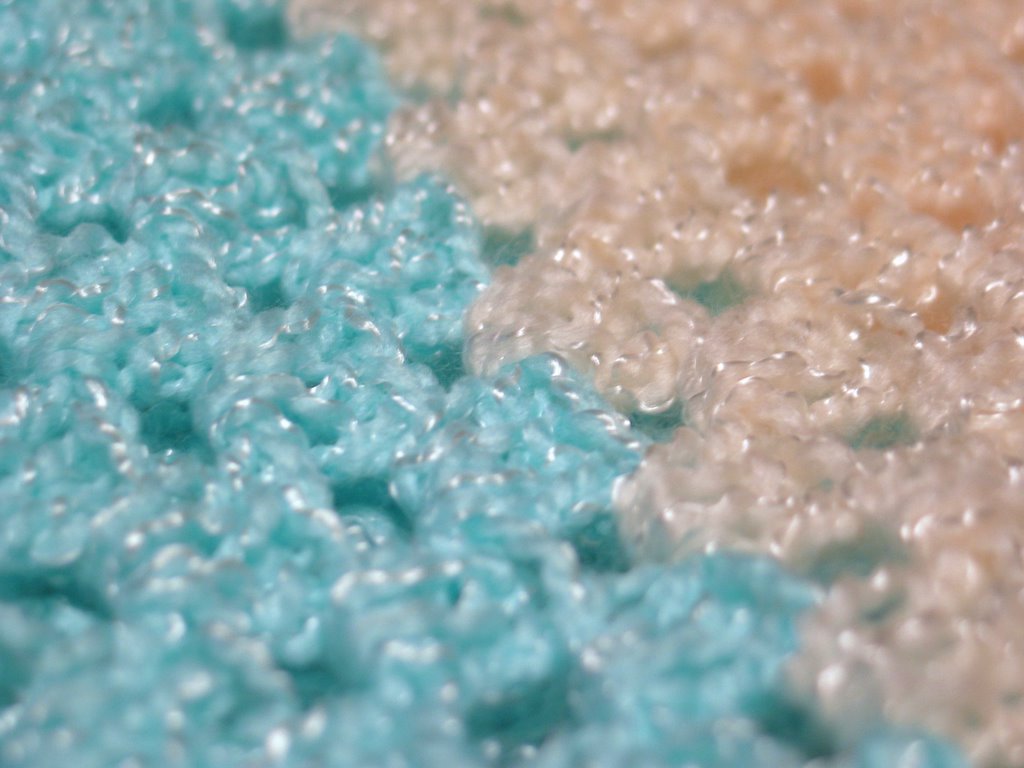
I can't wait to see him (and his parents) and to give them the baby blanket I crocheted for them.

samedi, novembre 05, 2005

here's to good friends and good food

Susan A. is in town from North Carolina!! The old Torrey Pines Center South crowd (Josette, Jen B., Jennifer S., Susan A., Susan G., Nolan, and I) got together to celebrate today over a great meal at Just Fabulous.

Cass, Sydney, Fred, and Cynthia: you were missed ... and you missed a tasty lunch and fabulous (of course) desserts.

Better than Extraordinary Desserts
bavaroise
Nolan's lemon bavaroise and blackcurrant gelato
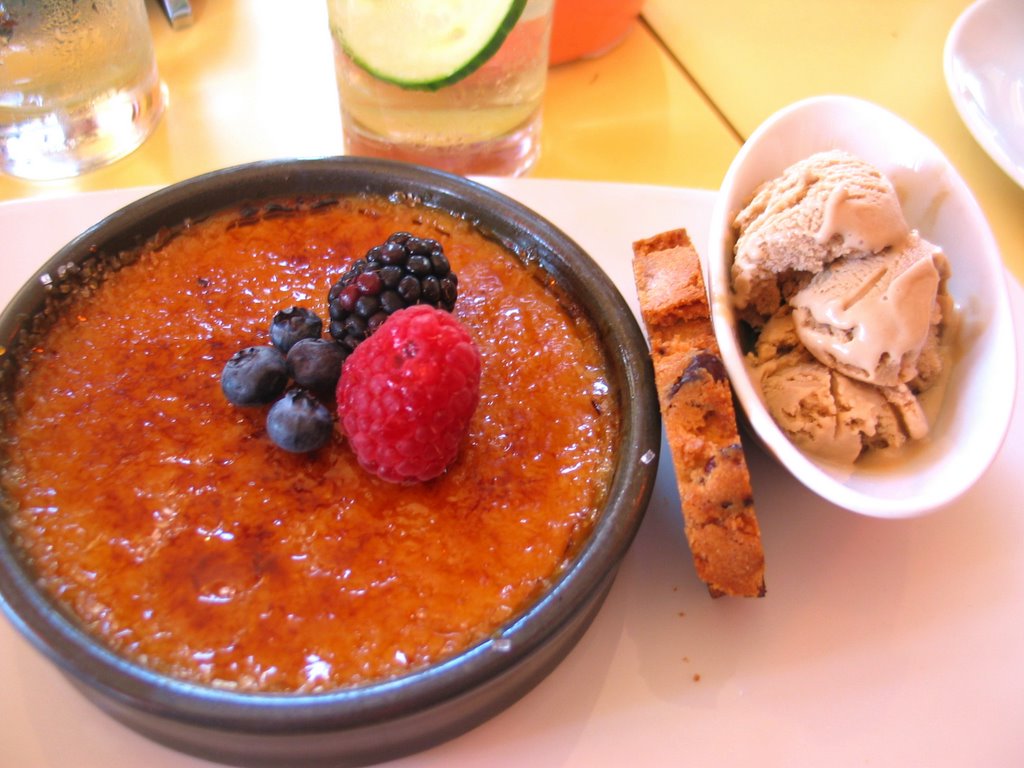
dulce de leche crème brûlée
Susan G.'s dulce de leche crème brûlée
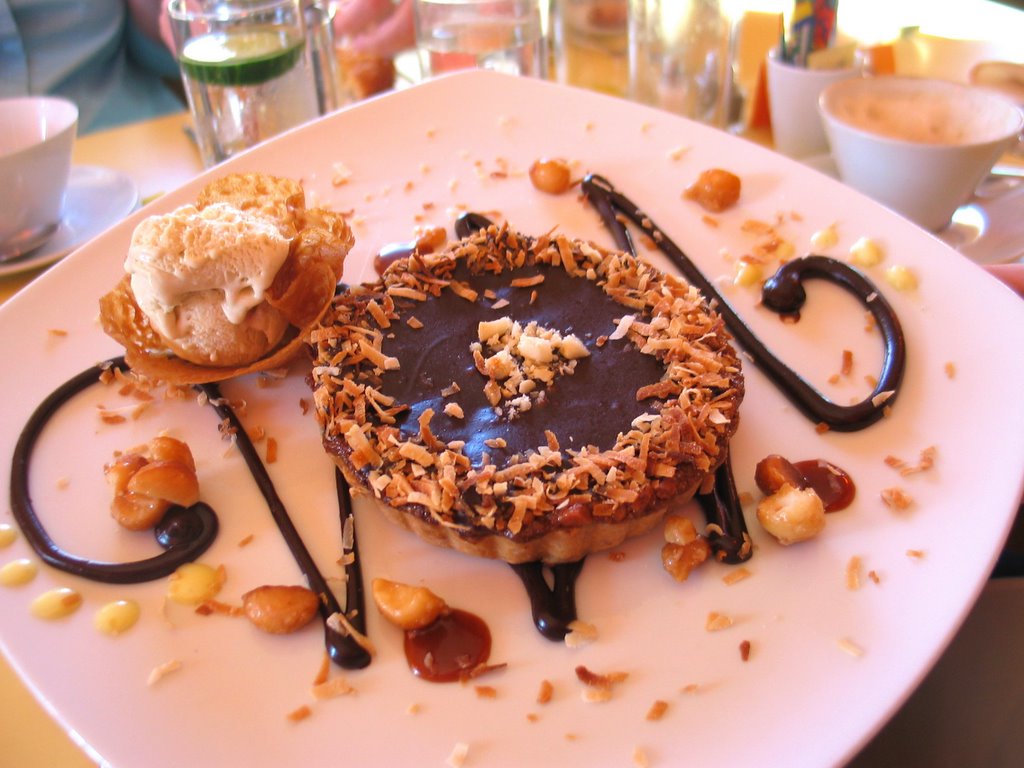
macadamia coconut chocolate tart
Susan A.'s chocolate coconut macadamia tart
lemon torte
Josette's lemon torte
lemon torte
My lemon torte and raspberry gelato

the beauty of hope

Ben, pourquoi tu pleures?

Et Mathilde s'adosse bien droite sur sa chaise,

Croise les mains sur ses genoux,
Et le regarde.

Dans la douceur de l'air,
Dans la lumière du jardin,
Mathilde le regarde.
Elle le regarde.
Elle le regarde.

But why are you crying?

Mathilde leans back against her chair,
Folds her hands in her lap,
And looks at him.

In the sweetness of the air,
In the light of the garden,
Mathilde looks at him.
And she looks at him.
Last night, I finally saw "A Very Long Engagement." I went to bed mulling over the absurdity of war and the beauty of hope.

This morning, I woke up thinking about Sandra and Bob and their hope. Two years ago last week, their home burned down in the San Diego fires. They narrowly escaped the Wildcat Canyon inferno with their lives and their dogs.

After losing almost every physical manifestation of the life they've built together (including most of their family photographs and much of Sandra's writing), they had the courage to rebuild Terra Nova on the same spot where it had been before. And that is beautiful.

vendredi, novembre 04, 2005

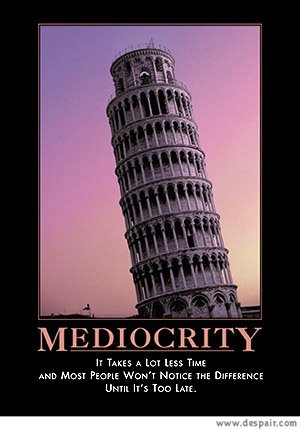
despair.com

well said

The poster reads "¡Fuera Bush! Asesino corrupto y hambreador" (Get out, Bush! Corrupt assassin and maker of hunger). The swastika and blood on his hands are interesting details, as is the button with the U.S. flag on it that the woman on the right is wearing.

Thousands Protest Against Bush at Summit in Argentina. The sad part is how one man's actions and arrogance have made much of the world hate our country.

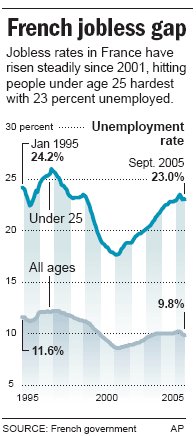
l'enfer

Another reason Paris is burning:

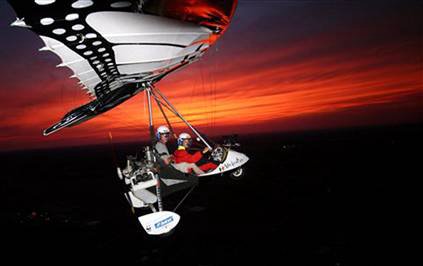
papalotzin


Pilot finishes his butterfly odyssey
Ultralight accompanies monarchs on 3,000-mile trip
Vico Gutierrez flew his plane alongside the bright orange and black butterflies for 72 days and landed near the Angangueo forest sanctuary set aside for them in Mexico, where they rest after an annual migration that fascinates biologists.

It was the first time an ultralight aircraft, weighing about 420 pounds (190 kilograms) with a wingspan of 5 yards (meters), has followed and filmed the butterflies’ migration.

Gutierrez decided to join them to highlight the need for conservation.

“Understanding the cycle of life, migration and challenges of this small butterfly, which has the ability to fly more than 3,000 miles, gives humanity a unique message: We can and should learn to confront the diverse challenges of life,” the Mexican pilot said. “We need to put in place conservation projects, not just for the butterflies, but also for the forests, the deserts, the oceans, rivers, plants and animals, and we need this to happen so, so urgently.”

Tens of millions of monarchs arrive in Michoacan state every year to sit out the winter months in central Mexico’s temperate fir forests before returning to Canada.

Not one butterfly makes the round-trip journey, and the offspring of those who start it head instinctively for a place they have never been.

After leaving Mexico, it takes three or four generations of monarch butterflies to reach their summer grounds in Canada and northern areas of the United States. The last generation, which has a longer life span, then makes the journey south to Mexico for the winter.

Locals performed a pre-Hispanic dance to herald the arrival of the aircraft that was decked out like the butterflies’ striking black and orange wings. The plane was named Papalotzin, or “little butterfly” in the Nahuatl language. The Papalotzin team plans to make a documentary using film and photographs along the migration route.

bridges at night - malayasia

Note to self: Check the Nighthawks photo blog more often.

Alice Teoh has a fantastic series of photos of a suspension bridge in


tags: , , , , , ,

jeudi, novembre 03, 2005

eating (and drinking) your words

What, exactly, is spoom? And what's the difference between Riesling and Gewürztraminer?

The food lover's companion and wine lover's companion answer all the questions you never knew you had.

a conversation with barbara ehrenreich

I was lucky enough to attend a small group discussion about writing with Barbara Ehrenreich today. After she spoke about the process she used to write "Nickel and Dimed: On (Not) Getting By in America," it became a Q & A free-for-all. I asked her about Welcome to Cancerland, an essay she wrote for Harper's that I found unsettling.

Finally, a few things she said about writing really struck me:
"Two things motivate me. One is indignation / moral outrage. And the other, not as socially commendable, is curiosity."

"To communicate to other people is to take your experience and universalize it ... but the awful truth is that nobody much cares."

"The other thing they don't understand is how much research it takes to even write one sentence."

"When I'm writing, I ask myself 'am I describing things as accurately, vividly, and concretely as I can?'"

indignant liberals

H: "Are you going to the Barbara Ehrenreich lecture on campus today?"
A: "I can't. And I haven't read her book yet."
H: "You should. It will get you all hot and bothered."
A: "Oh, 'cause I really need any help there?"

mercredi, novembre 02, 2005

six feet under portraiture

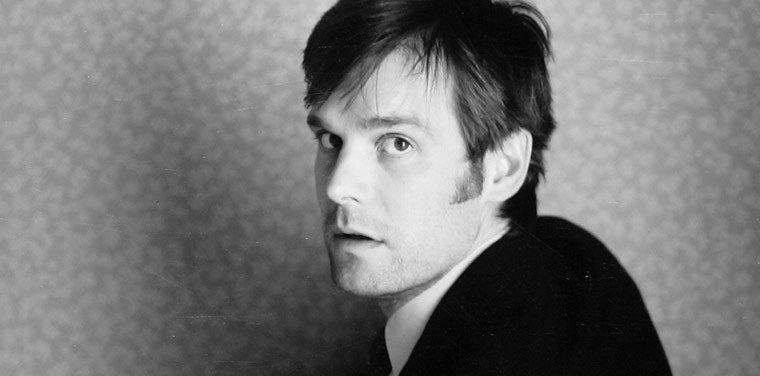
Nate Fisher is one complicated man. The best part about his character is that he is alternately amazing and despicable ... loving and hateful ... agreeable and contrarian. The writers for "Six Feet Under" have distilled much of what is beautiful (and awful) about human nature and play that out wonderfully.

I really like these portraits. And not just because Nate Fisher (Peter Krause) is the subject.

They're part of Claire's art on the show.


creamy tomato balsamic soup

Inspired by my soup days post, Susan A. sent me this recipe for her (current) favorite tomato soup. When it ceases to be 88 degrees outside, I'll have to make a pot. Until then, this recipe's for those of you in colder climates, where heating one's oven to 500 degrees actually sounds like a good idea.

Creamy Tomato Balsamic Soup
1 cup less-sodium beef broth, divided
1 tablespoon brown sugar
3 tablespoons balsamic vinegar
1 tablespoon low-sodium soy sauce
1 cup coarsely chopped onion
5 garlic cloves
2 (28-ounce) cans whole tomatoes, drained
Cooking spray
3/4 cup half-and-half
Cracked black pepper (optional)

Preheat oven to 500°.
Combine 1/2 cup of broth, sugar, vinegar, and soy sauce in a small bowl. Place onion, garlic, and tomatoes in a 13 x 9-inch baking pan coated with cooking spray. Pour broth mixture over tomato mixture. Bake at 500° for 50 minutes or until vegetables are lightly browned.
Place tomato mixture in a blender. Add remaining 1/2 cup broth and half-and-half, and process until smooth. Strain mixture through a sieve into a bowl; discard solids [ignore this step if you like]. Garnish with cracked black pepper, if desired.

Yield: 4 servings (serving size: about 1/2 cup)

CALORIES 120 (35% from fat); FAT 4.7g (sat 3g,mono 1.5g,poly 0.1g); PROTEIN 3.8g; CHOLESTEROL 23mg; CALCIUM 120mg; SODIUM 452mg; FIBER 1.7g; IRON 1.7mg; CARBOHYDRATE 14.9g
Cooking Light, OCTOBER 2005

me and the prez

It turns out that I do have something in common with W. I wear a Timex when I swim.

There's no "W" on the dial, though.

fattening them up

Sadly, women are chattel in most cultures. That their families do everything they can to make them more attractive to potential husbands is no surprise. But the Mauritanian practice of force-feeding girls into obesity literally turns my stomach.

I don't know why I continue to be surprised when I learn that women are the ones who perpetrate these types of abuse. Clitoridectomy is another good example of women being the enforcers of traditional practices undertaken (ostensibly) to improve a girl's chances at a good marriage (and therefore, economic security).

It seems to be yet another case of those in the second-least powerful position exercising arbitrary power over the weakest members of a society.
In Mauritania, when it comes to women, for many people fat is beautiful. Here in this desert country, where poverty and malnutrition affect many, obesity is seen as a badge of wealth and prestige.

But for some young women, getting fat is hard work.

The quest for obesity is driving some women in outlying villages to force-feed their daughters and granddaughters.

Momta, an imposing grandmother and expert force-feeder, says: "For us, a girl who has not been force-fed is ugly, not beautiful, and she’s a source of shame to her family."

Momta believes that if a girl is fat she will attract a richer husband.

blue moon

I couldn't help but think of the singing mice in "Babe" when I saw this headline.

Mice appear to woo mates in song Birdlike tunes surprise scientists
Scientists have known for decades that male lab mice produce high-frequency sounds when they pick up the scent of a female mouse, but it turns out those sounds are more complex and interesting than previously thought.

Songbirds may be the Sinatras of the animal world, but male mice can carry a tune too, say Washington University researchers who were surprised by what they heard.

Scientists have known for decades that male lab mice produce high-frequency sounds — undetectable by human ears — when they pick up the scent of a female mouse. This high-pitched babble is presumably for courtship, although scientists are not certain.

"It soon became ... apparent that these vocalizations were not random twitterings but songs," said researcher Timothy Holy. "There was a pattern to them. They sounded a lot like bird songs."

If the analysis by the researchers is confirmed, mice can be added to the short list of creatures that sing in the presence of the opposite sex, including songbirds, humpback whales, porpoises, insects and, possibly, bats.

Holy and co-author Zhongsheng Guo were studying the brain response in male mice to chemical signals emitted by female mice. The mice sounds were not audible without technical amplification. Initially, researchers recorded the sounds with a microphone, stored them in a computer and converted them to an image.

Later, they developed a way to hear the sounds by recording them on tape and reconstructing them four octaves lower. Holy said the mice sounds met two key criteria for song — distinct syllables and recurring themes, "like the melodic hook in a catchy tune."

mardi, novembre 01, 2005

true friendship, defined

My friend Margaret sent me this. I've seen it before, but not in a long time. It still makes me laugh.

Are you tired of all those cheesy "friendship" poems that never come close to reality? Here's a series of promises that really speaks to true friendship:
  1. When you are sad, I will help you get drunk and plot revenge against the sorry bastard who made you that way.
  2. When you are blue, I will try to dislodge whatever is choking you.
  3. When you smile, I will know you've finally had sex.
  4. When you are scared, I will tease the crap out of you about it every chance I get.
  5. When you are worried, I will tell you horrible stories about how much worse it could be and to stop your bloody whining.
  6. When you are confused, I will use little words.
  7. When you are sick, stay the hell away from me until you are well again, I don't want whatever you have.
  8. When you fall, I will point and laugh at your clumsy self.
Send this to 10 of your closest friends, then get depressed because you can only think of two, and one of them isn't speaking to you right now anyway.

Remember: A good friend will help you move. A really good friend will help you move a body. Let me know if I ever need to bring a shovel.

satisfecha

The Spanish word for "satisfied" is satisfecha.
I am muy satisfecha after a nice walk at lunch today with Suzi.

We cruised past Cox Arena and then stopped to count the turtles in the pond at Scripps Cottage. The weather's a perfect 84 degrees and as the sun shone on my bare shoulders and face, I appreciated the fact that I live in this gorgeous city. Our last stop was the old botanical garden where the remains of this year's grape harvest sit on the vine, having become raisins in the sun.

Tomorrow, I'm taking my camera.

universe

Inexplicably, I woke up with these Crowded House lyrics in my head. (Inexplicably because I haven't heard the song in about a year.)

Then again, it could be my mind free-associating with a publication with "universe" in its name that I supervise and will be putting out alone shortly. (Universe's editor will go out on paternity leave any day now.)

"Private Universe"
No time, no place to talk about the weather
The promise of love is hard to ignore.
Who said the chance wasn't getting any better?
The labour of love is ours to endure.

The highest branch on the apple tree
It was my favourite place to be
I could hear them breaking free
But they could not see me.

I will run for shelter
Endless summer lift the curse
It feels like nothing matters
In our private universe

I have all I want, is that simple enough?
And a whole lot more I'm thinking of ...

Every night about six o'clock
Birds come back to the pond to talk
They talk to me — birds to talk to me
If I go down on my knees.

It feels like nothing matters
In our private universe ...

lundi, octobre 31, 2005

freakonomics

While studying for the evil econ midterm today:

A: "At least we learned derivatives this weekend."

H: "For all the fucking good that's going to do me ..."

A: "Wow. That was just a major role reversal. You usually point out the silver lining and I'm the one to be all bitter / negative / sarcastic."

H: "Shit. You're right."

Obviously constrained demand, profit optimization, and elasticity have warped our minds and our personalities.

on becoming vulnerable

Last night, I told Ben that vulnerability is a beautiful human quality, but that neediness is not.

This morning, I read the following article, which resonated with me on so many levels. Several details jumped out at me. The last line virtually screamed at me today, especially after last night's conversation.
This is my struggle still, to learn how to be vulnerable in love, to be able to show my naked underbelly and trust that it will be neither smothered nor starved of devotion.
I value vulnerability in a partner precisely because it's so hard for me to show my belly, to love and trust someone else in the way I do myself. If he shows that vulnerability, then I feel safe enough to also show mine. I think it stems from many experiences, not the least of which are my own romantic history and a childhood home rife with unhealthy (and unresolved) conflict.

I've yet to have a partner who takes as much care of me as I do of him. That's probably my own fault. One lover once described me as "so fucking self-sufficient" and went on to seethe about how I was "unwilling to let [him] do anything for [me]." It was an oversimplification, to be sure. But there was also truth in those anger-filled words. In that situation, I had reverted to my core tendencies, and had been taking care of myself because the sad fact was that I didn't trust him to take care of me.

I loathe relying on someone else for my basic needs. I despise asking others for favors (but I'll do it). I hate feeling like I'm imposing on a friend. The flip side: I'm the first to offer help when someone needs it, the first to do someone a favor. I don't expect anything in return, I just dislike the feeling of depending on someone else. So I underplay my own needs until push comes to shove.

I really need to get over myself. And, hopefully, to find a partner who strikes the right balance between being caring and giving me my space. At this point, I want to experience a relationship where my lover is a true equal — someone who actually does as much for me (emotionally, intellectually, and physically) as I do for him.

Please no needy men, though.
Modern Love: Love Me, Love My Dog. All Right, Love My Dog.
I was married, and feeling the stirrings of loneliness, when I started thinking seriously about getting a dog. In broaching this subject with my husband of a year and a half, I didn't mention the loneliness part. I simply told him I wanted a dog and waited for his reaction.

Back in junior high school I had bonded fiercely with our family dog, a yellow Lab who everyone thought belonged to me. When that dog died - I was 19 - I remember telling myself, as I lay sobbing on my bed, that it was time for me to try bonding with a man. Over the next decade I bonded with several. And then I got married.

Glenn, the man I married, wasn't sure a dog was such a good idea. He kind of wanted one, but the reality seemed to scare him. I remember standing in the living room of our town house in Los Angeles as he laid out his concerns. He spoke methodically in his mild Southern accent, his anxiety showing through, the way it often did when I presented my deepest desires.

Mostly he worried that a dog would breach the no-pets rule of our condominium complex in a much riskier way than his cat already did. I assured him that a very small dog - my research had led me to the miniature dachshund, "a big-dog personality in a small-dog body," according to the books - would be easy to sneak in and out via a tote bag. Still, he hesitated.

Even so, the following weekend I found a breeder in the classified ads and invited Glenn to go with me, "just to look." He declined. He didn't discourage me from going or tell me not to come back with a dog, but clearly he wasn't going to participate.

As I drove to the far reaches of Los Angeles, pretending not to notice his absence, an image from one of the cards we had received with our wedding gifts popped into my head. It was a hand-colored photo of a bride and groom in midair, circa 1950, holding hands as they "took the plunge" from the end of a diving board.

I'd never bought a dog before. Never been to a breeder. This was the kind of plunge that, if taken together, might have brought Glenn and me closer. But apparently that was not the kind of relationship we had, and I wasn't clear why we didn't. I blamed him, of course, though I should have looked in the mirror as well.

I've always had a problem with the joined-at-the-hip aspect of marriage, with, for example, women who say "my husband" to listeners who are perfectly familiar with the man's name. Behind the phrase I sense a nervous grasping for validation, an odd mix of self-congratulation ("Look, everyone, I got one") and self-deprecation ("I am nothing without him").

My mother was one of those women. Her visible pleasure upon saying the words was indisputable, even though I thought they made my father sound like a pet. Yet I can't deny that my father mostly did as he was told and came when called.

I never wanted a boyfriend or husband like that, someone who catered to my every need. But perhaps in seeking to avoid that I went too far in the opposite direction, with my longstanding preference for men who are not caretakers, who do not bestow upon me special attention or guardianship.

When I have had needs in my relationships, I have undoubtedly underplayed them and done no one any favors in the process, eventually shocking the men I have loved with sudden relationship-ending confessions of unhappiness.

Yet the type of man who wants to take care of me generally also insists on driving and paying, prefers not to be corrected when he's mistaken, and feels at sea if he can't be saving the day. This breed has always tried my patience.

Glenn possessed none of those overbearing tendencies. But neither was he inclined to rush to my aid or offer his support when I really needed it. That was the trade-off.

And so my trip to the breeder's that afternoon was lonely and awkward. After an hour of driving, I stepped bravely into the strange house with a smile on my face and proceeded to act as if I knew what I was looking for. But having known only large dogs, I was taken aback by the tiny embryolike creatures. I sweated as I handled them, convinced that the animals didn't like me, and that the owners, seeing this, would refuse to let me take one.

Not that I, by then, had any intention of doing so. Suddenly the idea of raising a mini dachshund seemed remote without anyone to support me through the mysterious anxiety that had overtaken me. I got out of that overheated house and drove back to my beautiful condo and unruffled husband, who was relieved, though also slightly disappointed, that I hadn't come home with a dog.

I pretended I was fine. Strong, self-sufficient, decisive. Which I am, a lot of the time. I didn't explain my loss of interest; I simply stopped looking, stopped thinking about getting a dog. And Glenn was happy not to reopen the subject.

A few months later, though, I went to my favorite shopping center to look at purses, which took about 15 minutes, because purses don't interest me. I'd forgotten about the upscale pet store until I was right in front of it.

Inside, they had one black-and-tan mini dachshund for sale. He was the only dog not barking his head off in the cages, which struck me as a sign, given my erstwhile plan to flout the homeowner's association. I asked to see the dog and immediately started to feel nervous and hot, the way I had at the breeder's.

An employee removed him from the cage and took the two of us to a large room in back, outfitted with a carpeted bench and dog toys. The store wanted a couple of hundred dollars more than the breeders were asking, and I'd been warned not to buy from a pet store because the dogs usually come from puppy mills. But I knew within minutes this animal was the one.

As his gentle, sleepy body began to move about on its own, there was a certain spring in his step and sparkle in his eyes. He picked up a plastic toy, brought it over to me and laid it in my lap.

Oh no, I thought. Oh gosh.

My impulse was to get out of there, but first I stalled at the front desk with questions about payment and procedure, my eyes on the employee who was putting my dog back into the cage, where he was prone to be snatched up by someone else. Then I walked around the mall to give the whole thing - suddenly more terrifying and thrilling than ever - some serious final consideration.

I walked and walked, my stomach in knots. Just do it, a passing T-shirt seemed to coach me. Just get in your car and drive away, I coached myself.

After 45 minutes I called Glenn, who wasn't home. Into the answering machine I nervously outlined the crux of my problem. He hadn't given his permission, so I was afraid to anger him by going forward. But I thought this was the right dog. But he was really expensive. But I really wanted him. And on and on until the machine cut me off.

I went back into the pet store to look at the dog, who was sleeping in a little mound. I attempted to negotiate a lower price and was offered $100 worth of supplies to go with the purchase. Damn, damn, damn.

I left the store again and this time went to my car, started it, and backed out. Then I pulled forward into the space again, turned off the motor and dragged myself back up to the mall, where I called my closest friend, an ex-boyfriend who had never understood my marriage. He wasn't home either. I babbled some more into his machine, then hung up.

No one's going to make this easier for you, I said to myself. The anguish was not knowing if I could take care of another living thing. I felt unfit, inadequate, out of practice. After all, I didn't take care of Glenn, and he didn't take care of me. Though we loved each other, it could hardly have been said that we belonged to each other.

I TOOK several deep breaths. Then I went and got my dog.

During the drive home he threw up on me. It was nothing. I cleaned up the mess and we continued on. At home Glenn was waiting for us with a huge smile. He'd locked away the cat and put out a bowl of water.

As we sat on the floor together, Glenn cooing as he rubbed the puppy's soft belly, I was surprised to find myself angered by his happiness. He had no idea what I'd gone through to bring this sweet gift, this simple pleasure, into our life.

But whose fault was that? At a young age I had learned that needing someone was the quickest way to disappointment and pain, so I had become self-sufficient and strong, which both attracted the kind of men I liked and protected me from our inevitable parting. With dogs, there was no such problem.

And true enough, Glenn and I lasted only a few more years after that, but I still have the dog. Actually I have two.

I am now one of those women who lives alone and goes in and out of relationships while depending on her dogs for long-term companionship and tactile comfort. A few weeks ago, at a party, I met one of my brethren; this woman admitted to spooning her dog, whose face is the first she sees each morning, asleep on the pillow beside her.

"Love is love," another friend said, shrugging.

But I don't know. I watch the way my dogs, a male and female, interact. She is the dominant one, aggressive when it comes to getting attention and food. When they play, he is on his back, delighting in the clumsy way she noses his ribs and nibbles his neck. Yet she takes good care of him, licking his head and ears, finding the ball when he can't and taking it to him.

This is my struggle still, to learn how to be vulnerable in love, to be able to show my naked underbelly and trust that it will be neither smothered nor starved of devotion.

scariest halloween ever

An unexpected text message from Phil today led to this exchange:

P: Wow ... The workers at Pannikin (a local indie coffee house) have the scariest halloween costumes! They are wearing starbucks uniforms! It's a riot!

H: Nice. I'm having the scariest hween ever ... taking an econ midterm tonight. : 0

P: Yikes!

H: Indeed.

dimanche, octobre 30, 2005

me and pablo

Picasso is a recurring theme in my life right now (exhibit a, exhibit b). Here's the latest incarnation:

The Pablo Picasso Alzheimer's Therapy
Sitting the other day in front of Picasso's rapturous "Girl Before a Mirror" at the Museum of Modern Art, Rueben Rosen wore the dyspeptic look of a man with little love for modern art. But the reason he gave for disliking the painting was not one you might expect to hear from an 88-year-old former real estate broker.

"It's like he's trying to tell a story using words that don't exist," Mr. Rosen said finally of Picasso, fixing the painter's work with a critic's stare. "He knows what he means, but we don't."

This chasm of understanding is one that Mr. Rosen himself stares into every day. He has midstage Alzheimer's disease, as did the rest of the men and women who were sitting alongside him in a small semicircle at the museum, all of them staring up at the Picasso.

It was a Tuesday, and the museum was closed, but if it had been open other visitors could have easily mistaken the group for any guided tour. Mr. Rosen and his friends did not wear the anxious, confused looks they had worn when they first arrived at the museum. They did not quarrel in the way that those suffering from Alzheimer's sometimes do. And when they talked about the paintings, they did not repeat themselves or lose the thread of the discussion, as they often do at the long-term care home where most of them live in Palisades, N.Y.

At one point, a member of the tour, Sheila Barnes, 82, a quick-witted former newspaper editor who suffers from acute short-term memory loss, was even uncharacteristically aware of the limitations of her memory. "If I've told this story before, then somebody just say, 'Cool it, Sheila,' " she announced, laughing.

She was a test subject, in a sense, in a growing effort to use art as a therapeutic tool for those in the grip of Alzheimer's. Art therapy, both appreciating art and making it, has been used for decades as a nonmedical way to help a wide variety of people - abused children, prisoners and cancer and Alzheimer's patients. But much of this work has taken place in nursing homes and hospitals. Now museums like the Modern and the Museum of Fine Arts, Boston, are trying to bring it into their galleries, using their collections as powerful ways to engage minds damaged by dementia.

It seems to be working, though no one knows exactly how. While extensive research has been conducted on the effects of music and performing arts on brain function - the Institute for Music and Neurologic Function in the Bronx has been studying the phenomenon for a decade now - there has been comparatively little work done in the visual arts.

What exists mostly is a stockpile of anecdotal evidence, encouraging but murky. Why did Willem de Kooning become more productive, almost maniacally so, as he descended into Alzheimer's? Why does frontotemporal dementia, a relatively rare form of non-Alzheimer's brain disease, cause some people who had no previous interest or aptitude for art to develop remarkable artistic talent and drive?

"Certainly it's not just a visual experience - it's an emotional one," said Oliver Sacks, the neurologist and writer. "In an informal way I have often seen quite demented patients recognize and respond vividly to paintings and delight in painting at a time when they are scarcely responsive to words and disoriented and out of it. I think that recognition of visual art can be very deep."

The Museum of Modern Art began to experiment with short, focused tours a year ago, working with an Alzheimer's care company called Hearthstone, based in Lexington, Mass. The Museum of Fine Arts, Boston, began to reach out to Alzheimer's patients more than five years ago, offering tours alongside those for other disabled groups. And the Bruce Museum of Arts and Science in Greenwich, Conn., also offers tours, in addition to conducting a program in which it sends educators to Alzheimer's care facilities to help with art therapy.

At the Modern, which plans to expand the Alzheimer's program next year to families and other care providers, the effects of the tours are often striking and seem to speak - in a world of reproduction - to the power of the original. (For now, the tours focus on representational art, on the theory that it's an easier touchstone for narratives and memories. There are no Pollocks, for example.)

Besides improving patients' moods for hours and even days, the tours seem to demonstrate that the disease, while diminishing sufferers' abilities in so many ways, can also sometimes spark interpretive and expressive powers that had previously lay hidden. Mr. Rosen, for instance, who had little interest in art when he was younger, talked with ease and inventiveness about the composition of Rousseau's "Sleeping Gypsy."

sunday pleasures

Reading the New York Times with my morning tea.
Noting that the temperatures in San Diego and New York City are identical today (68F/20C).
Getting smiles at the gym while I crocheted.
Buying fresh challah, pink ladies, and apple-green chrysanthemums at the farmer's market.
Seeing a MiFuerza.org billboard.
Eating hot cakes at Rudford's.
Listening to This American Life at home.
Watching Casey chase bunnies while he napped in the afternoon sunlight.

what's a modern girl to do?

Maureen Dowd's article, What's a Modern Girl To Do? left me with more questions than answers. She raises topics that I've discussed with girlfriends, on dates with men, and generally marinated on for some time now. Let's discuss ...

Power Dynamics
At a party for the Broadway opening of "Sweet Smell of Success," a top New York producer gave me a lecture on the price of female success that was anything but sweet. He confessed that he had wanted to ask me out on a date when he was between marriages but nixed the idea because my job as a Times columnist made me too intimidating. Men, he explained, prefer women who seem malleable and awed. He predicted that I would never find a mate because if there's one thing men fear, it's a woman who uses her critical faculties. Will she be critical of absolutely everything, even his manhood?

He had hit on a primal fear of single successful women: that the aroma of male power is an aphrodisiac for women, but the perfume of female power is a turnoff for men. It took women a few decades to realize that everything they were doing to advance themselves in the boardroom could be sabotaging their chances in the bedroom, that evolution was lagging behind equality.

A few years ago at a White House correspondents' dinner, I met a very beautiful and successful actress. Within minutes, she blurted out: "I can't believe I'm 46 and not married. Men only want to marry their personal assistants or P.R. women."

I'd been noticing a trend along these lines, as famous and powerful men took up with young women whose job it was was to care for them and nurture them in some way: their secretaries, assistants, nannies, caterers, flight attendants, researchers and fact-checkers.

John Schwartz of The New York Times made the trend official in 2004 when he reported: "Men would rather marry their secretaries than their bosses, and evolution may be to blame." A study by psychology researchers at the University of Michigan, using college undergraduates, suggested that men going for long-term relationships would rather marry women in subordinate jobs than women who are supervisors. Men think that women with important jobs are more likely to cheat on them. There it is, right in the DNA: women get penalized by insecure men for being too independent.

"The hypothesis," Dr. Stephanie Brown, the lead author of the study, theorized, "is that there are evolutionary pressures on males to take steps to minimize the risk of raising offspring that are not their own." Women, by contrast, did not show a marked difference between their attraction to men who might work above them and their attraction to men who might work below them.

So was the feminist movement some sort of cruel hoax? Do women get less desirable as they get more successful?

After I first wrote on this subject, a Times reader named Ray Lewis e-mailed me. While we had assumed that making ourselves more professionally accomplished would make us more fascinating, it turned out, as Lewis put it, that smart women were "draining at times."

Or as Bill Maher more crudely but usefully summed it up to Craig Ferguson on the "Late Late Show" on CBS: "Women get in relationships because they want somebody to talk to. Men want women to shut up."

Women moving up still strive to marry up. Men moving up still tend to marry down. The two sexes' going in opposite directions has led to an epidemic of professional women missing out on husbands and kids.

Sylvia Ann Hewlett, an economist and the author of "Creating a Life: Professional Women and the Quest for Children," a book published in 2002, conducted a survey and found that 55 percent of 35-year-old career women were childless. And among corporate executives who earn $100,000 or more, she said, 49 percent of the women did not have children, compared with only 19 percent of the men.

Hewlett quantified, yet again, that men have an unfair advantage. "Nowadays," she said, "the rule of thumb seems to be that the more successful the woman, the less likely it is she will find a husband or bear a child. For men, the reverse is true."

A 2005 report by researchers at four British universities indicated that a high I.Q. hampers a woman's chance to marry, while it is a plus for men. The prospect for marriage increased by 35 percent for guys for each 16-point increase in I.Q.; for women, there is a 40 percent drop for each 16-point rise.

On a "60 Minutes" report on the Hewlett book, Lesley Stahl talked to two young women who went to Harvard Business School. They agreed that while they were the perfect age to start families, they didn't find it easy to meet the right mates.

Men, apparently, learn early to protect their eggshell egos from high-achieving women. The girls said they hid the fact that they went to Harvard from guys they met because it was the kiss of death. "The H-bomb," they dubbed it. "As soon as you say Harvard Business School . . . that's the end of the conversation," Ani Vartanian said. "As soon as the guys say, 'Oh, I go to Harvard Business School,' all the girls start falling into them."

Hewlett thinks that the 2005 American workplace is more macho than ever. "It's actually much more difficult now than 10 years ago to have a career and raise a family," she told me. "The trend lines continue that highly educated women in many countries are increasingly dealing with this creeping nonchoice and end up on this path of delaying finding a mate and delaying childbearing. Whether you're looking at Italy, Russia or the U.S., all of that is true." Many women continue to fear that the more they accomplish, the more they may have to sacrifice. They worry that men still veer away from "challenging" women because of a male atavistic desire to be the superior force in a relationship.

"With men and women, it's always all about control issues, isn't it?" says a guy I know, talking about his bitter divorce.

Or, as Craig Bierko, a musical comedy star and actor who played one of Carrie's boyfriends on "Sex and the City," told me, "Deep down, beneath the bluster and machismo, men are simply afraid to say that what they're truly looking for in a woman is an intelligent, confident and dependable partner in life whom they can devote themselves to unconditionally until she's 40..."

Women's Magazines
It took only a few decades to create a brazen new world where the highest ideal is to acknowledge your inner slut. I am woman; see me strip. Instead of peaceful havens of girl things and boy things, we have a society where women of all ages are striving to become self-actualized sex kittens. Hollywood actresses now work out by taking pole-dancing classes.

Female sexuality has been a confusing corkscrew path, not a serene progressive arc. We had decades of Victorian prudery, when women were not supposed to like sex. Then we had the pill and zipless encounters, when women were supposed to have the same animalistic drive as men. Then it was discovered - shock, horror! - that men and women are not alike in their desires. But zipless morphed into hookups, and the more one-night stands the girls on "Sex and the City" had, the grumpier they got.

Oddly enough, Felix Dennis, who created the top-selling Maxim, said he stole his "us against the world" lad-magazine attitude from women's magazines like Cosmo. Just as women didn't mind losing Cosmo's prestigious fiction as the magazine got raunchier, plenty of guys were happy to lose the literary pretensions of venerable men's magazines and embrace simple-minded gender stereotypes, like the Maxim manifesto instructing women, "If we see you in the morning and night, why call us at work?"

Jessica Simpson and Eva Longoria move seamlessly from showing their curves on the covers of Cosmo and Glamour to Maxim, which dubbed Simpson "America's favorite ball and chain!" In the summer of 2005, both British GQ and FHM featured Pamela Anderson busting out of their covers. ("I think of my breasts as props," she told FHM.)

A lot of women now want to be Maxim babes as much as men want Maxim babes. So women have moved from fighting objectification to seeking it. "I have been surprised," Maxim's editor, Ed Needham, confessed to me, "to find that a lot of women would want to be somehow validated as a Maxim girl type, that they'd like to be thought of as hot and would like their boyfriends to take pictures of them or make comments about them that mirror the Maxim representation of a woman, the Pamela Anderson sort of brand. That, to me, is kind of extraordinary."

The luscious babes on the cover of Maxim were supposed to be men's fantasy guilty pleasures, after all, not their real life-affirming girlfriends.

Beauty
While I never related to the unstyled look of the early feminists and I tangled with boyfriends who did not want me to wear makeup and heels, I always assumed that one positive result of the feminist movement would be a more flexible and capacious notion of female beauty, a release from the tyranny of the girdled, primped ideal of the 50's.

I was wrong. Forty years after the dawn of feminism, the ideal of feminine beauty is more rigid and unnatural than ever.

When Gloria Steinem wrote that "all women are Bunnies," she did not mean it as a compliment; it was a feminist call to arms. Decades later, it's just an aesthetic fact, as more and more women embrace Botox and implants and stretch and protrude to extreme proportions to satisfy male desires. Now that technology is biology, all women can look like inflatable dolls. It's clear that American narcissism has trumped American feminism.

It was naïve and misguided for the early feminists to tendentiously demonize Barbie and Cosmo girl, to disdain such female proclivities as shopping, applying makeup and hunting for sexy shoes and cute boyfriends and to prognosticate a world where men and women dressed alike and worked alike in navy suits and were equal in every way.

But it is equally naïve and misguided for young women now to fritter away all their time shopping for boudoirish clothes and text-messaging about guys while they disdainfully ignore gender politics and the seismic shifts on the Supreme Court that will affect women's rights for a generation.

What I didn't like at the start of the feminist movement was that young women were dressing alike, looking alike and thinking alike. They were supposed to be liberated, but it just seemed like stifling conformity.

What I don't like now is that the young women rejecting the feminist movement are dressing alike, looking alike and thinking alike. The plumage is more colorful, the shapes are more curvy, the look is more plastic, the message is diametrically opposite - before it was don't be a sex object; now it's be a sex object - but the conformity is just as stifling.

remnants

I found a dead dragonfly on the sidewalk this morning while walking Casey. It's proof that summer is dead.

Its gossamer wings were torn and its body had been eviscerated by ants. Apparently, it has been there long enough for nature to have recycled the best of it, leaving a chitinous shell that reminds us of what once was.

That got me thinking about other artifacts of my previous life. Yesterday, I picked up the dismantled components of my engagement ring. The stones and original setting will go back to Eric's family, where they belong.

As I sat looking at the empty platinum setting that I wore for several years, I wasn't sure what to do next. It doesn't fit me stylistically or physically (it's a 7 3/4, I now wear a 5 1/2), but I'm unsure how to remake the ring, because I don't know what I want it to be. Perhaps I'm thinking about it so much because its an apt metaphor for my life.

I have ideas of how I'd like it to be remade, to be sure. All of them involve destroying the old form and forging a new one, a process that's well underway.

In the end, I took the setting, put it back in its box, and told my jeweler that I'd be back when I knew what I wanted.

hey, isn't that my camera?