mardi, septembre 12, 2006

lemon-scented quinoa salad

Cass introduced me to quinoa (keen-wah) a few years ago. Until now, all that I knew about quinoa was that it's an Incan crop that's a great source of protein. And that it should be refrigerated so that it doesn't go rancid. Here's more:

Instead of going on about the nutritional benefits of quinoa (which you can read about just about everywhere) I'll throw out a few words/phrases that come to mind: Seed not grain. Cute curlicue. Grain-like. Ancient. Pretty colors. Underutilized. Superfood. Quick cooking. Incan gold. Complete protein. Whole. Rinse and cook. Tiny. Fluffy yet crunchy. Breakfast. Lunch. Dinner. Keen-wah.
I'm thinking that this would go quite well with some souvlaki or other marinated chicken, and that I'd omit the cilantro and garbanzos and serve it with pita, veggies, olives, and hummus instead.

1 cup quinoa
2 cups water
1/2 teaspoon fine grain sea salt
1 can garbanzo beans, or dried equivalent
1/2 cup cilantro, chopped
1/2 red onion, chopped

Tahini Dressing:
1 garlic clove, smashed and chopped
1/4 cup tahini
Zest of one lemon
scant 1/4 cup fresh lemon juice
2 tablespoons olive oil
2 tablespoons hot water
scant 1/2 teaspoon fine grain sea salt

Rinse the quinoa in a fine-meshed strainer. In a medium saucepan heat the quinoa and water until boiling. Reduce heat and simmer until water is absorbed and quinoa fluffs up, about 15 minutes. Quinoa is done when you can see the curlique in each grain, and it is tender with a bit of pop to each bite. Drain any extra water and set aside.

While the quinoa is cooking make the dressing. Whisk together the garlic, tahini, lemon zest and juice, and olive oil. Add the hot water to thin a bit and then the salt.

Toss the cooked quinoa, beans, cilantro, red onion, and half of the dressing. Add more dressing if you like and season with more salt to taste. Serve garnished with a bit of cilantro.

Serves 4.

Via 101 Cookbooks

how appropriate

I learned a new word today. It happens to match my current mood.
tetchy: peevish; testy; irritable.

lundi, septembre 11, 2006

yesterday once more

My old friend Alexander Akin sent me a 1950's French elementary school textbook last week. It whitewashes things like colonialism and has an unflattering take on Julius Caesar (surprise, surprise). It's fascinating to look at these artifacts of the past and see how one culture saw another at a given point in time.

It's even more fun to get those snapshots of our past (when they were still considered current events) and then place them in a larger context. The new Google news archive search makes it really, really easy.
Official Google Blog: History as it unfolds
"And now you can find those contemporary details (and more current ones as always) through through a new archive search feature of Google News. This new feature can help you explore history through archives of news and other information sources. You can search for events, people and ideas, and see how they have been described over time. If you were to seek information on the 1969 moon landing, now you can find original coverage from that year, as well as analysis, news and commentary from the 37 years following.

Based on relevance, the archive results on Google News include freely available articles from sources such as TIME.com, The Guardian and many others, as well as snippets of articles available for a fee or via subscription. These may come from news organizations like The New York Times, The Wall Street Journal, Washingtonpost.Newsweek Interactive, and also from news aggregators like AccessMyLibrary.com, ThomsonGale, Factiva, HighBeam™ Research, LexisNexis and others.

In addition to finding the most relevant articles for your query, you can get an historical overview of the results by browsing an automatically created timeline. Articles related to a single story or theme within a given time period are grouped together to enable you to see a broad perspective on the events. The archive search results include articles about an incredibly wide variety of topics, people and events over the last 200 years or so. About kings and battles, yes, but also about athletes and games, political dramas, crimes, romances and much, much else.

History is often presented to us with a viewpoint many years after it happens -- and it's frequently smoothed over in many ways, and for many reasons. Here's hoping archive search in Google News can help you read about history as it has unfolded, and explore and understand the past for yourself.

bad memories and squandered opportunities

I've got Katrina fatigue. And 9/11 fatigue.

Frankly, I'm just tired — tired of excuses for a war that can't be won, tired of fundamentalists (of all religious stripes), and tired of an apathetic electorate that is complicit in the erosion of our civil liberties.
Editorial: 9/11/06
Published: September 11, 2006
The feelings of sadness and loss with which we look back on Sept. 11, 2001, have shifted focus over the last five years. The attacks themselves have begun to acquire the aura of inevitability that comes with being part of history. We can argue about what one president or another might have done to head them off, but we cannot really imagine a world in which they never happened, any more than we can imagine what we would be like today if the Japanese had never attacked Pearl Harbor.
What we do revisit, over and over again, is the period that followed, when sorrow was merged with a sense of community and purpose. How, having lost so much on the day itself, did we also manage to lose that as well?
The time when we felt drawn together, changed by the shock of what had occurred, lasted long beyond the funerals, ceremonies and promises never to forget. It was a time when the nation was waiting to find out what it was supposed to do, to be called to the task that would give special lasting meaning to the tragedy that it had endured.
But the call never came. Without ever having asked to be exempt from the demands of this new post-9/11 war, we were cut out. Everything would be paid for with the blood of other people’s children, and with money earned by the next generation. Our role appeared to be confined to waiting in longer lines at the airport. President Bush, searching the other day for an example of post-9/11 sacrifice, pointed out that everybody pays taxes.
That pinched view of our responsibility as citizens got us tax cuts we didn’t need and an invasion that never would have occurred if every voter’s sons and daughters were eligible for the draft. With no call to work together on some effort greater than ourselves, we were free to relapse into a self- centeredness that became a second national tragedy. We have spent the last few years fighting each other with more avidity than we fight the enemy.
When we measure the possibilities created by 9/11 against what we have actually accomplished, it is clear that we have found one way after another to compound the tragedy. Homeland security is half-finished, the development at ground zero barely begun. The war against terror we meant to fight in Afghanistan is at best stuck in neutral, with the Taliban resurgent and the best economic news involving a bumper crop of opium. Iraq, which had nothing to do with 9/11 when it was invaded, is now a breeding ground for a new generation of terrorists.
Listing the sins of the Bush administration may help to clarify how we got here, but it will not get us out. The country still hungers for something better, for evidence that our leaders also believe in ideas larger than their own political advancement.
Today, every elected official in the country will stop and remember 9/11. The president will remind the country that he has spent most of his administration fighting terrorism, and his opponents will point out that Osama bin Laden is still at large. It would be miraculous if the best of our leaders did something larger — expressed grief and responsibility for the bad path down which we’ve gone, and promised to work together to turn us in a better direction.
Over the last week, the White House has been vigorously warning the country what awful things would happen in Iraq if American troops left, while his critics have pointed out how impossible the current situation is. They are almost certainly both right. But unless people on both sides are willing to come up with a plan that acknowledges both truths and accepts the risk of making real-world proposals, we will be stuck in the same place forever.
If that kind of coming together happened today, we could look back on Sept. 11, 2006, as more than a day for recalling bad memories and lost chances.

dimanche, septembre 10, 2006

par-tay

I had my third annual "I don't have cancer, let's drink" blowout this Friday. Thanks to those of you who stopped by and celebrated with me. My apologies to those of you who got hangovers from the fruit in the sangria. Hope to see the rest of you at the fourth annual shindig.

I'll post some photos of the event online later this week. Meanwhile, this note will give you a sense for what the night was like ...
Cher H,
Lovely party, as usual.
Hope the cops didn't come and you didn't puke.
Thanks again,
Gregoire

mercredi, septembre 06, 2006

crikey!

This New York Times appreciation left me slighty less ambivalent about the passing of Steve Irwin. Crikey!
Appreciations
By LAWRENCE DOWNES
Published: September 6, 2006
When I heard that Steve Irwin, the Crocodile Hunter, had been killed by a stingray in Australia on Monday, my heart went out to a friend, a 6-year-old boy named Sean who considered Mr. Irwin’s the definitive example of a life well lived.

It was a life of strenuous exertion, of mud and blood and the tireless pursuit of muscular creatures with jaws, claws and the ability to eat you up. My young friend concocts his version with crayons, Legos and pointed sticks, and acts it out in the fevered jungle of his imagination. Mr. Irwin went after actual creatures, including crocodiles, vipers and, tragically, the ray that pierced his chest.

They weren’t that different. Mr. Irwin, with the thick Aussie accent and khaki outfit that mean “explorer” in any language, tromped around subduing dangerous animals and spouting exclamations like “She’s a beauty!” and “Crikey!” He was 44 going on 6, and lived, like Sean, in a world of fun and excitement that seems a lot richer than most people’s.

It was easy to parody Mr. Irwin’s boisterous shtick, and many people did. It is easy, too, to shake our heads at the relentless peddling of nature as TV entertainment, and to lament that the only animals people ever bother thinking about are either fuzzy-cute or man-eating. It is all too obvious that Mr. Irwin was no biologist, that exploring the world on cable TV is a lot different from actually plunging into it, that wild animals really are dangerous, and blah blah blah.

But there are far worse ways to view the natural world than through the eyes of a young child, and Mr. Irwin offered a far more temperate version of the classic 6-year-old-boy approach, which is to confront a wild animal, marvel at its strength and ferocity, and then try to hit it with a rock. For Mr. Irwin, wild nature was something to wonder at, and he did so with an enthusiasm indistinguishable from love. Animals — even deadly ones — are good, poachers are evil, and, crikey, that’s pretty much it.

Call that simple-minded, call it dumb, but it resonates. Future environmentalists and conservationists have to come from somewhere, and if the energetic wonderment of the Crocodile Hunter has seeped into the brains of significant numbers of children — as it did that of Sean, who went trick-or-treating as Mr. Irwin last year, who turned 6 with a crocodile cake, who wears khaki and boots and fills notebooks with meticulous drawings of reptiles — then Mr. Irwin used his 44 years remarkably well.

mardi, septembre 05, 2006

sangria prep

Yesterday was another milestone — the anniversary of my kidney cancer surgery in 2003. I spent the day running errands with Leo and then enjoying a Labor Day barbecue with Leo, Cass, Josh, Brian, Chris, my dad, and my dog.
The official "Happy doesn't have cancer, let's drink!" party is this Friday. I got a head start on the party prep and am now macerating the red plums and white peaches and nectarines that will go in Diana's (famous) sangria.
Thanks to Jason and Dana (and Ash and James) for the inspired idea ...

dimanche, septembre 03, 2006

"never caress a calf"

How not to butt heads with a Swiss cow
GENEVA, Switzerland (Reuters) -- Keep your distance. Avoid eye contact. And even if it looks cute, never hug a Swiss cow.
Responding to numerous "reports of unpleasant meetings between hikers and cattle" along Switzerland's picture-perfect Alpine trails this summer, the Swiss Hiking Federation has laid down a few ground rules.
"Leave the animals in peace and do not touch them. Never caress a calf," the group's guidance, posted on the Web site www.swisshiking.ch, reads.
"Do not scare the animals or look them directly in the eye. Do not wave sticks. Give a precise blow to the muzzle of the cow in the event of absolute need," it continues.
Evelyne Zaugg of the Swiss Hiking Federation said that while there were no precise statistics on incidents involving cows, walkers are reporting more run-ins than a few years ago.
She said new rearing practices, where the animals spend less time around farmers and
wander in pastures with little human interaction, were partly to blame for the
anti-social behavior.
Many walkers also panic when confronted by cattle.
"Hikers lose reality about the cows. They don't know how to react when a cow appears," Zaugg said.
If approached by a cow, the hiking association recommends that walkers remain calm and slowly leave the area without turning their backs on the animal.
Michel Darbellay of the Service for the Prevention of Agricultural Accidents, a private group that helped produce the Swiss Hiking Federation's lowdown, said walkers had little to fear if they stayed 20 meters to 50 meters (yards) from any cow.
But dogs attract cow trouble, he warned. Mother cows consider dogs a threat to their calves and tend to respond aggressively to their presence. It is when the dogs retreat towards their owners that walkers are most likely to face a charging cow,Darbellay said.
"The best practice is to maintain a fair distance and keep dogs on a leash," he said.

samedi, septembre 02, 2006

quotable

"The three differences between American and British people:
  • We speak English and you don't.
  • When we hold a World Championship for a particular sport, we invite teams from other countries to play, as well.
  • When you meet the head of state in Great Britain, you only have to go down on one knee."
-John Marwood Cleese (October 27, 1939 -), English comedian and actor best known for being one of the members of the comedy group Monty Python and for co-writing the TV series Fawlty Towers.

jeudi, août 31, 2006

this film is not yet rated

In 1968, the MPAA implemented a ratings system to keep the government from stepping in and regulating the film industry. It's a secretive and imperfect system, with many high profile critics, including Roger Ebert.
He argues that the system places too much emphasis on not showing sex while allowing the portrayal of massive amounts of gruesome violence. Moreover, he argues that the rating system is geared toward looking at trivial aspects of the movie (such as the number of times a profane word is used) rather than at the general theme of the movie (for example, if the movie realistically depicts the consequences of sex and violence).
One director, Kirby Dick (apparently his real name), has made a movie about what happened when he tried to find out who actually sits on the ratings board. I think it's interesting that the board members felt like they were being stalked. Apparently, the watchers don't like being watched.
New film attacks Hollywood's "censorship" system
By Arthur Spiegelman
LOS ANGELES (Reuters) - When director Kirby Dick wanted to learn the identities of the most secretive group in the film industry, he resorted to a time-honored Hollywood tradition. He hired a private eye to follow them and go through their garbage.

Dick, whose movie, "This Film is Not Yet Rated," opens in New York and Los Angeles Friday, was carrying out what he considered a noble mission. He wanted to expose the secret "censors" of Hollywood -- the people who view movies before they go into theaters and classify them according to content.

Their decisions -- denoted in numerals and letters of the alphabet, like "PG-13" (parents warned that content may be inappropriate for children under 13) and "R" (restricted, under 17 admitted only with a parent or adult guardian) -- determine who sees which films.

Dick argues that the process amounts to censorship because it forces filmmakers to tone down -- maybe even gut -- their works rather the incur the wrath of the Motion Picture Association of America's ratings board.

The group keeps the names of most of its board members secret from the public.

Although not a censorship board in the traditional sense of the term, the board wields enormous power in Hollywood. Few filmmakers, for example, want their works rated NC-17, which bars anyone 17-years-old or under from attending, because newspapers and TV stations often won't accept ads for such films, and many theaters refuse to show them.

Moreover, NC-17 carries the stigma of an "adult movie," which in many people's minds translates into "pornography."

Many ratings board decisions stem from the nature of sex scenes in films, including such factors as the length of an on-screen orgasm. Dick's movie illustrates the point with steamy shots that were cut from several films -- "Where the Truth Lies," "Boys Don't Cry" and "Storytelling" -- to meet ratings requirements.

RATINGS GUMSHOE
Dick's decision to hire a private investigator named Becky Altringer and film her following ratings board members from their MPAA workplace to their cars came at a curious moment in Hollywood.

The whole town is currently abuzz over various investigations of another private eye -- Anthony Pellicano, the former "private eye to the stars" accused of wiretapping and other illegal activities on behalf of his A-list Hollywood clients.

Dick said he did nothing illegal in hiring his own investigator and filming her at work, scenes that help form a dramatic arc in his production.

"That was the only way I could get their names. They have been kept secret for nearly 30 years. If what they are doing is in the public interest, then the information about who they are should be public."

The MPAA says it keeps their names private to protect them from public pressure. The board members that Dick followed did not know he was making a movie and thought they were being stalked, a source close to the board said.

The MPAA has said its ratings board consists mostly of average Americans whose mandate is to provide guidance for parents on the nature of films' content, such as the level of violence and sexuality.

The board was established in 1968 to replace a more rigid system.

Dan Glickman, the head of the MPAA, denied any suggestions that the film industry trade association would go after Dick's movie in a counter-campaign. "Hey, this is a great country and the First Amendment is great" Glickman said,

"He raises some issues that we are looking at, but the essence of the rating system has been profoundly helpful to parents," Glickman added.

Dick said he would like to see the current ratings system replaced by one that gives more detailed information about what a film contains so that parents -- and parents alone -- can determine what their children see.

As for his own film, he submitted it to the ratings board and it received an NC-17 classification. But he decided to release it as an unrated movie, and thus avoid the stigma of NC-17.

mercredi, août 30, 2006

free katie

It's not just about the ethics of retouching photographs. It's about the motives behind the retouching. Check out this gallery of retouched photos.

My first thought as I read about the Katie Couric issue was: "would they have done the same thing if it were a male host?"


CBS resizes Couric in promo pic
August 30, 2006 5:48 AM PDT
An image of Katie Couric, originally released in May by CBS, was slimmed down for reuse.
The doctored photo appears in the September issue of Watch magazine, which is owned by CBS, according to Mediabistro, which first reported on the alteration. The New York Post and several blogs soon followed with coverage.
As photo-editing software becomes more available to the general public, the public has become more conscious of altered photography. The software with which average Americans can change themselves has gotten easier to use, with many reality-altering options built into the cameras themselves. A technique, which gives the same effect as the Couric photo, is available as a "Slimming Mode" on several Hewlett Packard cameras. (See a photo gallery of doctored photos, from altered Iraq battlefield scenes to a mash-up of Jane Fonda and John Kerry.)
Couric is scheduled to begin her job as anchor and managing editor of "The CBS Evening News with Katie Couric" in September. She replaces Dan Rather in the position. (Bob Schieffer also served as interim anchor.) Couric will be "the first female solo anchor of a weekday network evening news broadcast," according to CBS.
A brief search found no stories of doctored photos or weight issues related to Couric's male predecessors.

quotable

"When I let go of what I am, I become what I might be."
-Lao Tzu

mardi, août 29, 2006

yale, schmale

Unique? Check.
Funny? Bwahahaha.
Gimmicky? Dude, they're giving away SMART cars and PSPs!
Sustainable? Not so much.

In short, they've got a point, but I'm not sure how far it will get them. (Thunder Bay must be a really tough place to live if you have to give away PSPs and SMART cars to get students there. )

And then there's the whole fact that this campaign is probably not the best way to bolster your credibility as a University ...
Canada university in campaign row
A small Canadian university has sparked controversy with its recruitment drive by using posters and a website mocking US President George W Bush.

Lakehead University in northern Ontario set up www.yaleshmale.com in a bid to attract potential new students.

It shows a picture of Yale graduate Mr Bush with the caption: "Graduating from an Ivy League university doesn't necessarily mean you're smart."

The president of Lakehead's student union called the campaign "repugnant".

The university has issued posters bearing the black and white image of Mr Bush, who graduated from Yale in 1968, encouraging people to visit its campaign website.


Once there, users are invited to click on a link if they agree with the caption, and are taken through to a page promoting Lakehead, which is based in Thunder Bay and has 7,600 students.

"There are universities and then there are universities. So let's not beat around the bush," it says.

"Lakehead is different. We believe the person you become after you graduate is even more important than the person you were when you enrolled."

There is then a further link to take users through to Lakehead's official site for potential students.

'Inappropriate'

The university has defended its campaign, which also includes prizes of a car lease and handheld computer games consoles, saying it has had a positive effect.

"It was literally a tongue-in-cheek way of getting attention," university president and vice-chancellor Frederick Gilbert told Reuters news agency.

The website had received more than 7,000 hits, he said on Monday, and online comments had been 95% positive.

But he acknowledged the university had received e-mails which were "running in the opposite direction", which was a concern.

"Older generations" and some of Lakehead's students considered the campaign inappropriate, he said.

The university would not retract its campaign, however, although it would try to respond to individual concerns, he said.

Student union president Isabelle Poniatowski told Reuters the campaign was low-brow and lacked class.

"It still strikes me as being very repugnant," she said. "Lakehead has so many positive attributes that you could really sell to people that live down south."
Via Tess

no boom-boom lately

Locals know that the quiet boom of SeaWorld fireworks in the summertime means that it's almost 10 p.m. I haven't heard them lately, but now I know why.

I can't help but point out how ironic and hypocritical I think this is. Does anyone else think it's odd that an organization whose mission is about environmental stewardship is polluting waters in violation of the federal Clean Water Act? Hmmm.

In case you're curious, SeaWorld's mission is:
Based on a long-term commitment to education, SeaWorld, Busch Gardens, and Discovery Cove strive to provide an enthusiastic, imaginative, and intellectually stimulating atmosphere to help students and guests develop a lifelong appreciation, understanding, and stewardship for our environment.
Specifically the goals are...
  • To instill in students and guests of all ages an appreciation for science and a respect for all living creatures and habitats.
  • To conserve our valuable natural resources by increasing awareness of the interrelationships of humans and the environment.
  • To increase students' and guests' basic competencies in science, math, and other disciplines.
  • To be an educational resource to the world.
I'm Zoo member, but have no plans to visit the Anheuser-Busch-owned circus better known as SeaWorld.
SeaWorld suspends fireworks show
Environmentalists raise issue of water pollution
By Terry Rodgers
August 24, 2006

SeaWorld has suspended indefinitely its nightly fireworks show over Mission Bay and will apply for a potentially precedent-setting permit that would regulate pyrotechnics as a water pollutant.
SeaWorld has stopped the shows since Sunday to avoid a lawsuit from San Diego Coastkeeper, an environmental group that contends the chemical and paper residue falling into Mission Bay from spent fireworks constitutes a discharge of pollutants under the federal Clean Water Act.
“There are pollutants being discharged and the law says you need a permit,” said Marco Gonzalez, an attorney for Coastkeeper.
If water-quality regulators approve SeaWorld's application for a discharge permit, they could require others who display fireworks over bodies of water to apply for similar permits. Coastal cities that shoot pyrotechnics from piers, the San Diego Unified Port District, the fairgrounds in Del Mar and a host of other places could be affected.
“The implications of this are very significant,” said John Robertus, executive officer of the San Diego Regional Water Quality Control Board, the agency that will weigh the merits of SeaWorld's application.

While fireworks firms routinely obtain permits from local fire departments, pyrotechnics have not been regulated by water-quality agencies.
“It has not been done anywhere in the U.S. that I am aware of,” Robertus said. “Locally, we have not seen a need to regulate that.”
Coastkeeper's attorney said he hopes the SeaWorld controversy will prompt the State Water Resources Control Board in Sacramento to require a permit for fireworks.
“The state (should) create a general permit for fireworks displays with standardized monitoring and reporting requirements,” Gonzalez said.
San Diego and the state Coastal Commission currently allow SeaWorld to have as many as 150 fireworks shows annually. The marine-themed park typically conducts 120 to 125 shows per year, said SeaWorld spokesman Dave Koontz. Most of its pyrotechnic displays occur between Memorial Day and Labor Day.
During each “Summer Nights SkyBlast” show, which lasts about six minutes, some 240 fireworks shells are launched and exploded over Mission Bay from a barge.
Residue from the spent shells consists primarily of heavy metals, including copper, which is toxic to marine life, Robertus said.
“It's pretty clear that these are pollutants; the key question is whether the levels in the water are significant,” he said.
Five years ago, the state Coastal Commission required SeaWorld to monitor the water and sediment in Mission Bay to determine if the fireworks affected the environment.
No adverse effects have been detected, SeaWorld officials said.
But in June, Coastkeeper notified SeaWorld that it intended to file a lawsuit to force the park to apply for a discharge permit with the San Diego Regional Water Quality Control Board.
In response, SeaWorld suspended its fireworks shows and agreed to apply for the permit.
According to Coastkeeper's notice of intent to sue, its officials are worried about hazardous compounds found in fireworks, which can include perchlorate salts, arsenic, chromium, copper, strontium, mercury, cadmium, lead and zinc.
“Of particular concern are arsenic, mercury and lead. These metals are extremely poisonous to human and marine life and can lead to serious long-term illnesses such as cancer,” the document states.
SeaWorld officials said their fireworks contain only the salts and copper and not the other toxins listed by Coastkeeper.
After each fireworks show, SeaWorld litter crews motor into the bay to pick up paper in the water left from the exploded shells. The next morning, crews also clean the shoreline in front of SeaWorld and across the bay on Fiesta Island, Koontz said.
Had Coastkeeper not intervened, the shows would have continued nightly until Sept. 4. Koontz said he has fielded about a dozen phone calls and e-mails from local residents disappointed that SeaWorld has stopped its displays.
“We never asked for the cancellation of the fireworks,” said Bruce Reznik, executive director for Coastkeeper. “We just want to make sure they are used responsibly.”

dimanche, août 27, 2006

"everyone pretend to be normal"

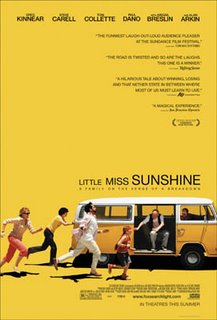
Tonight, I met D and Ophy for dinner at Ichiban and then we went and saw "Little Miss Sunshine" (starring Greg Kinnear, Steve Carell, Toni Collette, Paul Dano, Abigail Breslin and Alan Arkin).
Written by Michael Arndt, this is the story of the Hoovers, one of the most endearingly fractured families ever seen on motion picture screens. Together, the motley six-member family treks from Albuquerque to the Little Miss Sunshine pageant in Redondo Beach, CA, to fulfill the deepest wish of 7-year-old Olive, an ordinary little girl with big dreams. Along the way the family must deal with crushed dreams, heartbreaks, and a broken-down VW bus, leading up to the surreal Little Miss Sunshine competition itself. On their travels through this bizarrely funny landscape, the Hoovers learn to trust and support each other along the path of life, no matter what the challenge.
It probably comes as no surprise to anyone that I despise beauty pageants. This film actually handles the subject matter quite well. The music is also excellent, especially DeVotchKa's score.

As Gorilla vs. Bear put it:
Forget that the soundtrack features two Sufjan songs AND Rick James, the DeVotchKa songs are the highlight.
Listen to "The Winner Is" and "How it Ends."

If they sound familiar, it's because you've heard them before — in "Everything is Illuminated."

jeudi, août 24, 2006

quotable

"Some forms of reality are so horrible we refuse to face them, unless we are trapped into it by comedy. To label any subject unsuitable for comedy is to admit defeat."
-Peter Sellers (8 September 1925 - 24 July 1980) born Richard Henry Sellers: British comedian and actor

mardi, août 22, 2006

the pragmatic punk

I hate hearing the term "sell out" for any artist who goes from indie to popular. It is possible to grow up (and to have mainstream appeal) without losing yourself or your cred. And I think Dave Grohl's done it rather well.
Foo Fighters Unplug, and a Frontman Shows His Practical Side
By BEN RATLIFF
Published: August 23, 2006
“The nicest guy in rock” is what the common rock journalist says about Dave Grohl. It’s probably the dumbest thought in rock. Niceness, from a total stranger who is also a rock star, is usually just the star’s way of closing his transaction with you more quickly. Let’s settle for something more measurable: Dave Grohl is one of the more practical guys in rock.

As the singer and bandleader of Foo Fighters, Mr. Grohl seems like a paperboy doing his rounds, doing his work assuredly, almost plainly. Even when he’s screaming his head off, he’s adhering to his craft, with a confidence that anyone can admire. His is a shapely scream, empty of terror. (Before he works up to it, his voice is strangely anonymous, in the Dave Matthews, regular-dude-with-feelings ballpark.) Mr. Grohl came from punk — he was the drummer in Nirvana, of course, and before that the Washington bands Scream and Dain Bramage — but he isn’t hobbled by credibility issues; he’s not doing what the Clash called “turning rebellion into money.”

His paper route is recording hit rock songs about personal feelings, and he seems to live happily in the middle ground between punk probity and song hooks good enough for an iPod hit. (And don’t forget the obvious fact: he was an incredibly good rock drummer who let go of drumming to stand in front of his band with a guitar.) He has figured out his game to an exhilarating degree. Practicality is his charisma.

Foo Fighters celebrated their 10th anniversary last year with a gesture that indicates how rock stars live large now. They built a new studio and recorded a two-disc set, “In Your Honor,” with rock songs on the first disc, acoustic songs on the second. And after a rock-show tour last year, the band is now performing the acoustic songs in theaters more appropriate to nuance. These songs are sweet, not great. And the acoustic Foo Fighters show at the Beacon Theater on Monday night didn’t come off as pompous, just as gold-plated common sense. “It’s all about the catalog, dude,” Mr. Grohl joked in between songs. Of course he’s right, and maybe it’s even kind of punk to cop to it. But is that all there is?

Mr. Grohl fronted an eight-member version of the band at the Beacon, and true to the ethos of “MTV Unplugged,” all the musicians were sitting down as they played. Their set was most of the acoustic songs from “In Your Honor,” with three guitars, violin, keyboards, bass, drums and percussion; one song by the group’s violinist, Petra Haden; and some old Foo Fighters songs — “Times Like These,” “Everlong,” “My Hero” — that were easily enough adapted to acoustic sounds. They weren’t stripped down at all; the opposite, in fact. They were just pop songs with acoustic guitars and no screaming, and they often showed Mr. Grohl as a student of other practical guys, like Tom Petty and Paul McCartney.

Shows like this, no matter who’s doing them, are opportunities for the star to sit in one place and talk directly to the audience. Mr. Grohl has no problem in that department: he’s almost too good at it, too ingratiating. His raps were fatuous — guffaws about members of the band or why he wrote a certain song — but his timing is good, and in delivering them he channeled many overwrought comic gestures from his friend Jack Black.

It wasn’t until one of the encores, the uneasy, dirt-simple “Friend of a Friend,” that he seemed to unwind. He described the circumstances under which it was written: not long after he had joined Nirvana and moved into a house in Olympia, Wash., with Kurt Cobain and Krist Novoselic. He took his time telling the story, didn’t turn it all into an absurd joke and then just played the song, alone onstage. What a relief.

Frank Black, who opened the show, is Mr. Grohl’s character opposite: he didn’t say a single word to the audience, just appeared alone with an acoustic guitar and bashed through a little under an hour of his own songs, with a rougher guitar tone and a more alienated view of human nature. “Sing for joy,” he sang, unsmiling, in a kind of kaleidoscopic murder ballad with that title. “If nothing else, sing for joy.”

the armpit of southern california

I grew up in the (909). Actually, when I was growing up, it was the (714).

My parents still live in the lovely Inland Empire. I got the eff outta Dodge for college and I have to say that I was in no rush to move back to MoJack City after escaping.

But don't take my word for it.

From Urban Dictionary
909: The area code in Southern California for Riverside and San Bernardino County; usually associated with white trash.

From the OC Weekly
Despite cheap property, not to mention a rich array of trailer parks, white supremacists, cows and cold medicine, the Inland Empire—"909" to the kids—has somehow managed to become a punchline on everything from The O.C. to countless blogs and bumper stickers.

Still, the people love their trailers and ’tussin, which is why people keep moving to the 909, which is why there aren’t enough phone numbers to go around in the 909, which is why, on Oct. 30, western Riverside officially ceased being the 909 and became the 951, a change residents no doubt hope will have a transformative effect on their image.

Kevin and Bean of KROQ dubbed the area The Valley of the Dirt People after I left, but I still think of it as the armpit of Southern California.

Sidebar: Leo's Saturday night comment about gerrymandered area codes was strangely prescient. Take a look at the (760), yo.
Via Diana

england: ditch the fags, tom and jerry

Sure, kids are impressionable. And yes, I hate cancer sticks, er, cigarettes.

But sanitizing old cartoons? C'mon. If you removed all the "bad" messages to kids, there'd be no violence left in them, and then where would Wile E. Coyote and Roadrunner be? Have you watched "Dumbo" since you were a kid? That film is filled with racist stereotypes — Jim is the name of the crow, for pete's sake. Don't even get me started on the militaristic propaganda angle. And would Pepé Le Pew's unwelcome advances pass our present-day sexual harassment muster? I think not.

Seriously. Some (if not most) kids are sophisticated enough to figure out what's what. Having said that ...
Do I want Joe Camel advertised next to a playground? No.
Do I want new Hanna-Barbera cartoons put out with Yogi smoking? No.
Do I want an episode where Boo-Boo teaches us all why smoking is bad? No.

Showing how things were portrayed (cigarettes, minorities, women, etc.) and then having a conversation about what's wrong with those portrayals is a good opportunity for a great parenting moment. In some ways, removing the images almost absolves parents of their duty to talk to their kids about what's on-screen. It also whitewashes the past. I'm uncomfortable with both.

Fer chrissakes, leave the old stuff alone. It is what it is — pop culture that represents a time and a place (albeit a less-than-perfect one) in our civilization. Thankfully, we've moved on. Or at least most of us have ...
England wants Tom and Jerry to cut back on the smokes
LONDON, England (Reuters) -- Turner Broadcasting is scouring more than 1,500 classic Hanna-Barbera cartoons, including old favorites Tom and Jerry, The Flintstones and Scooby-Doo, to edit out scenes that glamorize smoking.
The review was triggered by a complaint to British media regulator Ofcom by one viewer who took offence to two episodes of Tom and Jerry shown on the Boomerang channel, part of Turner Broadcasting which itself belongs to Time Warner Inc.
"We are going through the entire catalogue," Yinka Akindele, spokeswoman for Turner in Europe, said on Monday.
"This is a voluntary step we've taken in light of the changing times," she said, adding the painstaking review had been prompted by the Ofcom complaint.
The regulator's latest news bulletin stated that a viewer, who was not identified, had complained about two smoking scenes on Tom and Jerry, saying they "were not appropriate in a cartoon aimed at children."
In the first, "Texas Tom", the hapless cat Tom tries to impress a feline female by rolling a cigarette, lighting it and smoking it with one hand. In the second, "Tennis Chumps", Tom's opponent in a match smokes a large cigar.
"The licensee has ... proposed editing any scenes or references in the series where smoking appeared to be condoned, acceptable, glamorized or where it might encourage imitation," Ofcom said, adding that "Texas Tom" was one such example.
Akindele said cartoons would only be modified "where smoking could be deemed to be cool or glamorized", and that scenes where a villain was featured with a cigarette or cigar would not necessarily be cut.
"These are historic cartoons, they were made well over 50 years ago in a different time and different place," she added. "Our audience is children and we don't want to be irresponsible."
Turner Broadcasting in the United States could not immediately be reached for comment.
Ofcom said it recognized smoking was more generally accepted when cartoons were produced in the 1940s, '50s and '60s, but argued that the threshold for including such scenes when the audience was predominately young should be high.
About 56 percent of Boomerang's audience is aged four to 14 years old.
Early reaction to the review on Web logs broadly attacked Turner's decision.
"Have to dig out all those photos and films of [Winston] Churchill and airbrush out the cigars," said a message posted on the "Organ Grinder" forum on the Guardian newspaper's Web site.
The review was not the first time a famous cartoon character was forced to give up smoking.
Belgian cartoonist Maurice de Bevere replaced his most popular creation Lucky Luke's ubiquitous cigarette with a blade of grass, winning him an award from the World Health Organization in 1988.

lundi, août 21, 2006

human history, from the top

shortly after the dawn of time: This guy kills that guy.
341: This group slaughters that group.
927: Land dispute. Thousands die.
1095: Religious dispute. Millions die.
1365: Famine, looting, raping, killing.
1861: Empires crumble, civil war (again).
1914: World War.
1939: World War II.
1951: Rampant industrialization = Global Warming.
2006: The Middle East, in its entirety, explodes.
2276: Rampant conservation = Global Cooling.
3287: Earth versus Mars.
30,998: Milky Way Galaxy versus Andromeda Galaxy.
2,683,988: The universe implodes; Second Big Bang occurs.

shortly after the dawn of time: This guy kills that guy ...

Inspired by Suzi and pseudomatt

dimanche, août 20, 2006

torremolinos 73

I've decided that I need to go into most movies with no expectations. Case in point: "Torremolinos 73". I had no expectations about it and I enjoyed it a great deal.

Javier Cámara
and Candela Peña are perfectly cast in this softcore comedy that begins with the most unlikely of premises. Fernando Tejero is also a great foil.
Alfredo Lopez is a tired encyclopedia salesman, and Carmen is his faithful wife. The lives of this married couple change forever when the Montoya publishing house, in which Alfredo works, makes a proposal to them to make erotic films that will sold in the Scandinavian countries, under the guise of being a false encyclopedia about reproduction. Unknown to them both, Carmen has become an adult film star in the Northern countries, and a Danish crew flies in to help Alfredo make an Ingmar Bergman inspired feature film called "Torremolinos 73." Instead of a career in show business, Carmen is eager to have a baby, and the tension between the artist and his muse grows.
The witty dialogue (counterbalanced with appropriate drama) made this film more than a fun romp. What I like most is the playful manner in which the writer/director, Pablo Berger, celebrates sex and filmmaking. In the end, the interesting characters, complicated situations, and Berger's lighthearted touch left Leo and I with smiles on our faces.

vendredi, août 18, 2006

soccer and the greater good

Leo's take on why soccer will never take off in the U.S.

this is why soccer rules: because it's a team game, and i don't mean that "you do your part, i do mine, don't bother me i'm busy, isn't it great to be part of the team" bullshit americans think of as "teamwork." which, by the way, is the essence of baseball. soccer is the one sport where you most share credit and blame. it's the socialist sport par excellence. and that, my friend, is why soccer has no future in the states. it's not the low scoring, it's not the lack of commercial breaks, it's not the long attention span required. mainly, it's that in order to be good at it you have to subjugate to the collective in a true and meaningful way, and you have to spread the action around.

jeudi, août 17, 2006

life in the nl

Kendall made it to Amsterdam. Sadly, her big suitcase didn't.

She's living her dream, going to graduate school abroad.

getting hopped up the guaraní way

Despite claims by some that mate is gaucho stuff (yes they drink it), it was the Jesuits who popularized the tea that the Guaraní drank.
A Cupful Puts Wings on Wheels
The latest buzz among endurance athletes isn’t from caffeinated energy gels, but from a South American tea called yerba maté — maté for short. Cyclists and distance runners claim that imbibing maté before a workout gives them long-lasting energy, though no studies have proved it’s good for the long haul.

Yerba maté gets its pep from caffeine. But it also contains theobromine, the stimulant in dark chocolate, and theophylline, tea’s pick-me-up. “Because caffeine isn’t the sole stimulant,” said Timothy Ferriss, a neuroscientist who has studied the effects of natural stimulants on athletic performance, “maté drinkers don’t experience the rapid upward trajectory and then the quick crash of coffee.”

Our tester, Lisa Sher, a mountain biker who won the 2002 United States National Downhill Championship, drank each maté product before riding for 90 to 120 minutes. None of the products were “miracle workers,” she said. But with two that actually gave her the best buzz — Guayaki and Eco Teas — she felt “a constant steady energy level” and didn’t experience the gut churning that some coffee-drinking athletes experience.

welcome to 'merica

dem·a·gogue n.
A leader who obtains power by means of impassioned appeals to the emotions and prejudices of the populace.
I was in first grade when my dad taught me that it wasn't okay to use racial slurs.

I came home and my dad asked what I'd done at school that day. I recounted math and reading and building a "Jap trap" in the sandbox with Mark Smith at recess. My dad stopped me and asked me if I knew what a "Jap trap" was. I told him it was a trap to catch the enemy. He asked if I knew who those enemies were. (I didn't.)

He then explained that "Jap" was an ugly way to refer to Japanese people and that he never wanted to hear me say it again, because it was hurtful. He also said that it isn't nice (or fair) to be mean to people who look, dress, or sound different than we do.

To this day, I remember that lesson and the power of words. And it's why I'm so disgusted by this demagogue's use of language.
Allen Quip Provokes Outrage, Apology: Name Insults Webb Volunteer
By Tim Craig and Michael D. Shear
Tuesday, August 15, 2006
RICHMOND, Aug. 14 -- Virginia Sen. George Allen (R) apologized Monday for what his opponent's campaign said were demeaning and insensitive comments the senator made to a 20-year-old volunteer of Indian descent.

At a campaign rally in southwest Virginia on Friday, Allen repeatedly called a volunteer for Democrat James Webb "macaca." During the speech in Breaks, near the Kentucky border, Allen began by saying that he was "going to run this campaign on positive, constructive ideas" and then pointed at S.R. Sidarth in the crowd.

"This fellow here, over here with the yellow shirt, macaca, or whatever his name is. He's with my opponent. He's following us around everywhere. And it's just great," Allen said, as his supporters began to laugh. After saying that Webb was raising money in California with a "bunch of Hollywood movie moguls," Allen said, "Let's give a welcome to macaca, here. Welcome to America and the real world of Virginia." Allen then began talking about the "war on terror."

Depending on how it is spelled, the word macaca could mean either a monkey that inhabits the Eastern Hemisphere or a town in South Africa. In some European cultures, macaca is also considered a racial slur against African immigrants, according to several Web sites that track ethnic slurs.

"The kid has a name," Webb communications director Kristian Denny Todd said of Sidarth, a Virginia native who was born in Fairfax County. "This is trying to demean him, to minimize him as a person."

Todd added that the use of macaca, whatever it means, and the reference welcoming Sidarth to America were clearly intended to make him uncomfortable.

Reached Monday evening, Allen said that the word had no derogatory meaning for him and that he was sorry. "I would never want to demean him as an individual. I do apologize if he's offended by that. That was no way the point."

Asked what macaca means, Allen said: "I don't know what it means." He said the word sounds similar to "mohawk," a term that his campaign staff had nicknamed Sidarth because of his haircut. Sidarth said his hairstyle is a mullet -- tight on top, long in the back.

Allen said that by the comment welcoming him to America, he meant: "Just to the real world. Get outside the Beltway and get to the real world."

But the apology, which came hours after Allen's campaign manager dismissed the issue with an expletive and insisted the senator has "nothing to apologize for," did little to mollify Webb's campaign or Sidarth, who said he suspects Allen singled him out because his was the only nonwhite face among about 100 Republican supporters.

"I think he was doing it because he could, and I was the only person of color there, and it was useful for him in inciting his audience," said Sidarth, who videotaped the event for the Webb campaign. "I was annoyed he would use my race in a political context."

Told of Allen's apology, Todd added, "I hope Allen realizes that Virginians come in all colors."

Allen is running for a second term in the Senate while planning a possible presidential bid in 2008. Webb, a Vietnam war hero and former Navy secretary under President Ronald Reagan, is working to derail those plans with an underfunded campaign based principally on Webb's early opposition to the war in Iraq.

Virginia Commonwealth University politics professor Robert Holsworth called Allen's comments a gaffe that probably wouldn't change the Senate race but could hurt his presidential ambitions.

"This doesn't turn the race around at all," Holsworth said. "But for a guy running for president, this is likely to be regularly aired this year and maybe beyond."

House Majority Leader H. Morgan Griffith (R-Salem), who represents southwest Virginia, said the Webb campaign is just "grabbing for stuff" to gain traction against Allen. Griffith said he doubts anyone at the rally even picked up on Allen's use of the word macaca.

"Not many people in southwest Virginia would think it is derogatory," Griffith said. "I didn't have a clue what it meant, and I doubt Allen did, either."

Sidarth, who is entering his fourth year at the University of Virginia and is an active Democrat, had been assigned to trail Allen with a video camera to document his travels and speeches for Webb, a common campaign tactic.

Steve Mukherjee, a spokesman for the Washington chapter of the Association of Indians in America, said Allen's comments were "hurtful," and he chided the senator for not being more sensitive.

"The world is so volatile and so delicate," Mukherjee said. "You have to be careful what you say and how you say it. The U.S. is no longer black and white."

Asked what macaca means, Mukherjee said: "What it means, I don't know. But it's going to cause him some grief."

It's not the first time Allen has confronted charges of insensitivity to race or ethnicity from minority leaders and longtime political opponents.

Before he ran for governor in 1993, Allen was criticized for keeping a Confederate flag in a cabin near his Charlottesville home, part of a collection of flags, he has said. He stirred controversy as governor by issuing a proclamation noting the South's celebration of Confederate History Month without mentioning slavery.

This year, the New Republic magazine published a photo of Allen wearing a Confederate flag on his lapel during high school.

"It wasn't a racial statement; it was a statement about his rebellious nature," said John Reid, Allen's communications director.

Allen campaign manager Dick Wadhams also went on the offensive, accusing Webb of mailing an anti-Semitic flier during his primary this year that contained a caricature of Webb's Jewish opponent.

Todd said Wadhams is trying to change the subject. "The flier was never meant to be anti-Semitic," she said. "That was a charge levied by our opponent at the time to drive voters away from Jim Webb, much like Allen's trying to do today."
Via Leo

mercredi, août 16, 2006

where have you gone, grisha perelman?

I'm not an egomaniac, but I've gotta admit that if I had ever solved an impossibly difficult problem in my field, I would be hard-pressed to fade into the woodwork just as the accolades came pouring in.
Elusive Proof, Elusive Prover: A New Mathematical Mystery - New York Times
By DENNIS OVERBYE
Published: August 15, 2006
Three years ago, a Russian mathematician by the name of Grigory Perelman, a k a Grisha, in St. Petersburg, announced that he had solved a famous and intractable mathematical problem, known as the Poincaré conjecture, about the nature of space.

After posting a few short papers on the Internet and making a whirlwind lecture tour of the United States, Dr. Perelman disappeared back into the Russian woods in the spring of 2003, leaving the world’s mathematicians to pick up the pieces and decide if he was right.

Now they say they have finished his work, and the evidence is circulating among scholars in the form of three book-length papers with about 1,000 pages of dense mathematics and prose between them.

As a result there is a growing feeling, a cautious optimism that they have finally achieved a landmark not just of mathematics, but of human thought.

“It’s really a great moment in mathematics,” said Bruce Kleiner of Yale, who has spent the last three years helping to explicate Dr. Perelman’s work. “It could have happened 100 years from now, or never.”

In a speech at a conference in Beijing this summer, Shing-Tung Yau of Harvard said the understanding of three-dimensional space brought about by Poincaré’s conjecture could be one of the major pillars of math in the 21st century.

Quoting Poincaré himself, Dr.Yau said, “Thought is only a flash in the middle of a long night, but the flash that means everything.”

But at the moment of his putative triumph, Dr. Perelman is nowhere in sight. He is an odds-on favorite to win a Fields Medal, math’s version of the Nobel Prize, when the International Mathematics Union convenes in Madrid next Tuesday. But there is no indication whether he will show up.

Also left hanging, for now, is $1 million offered by the Clay Mathematics Institute in Cambridge, Mass., for the first published proof of the conjecture, one of seven outstanding questions for which they offered a ransom back at the beginning of the millennium.

“It’s very unusual in math that somebody announces a result this big and leaves it hanging,” said John Morgan of Columbia, one of the scholars who has also been filling in the details of Dr. Perelman’s work.

Mathematicians have been waiting for this result for more than 100 years, ever since the French polymath Henri Poincaré posed the problem in 1904. And they acknowledge that it may be another 100 years before its full implications for math and physics are understood. For now, they say, it is just beautiful, like art or a challenging new opera.

lundi, août 14, 2006

i know i'm not alone

Leo and I listened to the new Michael Franti and Spearhead album, "Yell Fire," quite a bit this weekend. It felt like a new album, but also not like a new album, as much of the music is in his documentary, "I Know I'm Not Alone." Anyhow, the album and the film are both amazing.

We saw "I Know I'm Not Alone" a few months ago. In it, Michael Franti travels to Iraq, Palestine, and Israel to explore the human cost of war with a group of friends, some video cameras, and his guitar.

The film pulls you into these war zones — and via Michael's guitar, eloquence and wit— you feel the humanity, artistic resilience and sometimes horrific experience of what it's like to live under the bombs and military occupation.

With its guerrilla style footage captured in active war zones, the documentary is unlike the many academic and politically driven pieces in the marketplace, instead offering the audience a sense of intimate travel and the opportunity to hear the voices of everyday people living, creating and surviving under the harsh conditions of war and occupation.

femme mentale

Sure, men and women have different plumbing. So it's no surprise that we are also wired differently.

p.s. Let's hear it for the 22-second hug.
Femme Mentale
San Francisco neuropsychiatrist says differences between women's and men's brains are very real, and the sooner we all understand it, the better
Joe Garofoli
Sunday, August 6, 2006
Louann Brizendine's feminist ideals were forged in the 1970s, so the UCSF neuropsychiatrist is aware that some parts of her new book, "The Female Brain," sound politically incorrect.
Such as the part about how a financially independent woman may talk about finding a soul mate, but when she meets a prospective mate her brain is subconsciously sizing up his portfolio. Or the part describing the withdrawal pains moms feel when they return to work and can no longer cop a hormonal high from breast-feeding their babies.
Women have come a long way toward equality over the past 50 years, but the Yale-trained Brizendine, 53, says her research indicates that human brains are still wired for Stone Age necessities.
Male and female brains are different in architecture and chemical composition, asserts Brizendine. The sooner women -- and those who love them -- accept and appreciate how those neurological differences shape female behavior, the better we can all get along.
Start with why women prefer to talk about their feelings, while men prefer to meditate on sex.
"Women have an eight-lane superhighway for processing emotion, while men have a small country road," she writes. Men, however, "have O'Hare Airport as a hub for processing thoughts about sex, where women have the airfield nearby that lands small and private planes."
Untangling the brain's biological instincts from the influences of everyday life has been the driving passion of Brizendine's life -- and forms the core of her book. "The Female Brain" weaves together more than 1,000 scientific studies from the fields of genetics, molecular neuroscience, fetal and pediatric endocrinology, and neurohormonal development. It is also significantly based on her own clinical work at the Women's and Teen Girls' Mood and Hormone Clinic, which she founded at UCSF 12 years ago. It is the only psychiatric facility in the country with such a comprehensive focus.
A man's brain may be bigger overall, she writes, but the main hub for emotion and memory formation is larger in a woman's brain, as is the wiring for language and "observing emotion in others." Also, a woman's "neurological reality" is much more deeply affected by hormonal surges that fluctuate throughout her life.
Brizendine uses those differences to explain everything from why teenage girls feverishly swap text messages during class, to why women fake orgasms to why menopausal women leave their husbands.
So the next time parents scold their daughters for excessive text messaging, consider Brizendine's neurological explanation:
"Connecting through talking activates the pleasure centers in a girl's brain. We're not talking about a small amount of pleasure. This is huge. It's a major dopamine and oxytocin rush, which is the biggest, fattest neurological reward you can get outside of an orgasm."
Part road map for women looking for scientific explanations for their behavior, part geeky manual for relationship woes, "The Female Brain" already has become fodder for the morning chat shows. On the "Today" show this week, one critic downplayed the book's explanation of gender differences, saying men and women are "more like North Dakota and South Dakota."
Brizendine's goal isn't man-bashing (despite snippets like "the typical male brain reaction to an emotion is to avoid it at all costs"). Instead, she celebrates the differences.
"There is no unisex brain," Brizendine writes. "Girls arrive already wired as girls, and boys arrive already wired as boys. Their brains are different by the time they're born, and their brains are what drive their impulses, values and their very reality."
Brizendine's book offers a 2 1/2-page appendix on the female brain and sexual orientation, but she doesn't mention transgender folks. Sexual orientation, she writes, "does not appear to be a matter of conscious self-labeling but a matter of brain wiring." All women are wired for a sexual orientation during fetal development, and "the behavioral expression of her brain wiring will then be influenced and shaped by environment and culture."
That's not to say either sex is more intelligent. Just different, Brizendine said. Nor do she or other scientists who study the brain, like Bruce S. McEwen, a Rockefeller (N.Y.) University brain researcher, dismiss the role that parenting and environment and experience play in shaping a person.
"The basic idea is that men and women approach the same problems in somewhat different ways, at least in part because of the biological differences in the brain, which in turn interact with experience -- the nature-nurture story," said McEwen.
"This does not imply whether either sex is superior ... but it does provide the basis for such cultural sayings as 'Men are from Mars, and women are from Venus.' "
Indeed, "The Female Brain" covers ground that has been tilled, to various degrees, in books from 1993's "Men are From Mars, Women are From Venus" to 1999's "The First Sex," to last year's "The Mommy Brain: How Motherhood Makes Us Smarter." Brizendine takes the research a step further and stretches it to cover a female's life from womb through menopause.
Katherine Ellison, author of "The Mommy Brain," said Brizendine represents a trend among neuroscientists who have been inspired by their experiences as parents to investigate what scientists have recently dubbed "the maternal brain."
"It has become more OK to talk about brain differences between genders over the past few years, whereas before, if you said men and women were 'different,' it seemed to imply women were at a disadvantage," said Ellison, who lives in San Anselmo. "Now scientists are pointing out some clear advantages of the female brain, and in particular the 'mommy brain.' "
Among the more controversial subjects addressed in Brizendine's book is: Can new mothers successfully juggle career and family life?
Perhaps not, writes the onetime single mother. And that's OK, Brizendine said, if the workplace can be reshaped to better accommodate new mothers.
"This book is a call-to-arms for women and society to rework the social contract that women have with employers throughout their childbearing years," said Brizendine, while sitting in the Sausalito home she shares with her second husband of 10 years and teenage son. "We cannot afford to lose half the brainpower in this country. Our intelligent women are getting completely out of the loop for five to 10 years, and they cannot get back in.
"The message is that women can't stay at home 100 percent of the time and cut themselves off from their careers. The workplace should realize that women are wired to take care of children, and they want that time and need that time."
It is a sentiment that wasn't around when she was born in Hazard, Ky., a poor Appalachian mining town, where her parents, Protestant missionaries, were stationed. Her father, a minister, was active in the civil rights movement of the late 1950s and early 1960s, often appearing as a guest preacher in African American churches throughout the South. Despite Brizendine's mother being the valedictorian of her high school class, Brizendine's maternal immigrant grandparents believed that women should not be educated and refused to give their daughter any money for college.
"One of the things that has been passionate in my life is to have a profession that would allow me to support myself," Brizendine said. "Watching my mother, an intelligent woman, have limited choices because of the culture -- and because she was married to the typical male of that time in the 1950s in this country -- it was clear to me that I had to find a different way myself."
She attended UC Berkeley on an academic scholarship, initially in the nearly all-male world of architecture majors. But in her junior year, she switched to neurobiology, fascinated by experiments where manipulating the hormones of an animal produced different behaviors.
"To me, that hit pay dirt," Brizendine said. "To have that kind of explanation for behavior that wasn't based on how your family raised you -- or how the stereotypes of society were set on you."
From there she went to Yale Medical School, less than a decade after the undergraduate campus went coed. One day in class, Brizendine asked the professor why females weren't used in the study they were reviewing. She recalled him saying, "We don't use females in the study because their menstrual cycles would mess up the data."
"To be honest with you, the reason that this astounds me to this day," said Brizendine, "is because I didn't argue with him." But back then it was unthinkable to say, "Well, how can you then make medications, and how can you make assessments that you'll apply to female patients when you don't really know?"
Next, Brizendine hopes to expand her clinical work.
In the next month, she will open a satellite branch of the Women's and Teen Girls' Mood and Hormone Clinic at San Francisco General Hospital, which will focus on issues of most concern to African American women, Latinas and lesbians -- a further attempt to see how cultural issues affect the female brain.
For all women -- and those who love them -- she offers a tip.
Research shows that the female brain naturally releases oxytocin after a 20-second hug. The embrace bonds the huggers and triggers the brain's trust circuits. So Brizendine advises, don't let a guy hug you unless you plan to trust him.
"And if you do," she said, "make sure it lasts 20 seconds."

Head cases
A few neurological differences between women and men from Louann Brizendine's "The Female Brain":
  • Thoughts about sex enter women's brains once every couple of days; for men, thoughts about sex occur every minute.
  • Women use 20,000 words per day; men use 7,000 per day.
  • Women excel at knowing what people are feeling; men have difficulty spotting an emotion unless someone cries or threatens bodily harm.
  • Women remember fights that a man insists never happened.
  • Women over 50 are more likely to initiate divorce.
Via Arts & Letters Daily

dimanche, août 13, 2006

how to survive a freestyle rap battle

This reminded me of a night at the Nuyorican Poet's Cafe in NYC with Ben last year.

Happy birthday, Ben. Enjoy your freestyle, flowing, and battling.
Steps

  1. Listen to previous freestyle flows and battles by great artists (e.g., rappers like Jin, Jay-Z, Yusaf, Benefit, Rakim, Eminem, and any other great artist that spits hardcore rap).
  2. Understand the techniques those artists use to flow and battle, which will help you enhance those techniques yourself.
  3. Start writing rhymes. Write down anything that comes to mind and try to rhyme it. Using your emotions is a good way to describe what you're feeling when you spit or write lyrics. Make sure you eat a hearty meal before attempting a battle.
  4. Practice free-styling -- anytime, anywhere, as much as you can. Even if you run out of things to freestyle about, just continue spitting, no matter how wack you think you sound. It helps you develop better rhymes and your mind becomes more focused on what sounds good when you spit. It's like a mental workout. So always practice spitting anywhere.
  5. Once you've noticed you can spit on spot (when you want to), try to spit about more specific things. Direct your raps toward things that bother you or upset you. Anything you dislike or want to talk about, try to spit about it. Once again, practice this until you feel you've got it down.
  6. Start freestyle battling. The first step to freestyle battling is to practice the first 5 techniques in a battle against a friend or someone who it wouldn't matter to if you messed up. Constantly battle like that with people, especially if you can find a friend who is actually good at battling so they can teach how to improve what you lack. Again, continue to practice this until other friends you know (especially those into hip-hop music) think you're pretty good.
  7. Have your first real battle against someone you at least somewhat dislike. If you can find someone who just gets you emotional or who angers you, it makes it easier to flow about them. You want to make sure when you flow about them you include 3 major things.

    • Metaphors - Making comparisons with your target (the person you're battling) to something that denigrates them.
    • Disses - Saying things that either make fun of them in general (e.g., how they dress, speak, spit, look, walk, talk, act, or their personality) or about them personally (e.g., the way they live, their past, their lifestyle, weaknesses about them, anything that directly goes against them in a way that makes fun of them).
    • Punch-Lines - a Punch-Line basically is a bar (2 lines you spit) that incorporates a Metaphor, Dis, and/or anything else to enhance the flow directed at your opponent.
  8. Don't worry if you lose your first few real battles, the point is to constantly practice spitting. Continue practicing until you've got it down. And pay attention to how other people spit whom the crowd/judges enjoy. There are many techniques to battling, but these are just the basics.
Tips
  • If someone beats you in a battle and it gets to you, practice more until you think you're really ready. Then challenge them again: if you win, you will earn a lot of respect back. It's a great feeling, and chicks or dudes will dig your system and flair.
  • When you think you lost it, don't worry - just relax. The worst thing to do is freak out. Just relax and keep going. You might still ace it.
  • While your opponent is rapping, think how you can come back to what he says, so you get a better punchline.
Warnings
  • "Spit" as used in the context of this article is a synonym for rapping, not the forcible expulsion of saliva from the mouth. Please do not practice the latter kind of spitting; it does not make you look nearly as cool.
Related wikiHows
Via wikiHow