vendredi, juillet 14, 2006

le 14 juillet

Happy Bastille Day!

Two summers ago, I was living in Paris on Bastille Day. I spent that day recovering from one crazy night out the evening before avec mes voyous at the bal des pompiers. Then, we all headed to the Champ de Mars for a picnic and fireworks at la Tour d'Eiffel.

Getting home afterwards was quite an adventure, with everyone in the city pouring into the Metro to get home before the trains stopped running. We crammed onto a train that we thought was fairly full, only to have more and more people join at each stop. It's a good thing we did, as that was the last train of the night.

Spending a month in France is the best thing I've ever done for myself. It's time to go walkabout again. Soon.

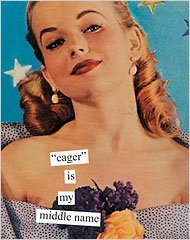
latter-day slut

I married my second boyfriend. So when we divorced shortly before my thirtieth birthday, I wasn't exactly an expert in the world of sex and dating.

I'll admit that it was fascinating, fun, and sometimes unnerving to learn how to read the verbal and non-verbal cues that make up the language of seduction. I'll also admit that I was honestly clueless early in the game. Still, it's a good feeling to come into my own at this stage, because my self esteem has never been better.

Through my adventures in dating, I've become a little less naïve, figured out what I do and don't want in a relationship, and am enjoying all aspects of my renaissance. That goes double for the sex.

Still, I wouldn't exactly call myself a libertine — yet.

The Taming of the Slur
STEPHANIE ROSENBLOOM
Published: July 13, 2006
WHISPERS follow her like so many eyes. She is the one who will go home with you, the sure bet, the kind of girl you can lie down with and then walk all over. She is ogled, envied and often ostracized. She is the slut.

The word, which originated in the Middle Ages, has emerged from a schoolyard barb to become commonplace in popular culture, marketing and casual conversation. In his duet with the rapper Eminem, Nate Dogg describes his hunt for “a big old slut” in the single “Shake That.” The ample-bosomed puppet in the Broadway musical “Avenue Q” is called Lucy the Slut.

Novelty shops and Web sites sell Slut lip balm, bubble bath, soap and lotion. A cocktail is known as the Red-Headed Slut. A teenager on MTV’s “Laguna Beach: The Real Orange County” demanded that a rival admit she was a slut. (She did.)

“Slut’’ is tossed around so often and so casually that many teenagers use it affectionately and in jest among their friends, even incorporating it into their instant messenger screen names.

Like “queer” and “pimp” before it, the word slut seems to be moving away from its meaning as a slur. Or is it?

“It’s definitely a term of familiarity with teens,” said Karell Roxas, a senior editor at Gurl.com, a Web site that addresses issues that affect teenagers. “They’ll say ‘Hi, slut!’ the way my generation would say ‘Hi, chick!’ or ‘Hi, dawg!’ ”


Even among adults, the word is used to demonstrate voraciousness: “coffee slut,” “TV slut.”

“Today, ‘slut,’ even ‘ho’ — girls use it in a fun way, a positive way,” said Atoosa Rubenstein, the editor in chief of Seventeen magazine, adding that a phrase such as “you little slut” has become a way for girlfriends to bust each other’s chops.

Beyond the word itself, cultivating an exhibitionistic, slutty appearance — donning the trappings of promiscuity as opposed to actually being promiscuous — has been a growing influence on fashion and popular culture for a decade.

Women wear T-shirts with provocative slogans. Stripping and pole dancing is an au courant way to exercise. Paris Hilton is called an “American cultural icon” on Sephora.com, where she sells $49 perfume.

Ariel Levy, the author of “Female Chauvinist Pigs: Women and the Rise of Raunch Culture,” said a girl in California told her that she and her friends compete to see who can look “the skankiest.” Ms. Levy told the girl that when she was in high school, girls wanted to be known as “the prettiest” or “the most popular.”

“How did you get the guys?,” the girl replied. “Charm?”

Given all of the slut-posturing, one may be inclined to think that society’s attitudes about women and promiscuity have changed. But it’s not entirely so, say authors who have studied popular culture. An entrenched sexual double standard is not easily uprooted. A promiscuous single man is lauded for being a player or a stud, but a woman who sleeps around rarely is.

Still, “slut’’ stings much more for girls than for women. Teenage girls get the cultural message that they should look provocative. Their social circles are small, so everyone knows who is doing what with whom. And those who do acquire the slut label have to face up to it daily in school and endure snickers about the very thing girls at that age are most embarrassed about — their sexuality.

“All of our pop icons look like porn stars,” Ms. Rubenstein said. “However they’re all virgins, quote unquote,” she said, referring to Jessica Simpson and Britney Spears. “That’s a very complex message to send to girls.”

For junior high and high school girls, said Leora Tanenbaum, the author of “Slut! Growing Up Female with a Bad Reputation,” being labeled a slut is still painful and humiliating, despite pop culture’s semi-embrace of the term. Ms. Roxas of Gurl.com said teenagers often inquire about it.

They ask, Ms. Roxas said, questions like: “I’ve acquired the reputation of being a slut, how do I get around it?” or “If I have a boyfriend and I perform a certain action, does that make me a slut?” (Ms. Levy said that even the girl who competed to dress “the skankiest” made it clear that having sex with someone who is not a boyfriend is unacceptable behavior.)

A slut, according to the primary definition in the Oxford English Dictionary, is “a woman of dirty, slovenly, or untidy habits or appearance; a foul slattern.” The second entry defines a slut as “a woman of a low or loose character; a bold or impudent girl; a hussy, jade.” For decades, the second definition has reigned.

Ms. Tanenbaum, who interviewed more than 100 women between the ages of 14 and 66 who had been pigeonholed as sluts, found that the label can be a self-fulfilling prophecy, leading to greater promiscuity. But, she said, it can also act as a brake, leading a woman to shut down sexually. As for the liberal use of the word today, “It’s still too hurtful,” she said.

There is no way to know if more women are being saddled with the dubious distinction now than in the past. What seems to be true, at least anecdotally, is that it is primarily girls who are pinning the label on other girls. They do it, Ms. Tanenbaum said, because of their confusion over the contradictory messages they receive about their sexuality and how to conduct themselves.

“The way they deal with their anxiety is pointing their fingers at other girls,” Ms. Tanenbaum said, adding that more than 90 percent of the people she interviewed were given their slut label by other girls.

Often, she said, the label has nothing to do with sexual behavior. Among teenagers, the word has been attached to girls whose bodies develop more quickly than those of their peers, Ms. Tanenbaum said, as well as to pretty girls, girls who are somehow different, even girls who have been raped.

“Girls wouldn’t feel the need to do this if we had one sexual standard,” she said. “It’s because we have the double standard that this phenomenon occurs.”

Whether they condone promiscuity or not, adults, who have an easier time than teenagers keeping their sex lives private, do not seem to feel as anxious about being labeled sluts. Nor are they as prone to calling others names.

“Once you get into your 20’s and 30’s, you just have better things to do,” said Susan Schulz, the editor in chief of CosmoGirl! magazine. “Everybody has that one friend who’s kind of loose and takes somebody home.”

But as Carrie Bradshaw might type on her laptop: Is there such a thing as going too far any more? Does society allow single women more sexual partners than it once did, before they get a “bad reputation?”

Jamie Breitman, 27, of Manhattan, has a friend she characterizes as promiscuous, a woman who, when they were in a bar in Spain, ended up singing on a stage and eventually making out with the bass player.

“That’s just the way that she is and we just love her for that,” Ms. Breitman said. “It makes her more interesting and fun and she always has good stories.”

Indeed, many women admired the fictional libertine Samantha Jones on “Sex and the City’’ because she had all of those qualities, not to mention confidence and an unapologetic attitude about satisfying her desires. Enjoyment was always mutual.

But viewers often commented that such a woman could not exist in real life. That attitude, Ms. Levy said, “goes to show we can’t accept a woman who’s promiscuous because she wants to be.”

Some men, especially, seem to have strong feelings about the matter.

“When I think of the word slut,” wrote Don Reisinger, a student doing accounting and law work in Albany, in an e-mail message, “I think of a woman who has been around the block more times than my dad’s Chevy. I might date a slut, but I certainly wouldn’t marry one.”

For that reason, perhaps, women sometimes feel pressured to downplay their sexual experience. “Women still have a script for their future that involves marriage, that involves children,” said Dr. Susan Freeman, an assistant professor of women’s studies at Minnesota State University, Mankato. “It governs a lot of choices they make, how sexually active they can be, what risks they are willing to take in terms of alienating a possible marriage partner.”

There seems to be a mysterious line between being experienced and being a slut, and no one can put a number on it. According to a government report released last year (“Sexual Behavior and Selected Health Measures”), men age 30 to 44 have had a median of six to eight sexual partners in their lifetimes. The women’s median was about four.

Many women steer clear of the numbers conversation entirely, but as was pointed out several times in interviews, it would be more unusual for them to be virgins.

The fact is, Ms. Levy said, “I think there are a lot of women who want to have a lot of sex because they enjoy it.”

jeudi, juillet 13, 2006

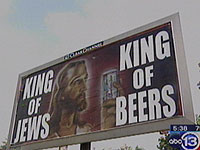
king of jewish beer?

Jesus beer billboard causing quite a stir
(7/11/06 - KTRK/HOUSTON) - Sophisticated graffiti artists have left their mark near downtown Houston.

Someone covered up a billboard on La Branch at Winbern with a poster featuring a picture of Jesus Christ holding a Budweiser can. The company that leases the billboard believes vandals made the poster at home and then pasted it on top of the ad that's supposed to be there.

It shows Jesus holding a Budweiser in between the phrases "Jesus, King of Jews" and "Jesus, King of Beers."

"I thought that was just crazy," said commuter Jose Cazares. "It looks professional too."

Neighbors say the billboard has been up there for a week or more.
Via Vanoosheh

jews for stevus

Jews for Jesus has been distributing a pamphlet in NYC that draws parallels between the careers of Apple CEO Steve Jobs and Jesus H. Christ. The pamphlet concludes by targeting the supposedly Jewish Jobs for conversion.


Via Jewschool

le coup de tête

The whack-a-Materazzi video game was funny, as was the Nintendo version of what happened, but I think this (Zidane headbutt outrage: new video evidence) pretty much takes the cake.
Via Brian and Asif

mercredi, juillet 12, 2006

great minds ...

I'm no Einstein, but after seeing this photoessay, Einstein: Behind the Genius, I discovered that Albert and I have at least one thing in common: perpetually messy desks.

nam


nam by jaymce

the new rules

I'm getting my MBA. Almost everyone who knows me well is still surprised by that fact. It's not just that I pictured myself committing hari-kari before ever studying business ... it's that I detest most corporations and all they stand for (read: greed at the expense of the environment, workers, and society at-large) because the traditional notion of business is anathema to most of my social values.

I'm three semesters into my program and I've endured more math and hard / boring classes than I thought humanly possible. This summer, I'm taking my first elective course (a Seminar in Business Ethics). It's awesome. My professor is thoughtful, brilliant, and funny as all get-out. The topics are tough and are forcing me to really think.

Fortune: The new rules - Tearing up the Jack Welch playbook
The Six Sigma master was once the undisputed authority in management. But Fortune is finding that today's smart CEOs are following a different set of rules.
By Betsy Morris, Fortune senior writer
July 11 2006: 8:55 AM EDT
NEW YORK (Fortune) -- Once upon a time, there was a route to success that corporate America agreed on. But in today's fast-changing landscape, that old formula is getting tired.
New Rules
Agile is best; being big can bite you.
Find a niche, create something new.
The customer is king.
Look out, not in.
Hire passionate people.
Hire a courageous CEO.
Admire my soul.
Old Rules
Big dogs own the street
Be No. 1 or No. 2 in your market.
Shareholders rule.
Be lean and mean.
Rank your players; go with the A's.
Hire a charismatic CEO.
Admire my might.

Even now, nearly five years after his retirement from General Electric (Charts), Jack Welch commands the spotlight.

He is still power-lunching, still making the gossip columns, still the charismatic embodiment of the star CEO. His books are automatic bestsellers.

More than any other single figure, he stands as a model not just for the can-do American executive but for a way of doing business that revived the U.S. corporation in the 1980s and dominated the world's economic landscape for a quarter century.

Just try to find an executive who hasn't been influenced by his teachings. What came to be known as Jack's Rules are by now the business equivalent of holy writ, bedrock wisdom that has been open to interpretation, perhaps, but not dispute.

But the time has come: Corporate America needs a new playbook. The challenge facing U.S. business leaders is greater than ever before, yet they have less control than ever - and less job security. The volatility of the markets is so unpredictable, the pressure from hedge funds and private-equity investors so relentless, the competition from China and India so intense, that the edicts of the past are starting to feel out of date.

In executive suites across the country, a dramatic rethinking is underway about fundamental assumptions that defined Welch and his era. Is an emphasis on market share really the prime directive? Is a company's near-term stock price - and the quarterly earnings per share that drive it - really the best measure of a CEO's success? In what ways is managing a company to please Wall Street bad for competitiveness in the long run?

Jack Welch, needless to say, is having none of it. When FORTUNE caught up with him recently, he was as confident and outspoken as ever. "I'm perfectly prepared to change," says Welch (who co-writes a column in Business Week with his wife, Suzy). "Change is great." But, he asserts, he sees no reason to back away from the principles by which he and other star CEOs like Roberto Goizueta of Coca-Cola (Charts) managed.

If applied correctly, Welch contends, his rules can work forever.

Sorry, Jack, but we don't buy it. The practices that brought Welch, Goizueta, and others such success were developed to battle problems specific to a time and place in history. And they worked. No one questions today that bloated bureaucracy can kill a business. No one forgets the shareholder - far from it. Yet those threats have receded. And they have been replaced by new ones. The risk we now face is applying old solutions to new problems.

Early on, Welch argued that lagging businesses - those not No. 1 or No. 2 in their markets - should be fixed, sold, or closed. In a 1981 speech titled "Growing Fast in a Slow-Growth Economy," he announced that GE would no longer tolerate lowmargin and low-growth units.

GE, he told analysts at the Pierre Hotel in New York, "will be the locomotive pulling the GNP, not the caboose following it." As much as any other single event, Welch's words marked the dawn of the shareholder-value movement. And GE eventually became its star. No question who was Welch's boss. His report card: the stock price. His goal: consistent earnings growth.

As his ruthlessly efficient strategy wrenched GE into high performance, the company's stock took off. Soon virtually everything Welch said became gospel - often to the extreme. When Welch embraced Six Sigma, the program began to proliferate all over corporate America.

He talked about being the leanest and meanest and lowest-cost, and corporate America got out its ax. Welch advocated ranking your players and weeding out your weakest, and HR departments turned Darwinian. As time went on, the mantra of shareholder value took on a life of its own.

Cheered on by academics, consulting firms and investors, more and more companies tried to defy history (and their own reality) to sustain growth and dazzle Wall Street as Welch was doing. Accounting tricks, acquisition mania, outright thievery - executives went overboard.

"It became all about 'real men make their numbers,' " says one CEO. "What were we thinking?"

This, says Harvard Business School's Rakesh Khurana, is the legacy of the Old Rules. Managing to create shareholder value became managed earnings became managing quarter to quarter to please the Street. "That meant a disinvestment in the future," says Khurana, author of "Searching for a Corporate Savior."

"It was a dramatic reversal of everything that made capitalism strong and the envy of the rest of the world: the willingness of a CEO to forgo dividends and make an investment that wouldn't be realized until one or two CEOs down the road." Now, he believes, "we're at a hinge point of American capitalism."

There is another model. In breathtakingly short order, the rock star of business is no longer the guy atop the FORTUNE 500 (today Rex Tillerson at ExxonMobil (Charts)), but the very guy those FORTUNE 500 types used to love to ridicule: Steve Jobs at Apple (Charts).

The biggest feat of the decade is not making the elephant dance, as Lou Gerstner famously did at IBM, but inventing the iPod and transforming an industry. Dell (Charts) spectacularly upended Compaq and Hewlett-Packard, yet few big companies paid close enough attention to see that new technologies and business models were negating the power of economies of scale in myriad ways. Nobody has proved that more than Google (Charts).

Yet in the corridors of corporate power, the old rules continue to cast an outsized shadow. Many CEOs are following a playbook that has, at best, been distorted by time.

"How do you think about building shareholder value when a lot of people are really just going to hold the share for the moment?" says Jim Collins, a former Stanford Business School professor and the author of "Good to Great" and "Built to Last." "The idea of maximizing shareholder value is a strange idea when [many shareholders] are really share flippers. That's a real change. That does make the notion of building a great company more difficult."

That doesn't mean everything about Welch's era is wrong. Indeed, we named him "manager of the century" in 1999. Were he at GE today, he might well be in the forefront of the current wave of rethinking, as his successor, Jeffrey Immelt, surely is. Still, in the way of all good analogies, we must begin by tearing down the old so that we can really open ourselves to something different.

In that spirit, then, here are seven old rules whose shortcomings have become apparent and seven replacements that point toward a new model for success. Some of the old rules are inspired directly by Welch's teachings; others are not.

You may not agree with all of our conclusions (Welch certainly didn't). We welcome the debate. What's most important is to get the discussion started.
Via Allison

by the rum's early light

I'm a huge fan of cultural history and of learning about the past by looking through an unconventional prism (drink, disease, architecture). As I'm also a fan of cocktails, this book's definitely in my "I'll read this when I'm done with grad school" queue.

Shaken and Stirred: By the Rum's Early Light
By JONATHAN MILES
Published: July 9, 2006
LAST week I resolved to drink patriotically. The most popular way to go about this is to lurk near a smoking grill drinking a six-pack of beer. Then there's bourbon, the king — whoops, president — of our homegrown spirits, which would have been my choice for toasting the republic had I not come across a new book, "And a Bottle of Rum" (Crown) by Wayne Curtis, to be published this month.

Subtitled "A History of the New World in 10 Cocktails," it views America's past through the prism of rum. "To track rum to its source — back through the mojito craze, the Trader Vic interregnum, the Prohibition era, the grim slave epoch, the age of the pirates and the first European settlement of America — is to run to ground the story of America," Mr. Curtis writes.

If I was going to raise a glass to America, it would contain grog or a rum flip or the mixture of rum, water, molasses and nutmeg that buccaneers used to call a bombo.

For liquid artifacts of this sort, one should visit the Pegu Club, Audrey Saunders's 11-month-old second-story cocktailery on West Houston Street. The space is sleek and contemporary, full of sharp right angles and mod Asian design touches, but its soul is as old and baroque as the 19th-century drink manuals Ms. Saunders keeps tucked behind the bar.

"When I look out onto Houston Street, I sometimes imagine horses and buggies," she confided.

The bombo, using Mr. Curtis's recipe, was a disappointment. But Ms. Saunders, a protégée of the legendary Dale DeGroff, concocted for me her own rum-based syllabus of American history.

The most thrilling chapter was reserved for ti' punch (for petit punch), a precursor of the daiquiri, imported from the French West Indies. A simple mixture of 100 proof Martinique rum, sugar cane syrup and lime, it mellows as the ingredients mingle in the glass, and it matures before your eyes.

If rum, as Mr. Curtis writes, "is the history of America in a glass," then ti' punch is an apt metaphor: brash and raffish around the edges, but blessed, as the flavors melting into one another reveal, with a heart gentle and beautiful.

TI' PUNCH
Adapted from Pegu Club

2 ounces rhum agricole blanc (La Favorite is an excellent brand)

1 teaspoon sugar cane syrup

1 lime

Cut a half-dollar-size disk from side of lime. Squeeze it into a rocks glass and drop it in. Pour in sugar cane syrup and stir to blend. Add rum; stir to blend. Add crushed ice; stir to blend.

liberty, reborn

Sacre bleu!
I didn't realize that homegirl was having a fashion emergency or in need of a makeover.

So much for welcoming the tired, the poor, and the huddled masses ...

Lady Liberty Trades In Some Trappings
By SHAILA DEWAN
MEMPHIS, July 4 — On Independence Day, Lady Liberty was born again.

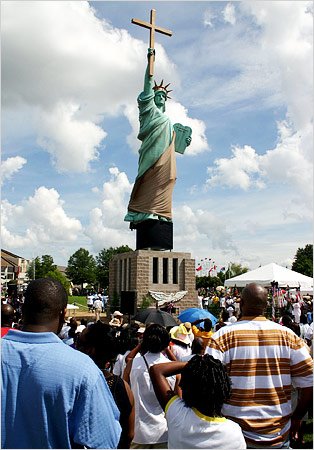
As the congregation of the World Overcomers Outreach Ministries Church looked on and its pastor, Apostle Alton R. Williams, presided, a brown shroud much like a burqa was pulled away to reveal a giant statue of the Lady, but with the Ten Commandments under one arm and "Jehovah" inscribed on her crown.

And in place of a torch, she held aloft a large gold cross, as if to ward off the pawnshops, the car dealerships and the discount furniture outlets at the busy corner of Kirby Parkway and Winchester that is her home. A single tear graced her cheek.

It was not clear if she was crying because of her new home, her new identity as a symbol of religion or, as the pastor said, America's increasing godlessness. But although big cheers went up from the few hundred onlookers at the unveiling, and some people even wore foam Lady Liberty crowns bearing Christian slogans, she was not universally welcomed.

Most of the customers at the Dixie Queen food counter near the church viewed the statue as a cheap attention grab, said Guardia Nelson, 27, who works there.

"It's a big issue," Ms. Nelson said. "Liberty's supposed to have a fire, not a cross."

Elena Martinez, a loan officer visiting Memphis from Houston, said her family was speechless at the sight.

"The Statue of Liberty has a different meaning for the country," Ms. Martinez said. "It doesn't need to be used in a religious sense."

At the pizza place next door, Amanda Houston pronounced the combination of the Statue of Liberty and Christianity "ridiculous," though her co-worker Landon Condit was far less critical: "I can't see anything wrong with it. This is the Bible Belt."

The Statue of Liberation Through Christ, as she is called, stands 72 feet tall from the base of her pedestal to the tip of her cross. She was the idea of Mr. Williams, a very successful pastor whose church, World Overcomers, qualifies as mega: it has a school, a bowling alley, a roller rink, a bookstore and, he said, 12,000 members.

The pastor is not shy. His church has bought full-page advertisements in The Commercial Appeal, the Memphis daily, condemning homosexuality. At the World Overcomers' previous location, neighbors complained that trees were felled unnecessarily; Mr. Williams said it had to be done so that people could see the church from the road.

The statue, inspired by a Memphis church that has three giant crosses, strikes him as "a creative means of just really letting people know that God is the foundation of our nation," he said.

Mr. Williams has written several books and pamphlets analyzing a variety of matters, among them patriotism and the original intent of the founding fathers.

In "The Meaning of the Statue of Liberation Through Christ: Reconnecting Patriotism With Christianity," he explains that the teardrop on his Lady is God's response to what he calls the nation's ills, including legalized abortion, a lack of prayer in schools and the country's "promotion of expressions of New Age, Wicca, secularism and humanism." In another book, he said Hurricane Katrina was retribution for New Orleans's embrace of sin.

Mr. Williams said his statue's essential point was that Christianity should be the guiding ethos of the nation. But because the church he leads is predominantly black, as is he, there is an added dimension to the message.

In "From Slavery to Lady Liberty: Lady Liberty's African Connection: The Key to Black America's Liberation," he pointed out that the real Statue of Liberty wears a broken shackle around one ankle, and revisited evidence that the statue, a gift from France, was originally intended not to welcome immigrants but to celebrate the emancipation of slaves.

"Many blacks are not patriotic, and they are not patriotic because of the history of our nation," Mr. Williams said in an interview at the church, in the richly appointed sitting room he uses to receive visitors. "It's good for our people to know that the nation has something for them as well."

To critics who say there are better ways to spend $260,000, Mr. Williams responds that his church gives millions to the needy and says he views the statue as outreach: "I personally feel that the answer for the poor is Jesus Christ."

To celebrate the Fourth of July, a good crowd gathered on the church grounds for free hamburgers and grape soda, carnival rides, a barbecue cook-off and entertainment. Children ate sno-cones, and a small army of volunteers and members of the staff darted around on bicycles and golf carts, dressed in white polo shirts. But the main event was the unveiling, preceded by speeches, prayers and consecrations.

"I decree the spirit of conviction on this intersection," Mr. Williams boomed from a podium decorated with red, white and blue bunting. "This statue proves that Jesus Christ is Lord over America, he is Lord over Tennessee, he is Lord over Memphis."
Via JewSchool

mardi, juillet 11, 2006

like a virgin

Double standards are a bitch. To be fair, male "verge-ins" have it tough, too.

I was curious about the attitudes of younger generations, so I did more reading on the topic. I found this site (a UNICEF-sponsored youth forum on attitudes about virginity) pretty interesting.

Europe’s Muslims go to extremes to be ‘virgins’
Women try hymen repair, get fake virginity certificates before marriage
Updated: 4:06 a.m. PT June 26, 2006
SAINT-DENIS, France - Chastity can exact a painful price from young Muslim women, forced into lies or surgery to go to the marriage bed as virgins.

Hymen repair, fake virginity certificates and other deceptions, said to be commonplace in some Muslim countries, are practiced in France and elsewhere in Europe, where Muslim girls are more emancipated but still live under rigid codes of family honor.

Such ploys have saved many a young woman from scorn and worse. But they also clash with the more liberal social mores of France and Europe, where some decry it as an attack on human rights.

The procedures are legal but shrouded in silence — “something that passes through nonofficial channels,” via friends or the Internet, said Dr. Nathan Wrobel. “There are circuits that lead women to me.”

‘It’s a secret we share’
Wrobel is one of an unknown number of gynecologists in France who are willing to repair hymens, the membrane usually broken by the first act of sexual intercourse. He was one of the few doctors willing to talk about it.

Wrobel says women come to him having convinced themselves that the procedure will somehow reverse the irreversible. “They tell me, ‘I’ll be a virgin again. You will make me a virgin,’ which in reality is totally false .... It’s a secret we share.”

Other doctors issue false virginity certificates or offer such tricks as spilling a vial of blood on the sheets to fool families into believing the bride has passed their purity bar.

Through the ages, virginity has been prized across religions and cultures, and doctors note that only a few generations back European brides also had to furnish documentary “proof” of chastity.

Broader question
In today’s France, with an estimated 5 million Muslims — the largest such population in western Europe — it’s part of the larger question of how to deal with cultural clashes ranging from head scarves in schools to sexual segregation in swimming pools.

A 2005 government report addressing culture clashes in hospitals, and issued a year after Muslim head scarves were banned from classrooms, briefly mentions the virginity issue, asking doctors to refuse to issue false certificates.

Isabelle Levy, author of “Religion in the Hospital,” decries both certificates and hymen repair, saying deception “increases the moral suffering.”

In Islam, virginity is linked to bridal purity and family honor, said Dalil Boubakeur, head of the Paris Mosque.

He notes that tradition holds that “adre,” virgins, are among the delights of paradise. However, Boubakeur, a doctor and a moderate Muslim, says the Quran does not address premarital virginity, and he is against the deception, counseling bride and bridegroom to confide in each other.

It is not known how many doctors in France or elsewhere in Europe help Muslim women to fake virginity. But in Germany, Turkish Muslim immigrants are increasingly seeking virginity certificates, said Serap Cileli, who survived a forced marriage and now helps victims.

German doctors who do hymen repair are easy to find, according to Sibylle Schreiber, who works with a women’s rights group in Tuebingen, but it’s “a taboo topic really only discussed best friend to best friend.”

Not on the Internet, however, where the desperation in Web forums is palpable. “If you have contacts to help me, I’ll never be able to thank you enough,” writes a woman calling herself Lubna who wants help finding someone to restore her virginity.

Wrobel, who teaches at the University of Paris, says he and another doctor at his clinic in a Paris suburb stitch up seven to eight hymens a month in a 20- to 30-minute operation under general anesthesia that he likens to plastic surgery. He asked that the clinic not be named.

The price, $500, is steep for a young woman in a poor family and possibly unemployed. A German doctor advertising on the Internet charges $1,250.

‘It’s easy to be like a virgin’
Dr. Emmanuelle Piet, who heads the family planning clinics in an area north of Paris where many Muslims live, says she has been issuing a half-dozen virginity certificates a year for three decades.

But instead of hymen repair, she suggests less drastic measures, like spilling blood on the sheet on the wedding night.

“It’s easy to be like a virgin,” she said.

It’s deceptive but “it’s one way to help the girls,” said Piet, a veteran women’s rights advocate. “They are stuck in things so terrible.”

In an interview, a French Muslim woman from the northern Paris suburb of Saint Denis, recounted how she was forced to procure a virginity certificate at age 12 “after my mother surprised me with a friend.” Although nothing had happened between her and the boy, her suspicious brothers beat her up, she said, requesting anonymity.

By age 19 she had lost her virginity and underwent hymen repair before marrying a man who demanded a virgin.

“I wanted to leave home. I took the first one who came along,” the woman said. The marriage ended after five years.

lundi, juillet 10, 2006

taking it too far ...

I'm not a luddite, but I think people can take technology too far.

I blog (obviously), have a few friends who are avid bloggers, and have a MySpace account that's handy for keeping in touch with certain folks and that has helped me reconnect with others. I've done online dating. I have dormant IM, Friendster, LiveJournal, and LinkedIn accounts. And I also keep a private (paper) journal where I document things that the rest of the world has no business knowing.

Some of my friends patently refuse to join MySpace or to get involved with online communities because they think they are lame / a waste of time / a way to get attention. I also "know" people online who overshare to the point that I sometimes question where fact ends and fiction begins.

Things got interesting for me when I started dating someone who is somewhat reluctantly part of online communities. I outed myself to him as a blogger before our first date. When I did so, he asked me why I 'm a blogger. My response ... I blog to:
  • Document my life.
  • Get in the practice of writing each and every day.
  • Use blogging as a way to think about, process, and externalize issues that I would've internalized in the past.
  • Keep in touch with loved ones near and far, without spamming them.
  • Stay current in my occupation (online communications).
Several months later, we're still dating, so I suppose you could say that he took it well (even joking that it provided a ready answer to the "what's she like?" questions from friends).

Anyhow, this article neatly summarizes why I don't take online communities too seriously ...
Modern Love: Someone to Watch Over Me (on a Google Map)
By THEODORA STITES
Published: July 9, 2006
I'm 24 years old, have a good job, friends. But like many of my generation, I consistently trade actual human contact for the more reliable emotional high of smiles on MySpace, winks on Match.com and pokes on Facebook. I live for Friendster views, profile comments and the Dodgeball messages that clog my cellphone every night.

I prefer, in short, a world cloaked in virtual intimacy. It may be electronic, but it is intimacy nevertheless. Besides, eye contact isn't all it's cracked up to be and facial expressions can be so hard to control. My life goes like this: Every morning, before I brush my teeth, I sign in to my Instant Messenger to let everyone know I'm awake. I check for new e-mail, messages or views, bulletins, invitations, friend requests, comments on my blog or mentions of me or my blog on my friends' blogs.

Next I flip open my phone and check for last night's Dodgeball messages. Dodgeball is the most intimate and invasive network I belong to. It links my online community to my cellphone, so when I send a text message to 36343 (Dodge), the program pings out a message with my location to all the people in my Dodgeball network. Acceptance into another person's Dodgeball network is a very personal way to say you want to hang out.

I scroll through the messages to see where my friends went last night, and when, tracking their progress through various bars and noting the crossed paths. I check the Google map that displays their locations and proximity to one another. I note how close Christopher and Tom were last night, only a block away, but see that they never met up.

I log on to my Friendster, Facebook, MySpace and Nerve accounts to make sure the mail bars are rising with new friend requests, messages and testimonials.

I am obsessed with testimonials and solicit them incessantly. They are the ultimate social currency, public declarations of the intimacy status of a relationship. "I miss running around like crazy w/you in the AM and sneaking away to grab caffeine and gossip," Kathleen commented on my MySpace for all to see. Often someone will write, "I just posted to say I love you."

I click through the profiles of my friends to the profiles of their friends (and their friends of friends, and so on), always aware of the little bar at the top of each profile indicating my multiple connections. A girl I know from college is friends with my friend from college's best friend from Minnesota. They met at camp in seventh grade. The boyfriend of my friend from work is friends with one of my friends from high school. I note the connections and remind myself to IM them later. On Facebook, I skip from profile to profile by clicking on the faces of posted pictures. I find a picture of my sister and her boyfriend, click on his face and jump right to his page.

Pictures are extremely necessary for enticing new friends — the more pictures the better. I change my pictures at least once a week.

There are hidden social codes in every image. Shadows and prominent eyes: not confident about their looks. Far away and seated in beautiful scenery: want you to know they're adventurous. Half in the picture: good looking but want you to know they're artistic, too.

Every profile is a carefully planned media campaign. I click on the Friendster "Who's Viewed Me" tab to see who has stumbled upon my profile recently, and if people I don't know have checked me out, I immediately check them back. I get an adrenaline rush when I find out that a friend of a friend I was always interested in is evidentially interested in me, too.

Just imagine if we could be this good in person. Online, everyone has bulletproof social armor.

Finding the perfect online community is not as easy as it looks. Some are too small. Dodgeball is so tiny it's almost too personal and requires constant attention. Not only does my online profile need to be updated regularly but the text messages demand prompt responses. To stay in the loop, it is even occasionally necessary to meet up with the members of my Dodgeball network in person.

Meanwhile, MySpace is so big that I can't even seem to find a place to start my own mini-network and branch out. I have 10 profiles, but not nearly enough friends.

I am constantly searching the Internet for new communities. Are there enough people on Plazes.com yet? Am I hip enough for Nerve? Can I be a part of Geocaching.com without having a GPS? Are the people on Fark.com my kind of people?

Fark.com members apparently opened their homes to other Fark.com members who were stranded after Hurricane Katrina. This makes their community seem beautiful and touching. Definitely worth starting a profile. Plazes.com is based on posting your GPS address on Google maps and finding people not just through interests but exact location. I, of course, have a profile and log in every day. But I don't know anyone else on it yet, so I'm not really ready to tell my friends.

WHY, you ask, do I have to be a part of so many online communities? Isn't it hard to keep track? I need to belong to all of them because each one enables me to connect to people with different levels of social intimacy.

Don't know you but think I may want you to be part of my network? I'll contact you through Match.com or Nerve. Just met? I'll look you up on MySpace. Known each other for a while, but haven't been in touch recently? Friendster message. Friends with my friends and want to get to know you better? Dodgeball or MySpace. Good friends and want to connect more often? Dodgeball. Really good friends? Instant Message.

I now think of most people by their screen names. Even when I see them in person.

Through IM, I talk to my friends in Japan and Jamaica as much as the friends I see every weekend. Likewise, I have friends on my buddy list who live in my neighborhood, but we only talk on IM. We would never dream of hanging out in person. We have enough connection online for our degree of closeness and don't need to enhance our relationship by spending time together offline. As Friendster puts it, some people are just second- or third-degree friends.

I also use IM as a tool for keeping track of my exes. I know when they sign on and I read their away messages. I can keep track of what's happening in their lives without their ever knowing I still care. Good or bad day, sick or asleep, I see what they're doing. I know if and when they're on the Internet. Sometimes they get smart, though, and click the little eye on the AIM Buddy List that makes them "invisible." It's a much less aggressive move than simply not responding to a message.

After I have checked the status of my communities I move along to the blogs. Blog content is so niche; if you like a blog, then the other people reading it must be just like you. Every site wants to feel like a community. More and more, the popular blogs and sites are going in the opposite direction of everything else and trying to extend into the offline world. Sites such as Flavorpill, Meetup and GeoCaching actually encourage and facilitate real interactions between their respective members. Flavorpill throws monthly parties for their subscribers.

Attending these parties, I found myself in awkward social situations I couldn't log out of, so I joined SecondLife. Every member of SecondLife is given an avatar — a three-dimensional body with a choice of clothing, hairstyle, body type and gender. Members of SecondLife have SecondLife jobs, families and friends. The population is over 200,000.

The virtual people in SecondLife talk to each other in intimate gatherings. They spend the day gossiping, shopping, fighting, giving each other tattoos, kissing, marrying, even engaging in prostitution and filing complaints of sexual abuse. I recently enlarged the breasts of my avatar, and men immediately started grabbing me. I could have filed abuse complaints about this if I'd wanted to, but I didn't. For a while I had a virtual boyfriend, Darren, but he hasn't contacted me recently.

OSTENSIBLY, there are no flaws in this world. You don't have to eat, and no one gets sick. All the members choose their body type, so no one is unattractive. You may think you'd act differently on SecondLife, in your perfect body and specially created persona. But I've found that I act much as I do in real life, and my SecondLife relationships tend to fail the same way my real-life relationships do. Virtual love is still complicated.

For now I've been placed on a lush tropical island to learn how to maneuver. Once I improve at virtually picking things up and moving them, sitting, walking and jumping, I'll be moved to the main city. But I've been called a newborn enough times to know I'm not ready yet.

I can't wait to log back in.

Hanging out in the real world one weekend, I went to a Flavorpill party. I was sucking down a cigarette with the head of Flavorpill when our cellphones rang at the same time. We flipped them open to see who was contacting us. He turned to me and said, "Dennis? He's really got to go someplace new."

I looked down at my screen and noticed that Dennis had sent out a Dodgeball message that he was at a bar on the Lower East Side — the fourth such message that week. I turned to the Flavorpill guy and said, "I didn't know you were in Dennis's network."

He nodded. We laughed. I exclaimed: "You aren't in my network. Why aren't you in my network?" I couldn't believe it. Here we were in person and both in Dennis's network, but not in each other's. That almost never happens.

Without looking at me, he responded, "Rock it."

"Rock what?"

"Rock my network."

savoring la dolce vita

Americans are very future-oriented and Europeans are very present-oriented.

It could be because we lack real history. Or it could be because most Americans have bought the disposable lifestyle that marketers are selling. Either way, conspicuous consumption and an ever-spiralling rat race have led to "starter" houses and "starter" weddding rings. Many Americans live what I term "the Costsco lifestyle" — more/cheaper is better (nevermind that the quality is actually shite). We eat fast food that's literally killing us. And many of us spend years of our lives fighting traffic in our daily commute to work, all so that we can buy that McMansion and afford the McMaid.

I was "most Americans" until I started travelling abroad. But what really cemented my distaste for the American way (of living large) was living in France for a month two summers ago.

Okay, so Europeans are ridiculously proud of their history and even fifty years ago were completely past-oriented. But a few things (most notably an end to colonialism and two world wars that wiped out entire generations of young men and ravaged historical places) have changed that. Today, the Italians, French, and Spanish understand that it's worth it to sit for three hours over a fresh, high-quality meal; to dance until 4 in the morning; and to spend the entire month of August at the beach. In short, they understand that life is about saveur.

I returned from Paris smitten with a lifestyle that's very much about quality. I vowed to move abroad once I had a few prerequisites (graduate school completed, some seed money) in place. My rough timeline is to move in 2010. That's 1,280 days away. Meanwhile, I'm living la dolce vita, even if it does mean that I feel like I'm swimming upstream much of the time.

Let's embrace la dolce vita
They're a far superior breed, more civilised, sociable, sensible and healthy than we are. Isn't it high time, asks Cristina Odone, that we British lived like the Italians?

Italians are diehard Anglophiles. "Il Barbour" is a fashion essential, London their favourite European destination, an English nanny proof of social status. Every summer, when I visit my Italian relations, they ask longingly about life in "l'Inghilterra".

But while Italians admire so much that is English, when it comes to food and drink, they always laugh at what they consider a terrible joke: Marmite, shepherd's pie, warm beer - Mamma mia! The English (indeed, all the inhabitants of the British isles) forego the holy ritual of sitting at table, and instead, eat standing up, on the hoof, or while watching television. Barbarians!

Add to this, the fact that the British drink alcohol as if Prohibition were round the corner, spend too many hours at work, think walking is something you do with weights in your hands, and you can see why Italians think their dolce vita is infinitely more civilised.

Not only more civilised, but more conducive to perfection. Take Italian footballers: they've proved themselves rather a superior breed to the English lot, this World Cup. Totti, Toni, et al have showed that the Italian way produces muscles, nerve and hair as well-conditioned as Ginola's.

Sophia Loren, so gloriously sexy at 71, is posing for the Pirelli calendar, a gig that wouldn't give most 20-year-old British starlets the time of day.

Italians are healthier. An Italian man can expect to stay healthy 10 years longer than his British counterpart, according to a Leicester University study just published. The difference between an Italian woman and a British one is 14 years of health.

So how can the British become more like the Italians?

Let's start at the very beginning - with the bambini. British middle-class mothers will spend far more time, energy, not to mention money, on ballet, judo, Kumon and piano lessons than on ensuring that their children eat nutritious meals.

Shop for children's food in a British supermarket and you'll find precocious labels ("chicken tikka and rice") masking gloppy, brown goo or lurid green purées. Many of these contain enough artificial flavourings and starch to compare with fast food. No wonder that almost two million British schoolchildren are overweight.

Italian bambini, instead, are taught that food is sacred: this is the country that spends £2 per child per day on schoolmeals (while Britain spends 40p), and where CIR, the co-operative that holds a virtual monopoly on school-food catering, will only serve meals made with ingredients found within a 30km radius.

Which is not to say that ready-made sauces are banned from Italian children's diet - or indeed their parents'. Today's Italians don't want to spends hours at the stove, as their mamma used to do. But, as London-based cookery writer Susanna Gelmetti points out: "Even while taking a short cut, you can avoid the sugar, starch, gunk and artificial flavourings found in mainstream brands."


When Gelmetti launched her label of pasta sauces, "Dress Italian" and "Dress Italian: Bambino", to cater for those who wanted to cut time spent in the kitchen without giving up the fresh ingredients, she was gratified by the response: "We stayed true to the Mediterranean diet - tomatoes, basil, onions, olive oil - and people were ready to pay that 20p more." She is now convinced that Britons are willing to "go Italian".

This is not just a question of taste. Meal times in Italy remain the traditional gathering of the clan - while Britons are more likely to sit with a tray in front of the telly. Italians find this blasphemous: strip meals of their ritual and you lose an appreciation of food, family and friends. If you'd rather share your sausages with the cast from EastEnders than your spouse, it's really time to book yourself a session at Relate.

In an Italian household, food is the top item of expenditure - in Britain it comes well after transport and leisure. James Lakeland, the fashion designer favoured by Sophie Anderton and Carole Caplin, grew up in Italy, where he found that people from every background made sure their provisions were of the best: "You could skimp on the square footage of your home,'' he says, ''but you made sure your parmigiano was parmigiano Reggiano, and your olive oil was extra-virgin olive oil."

Binge drinking leaves Italians positively perplexed: the point of alcohol, surely, is to enhance food and conversation, not to become paralytic and sick. Should someone invite you to have a "drink", they mean just that: one glass of prosecco, Campari or white wine before dinner. This is accompanied by appetising salatini or hors d'oeuvres. At meals, red wine and plenty of mineral water lubricate every piatto and children are given wine (diluted with water) so that they never regard it as a tempting forbidden fruit.

While the British are burdened with the longest working hours in Europe (43.6 on average), the Italians stay healthy by limiting theirs (38.5). Luca del Bono, who runs Beat Capital public relations, is adamant that his London office should respect the Italian model: "I expect my staff to work hard when they are here, but I don't believe that bums on seats are any indication of productivity,'' he says. ''In any case, we Italians work to live better, we don't live to work."

Del Bono hails the Italian lunch hour as "not a 10-minute break spent munching a sandwich at the computer, but a proper, two-to-three-hour interval in the middle of the day."

Most Italians still drive home for lunch and a nap. The British view sleep as suspect, and anything over eight hours, the sign of a wimpish disposition. But the penichella is the Italians' antidote to stress, a chance to call time-out and recharge their batteries.

Finally, there is the question of exercise. In Italy, more than a quarter of journeys are made on foot, while in Britain only 12 per cent are. These sedentary lives are jolted into action only every now and then by a "power walk" or a gym session that leave you sweaty and breathless. Italians would never tolerate such a departure from the bella figura. Far better simply to walk from errand to errand, from meeting to meeting, without straining yourself, without fuss.

The healthy dolce vita is a triumph of moderation and a tribute to a Mediterranean tradition that predates the Barbour and the nanny - and produces la Loren and il Toni.

Via Leo

vendredi, juillet 07, 2006

there's no 'my kid has cancer' in team

Leo said "there's no 'we' in team" the other day and it reminded me of this story.

There's No 'My Kid Has Cancer' In Team
By Jake Dobbins
Sales Manager
December 6, 2000 Issue 36•44
All right, team! Look alive! This is the big one. This is the week we finally pull into the sales lead, and that means total focus.

Now, as you no doubt know, the free trip to Vegas for the year's highest-selling office is within our reach. If we can keep the momentum of the past week going, we can pass the Denver office and take this thing. But that means we must all work together as a team. Every one of you is a cog in a well-oiled sales machine.

And I don't want to hear any excuses. That means no more 45-minute lunches. No more lingering around the break room. And, most of all, no more of this "But my daughter is going in for chemotherapy tomorrow" business. From anybody. I'm not going to name any names, but I've heard that one a couple of times this week, and that's a couple times too many. I hope I only have to say this once: There is no "My kid has cancer" in "Team."

I know, I know. Cancer sucks. Hey, I'm not happy your kid has it, either. But the way I look at it, cancer's not a reason to get slacking, it's a reason to get cracking! You think your kid's chemo is gonna be free? You gonna say to the doctor, "Hey, I decided not to go to work this week because I'm too upset about my kid's cancer, so how about you give me that chemo for free?" See how far that'll get you! (It certainly won't get you to Vegas!) As we say in the business, no COM-mission, no RE-mission.

I've seen too many salespeople take a nosedive in this business because they let their terminally ill kid hold them back. They start visiting the kid in the hospital, their cold calls drop off, and their sales numbers suffer. Next thing you know, it's not just the kid who's dying, but the hopes of an entire sales team that wants to win a Vegas trip!

You hear what I'm saying? You're part of a team, here. If you miss a pitch, you might miss a sale, and if you miss a sale, we all might miss winning that trip! Believe you me, we've all got plenty of problems we could use as excuses to miss work, but we don't want to let our team down! Do you see Jerry staying home because of his trial separation? Or Brian because of his car trouble?

What do we sing "The Team Song" at the start of every day for? You think it's just so we can hear Glen howling off-key? (Ha, ha, I'm just pulling your leg there, Glen.) What it comes down to is, we're Teamers, not Tumors!

And, while I'm on the subject, what about that trip a certain someone took to Disneyworld recently? You think the rest of us wouldn't love to spend five days whirling around on teacups? You can go to Disneyworld next year, two years from now, ten years from now! I realize the Make-A-Wish Foundation paid for the trip, but that's not reason enough. Hell, I've got tons of frequent-flyer miles piled up, but you don't see me taking off for Bora Bora smack-dab in the middle of our final sales drive, do you?

Did you even try to give the sales pitch to your kid's doctors? The nurses? The Make-A-Wish guys? See, that's what I'm talking about. You're letting opportunities slip through your fingers, and that hurts the team! We'd be the leaders for that Vegas trip if not for your lollygagging and lack of focus. Team has four letters. T-E-A-M. Here's an easy way to remember it: Take Every Avenue Manageable. Do you see the letters "T-H-E D-O-C-T-O-R-S S-A-Y T-H-E C-A-N-C-E-R H-A-S S-P-R-E-A-D T-O H-E-R B-R-A-I-N" somewhere in there? I don't.

This job is about one thing: moving vacuum cleaners. Everything else is a blind alley, kiddo.

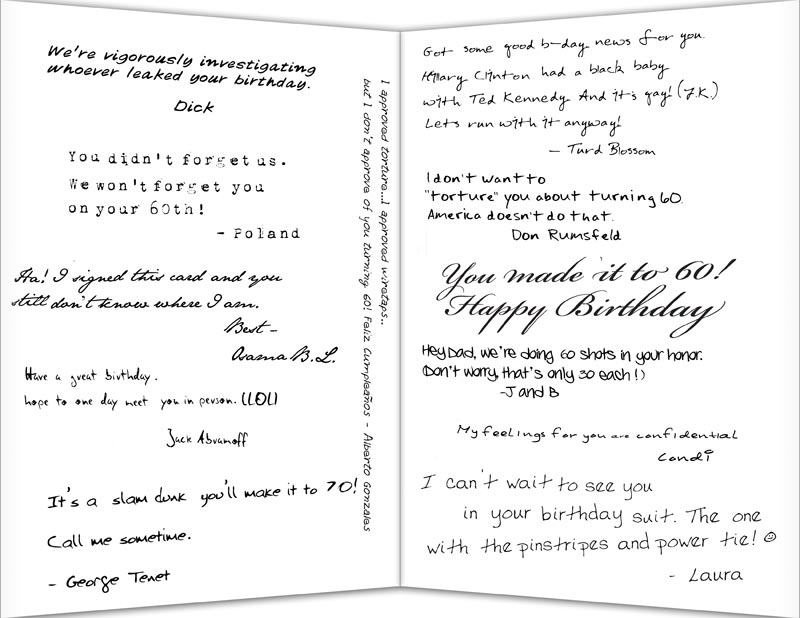
mission accomplished

Enjoy Slate's birthday card to W.

Via Amber

we are not afraid

It's been one year since the London bombings.

I have to say that I admire the British response: somber defiance.

Check out the "We Are Not Afraid" campaign, OpenDemocracy.net, and Citizens Against Terror.

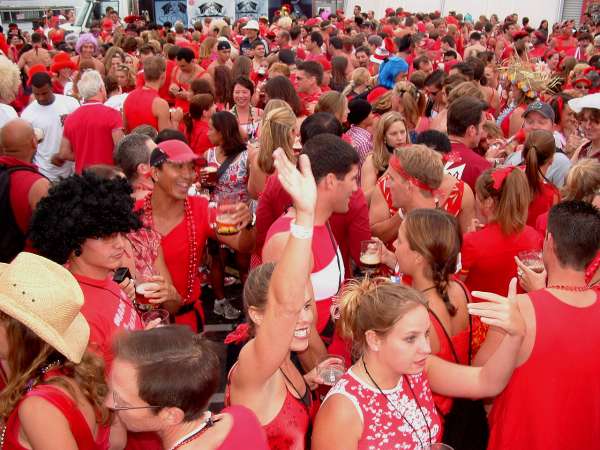
san diego red dress run 2006

It's finally time! I'm doing the Red Dress Run tonight.
The run begins and ends at 1050 N. Harbor Drive (Broadway Pier), near the cruise terminal. Run Start (Hares Off) is at 6:45 p.m.-ish.
Trevor, Nolan, and I bought our dresses last weekend. Nolan's is a fetching psychedelic number with swirly grey, black, and white patterns that form a dizzying symphony in knit polyester.

Trevor's sleeveless cocktail dress is made of a flowy crêpe material and features a plunging neckline and a gathered empire waist, accented with a small rosette underneath his (tasteful) decolletage. Mine is the exact same. But my cleavage isn't as nice as his. (Damn my jogbra!)

If you want to watch the spectacle, be my guest. And bring a camera!

FYI: it's too late to register (the thing filled up months ago), but it's never too late to have a drink and laugh. And to watch hundreds of men and women take to the streets in red dresses and fierce accessories as they raise money for the Challenged Athletes Foundation.

jeudi, juillet 06, 2006

joyeux anniversaire, ma belle


a l'heure
Originally uploaded by comment dit-on.
It's Diana's birthday.

Hope it's filled with good food and great friends!

And that we both get to look out this window again sometime soon.

rioplatense in the house

¡Hola, Mercedes! I hope your mother is feeling better soon.

the original jogo bonito

Pelé


Via Aaron

dogmatic

Brown shirts and armbands optional.

Nazi ship to become vehicle of faith
Wed Jul 5, 2006 07:58 AM ET
ZAGREB (Reuters) - Croatia's defense ministry has donated a World War II Nazi ship to a local Roman Catholic monastery, which will turn it into a sailing church, the Jutarnji List daily newspaper reported Tuesday.

The landing ship DTM-219 was used by Nazi Germany to transport tanks and infantry. It was given to communist Yugoslavia after 1945 as part of war compensation, it said.

The ship, currently anchored at a Croatian navy port, will be towed to the city of Sibenik, in the central Adriatic, where it will be adapted at a local shipyard.

It will be used as sailing church for the young, who will be able to sail the Adriatic, pray and meditate as part of church-sponsored religious cruises, the daily said.

Some 90 percent of Croatia's 4.4 million people are Roman Catholics. The country, which gained independence from Yugoslavia in 1991, hopes to join the European Union by the end of this decade.

mercredi, juillet 05, 2006

das dummkopfen

This may be the funniest thing I've seen in awhile. And it proves that stupidity knows no nationalität. There are idiots everywhere.

Police arrest suspected concrete ball makers
Police believe they have solved the mystery of Berlin's concrete soccer balls.

Two young men suffered slight foot injuries in recent days after kicking concrete-filled balls chained to lamp posts and trees in the capital.

The words "Can u kick it" were sprayed in pink paint close to each of the balls, at least six of which were left in the streets.

Police said they arrested on Wednesday two men, ages 26 and 29, who apparently had set up a workshop to produce the offending balls.

Officers found three new concrete-filled balls, spray cans and chains.

The suspects were being questioned by investigators and could face charges of bodily harm. There was no immediate comment on their possible motive.

Via Leo

zizou, bitches!

Les bleus sont victorieux!
The Champs-Elysées after the French victory against Portugal:


So, it's on to an all-blue (La Squadra Azzurri vs. Les Bleus) final.

bonne chance, les bleus

So I'm torn. I was in Paris for the Euro Cup in 2004 and rooted for Portugal. I came home from that trip with a Portugal jersey and a France jacket.

But my francophilia means that I'm supporting les bleus in today's semi-final match.
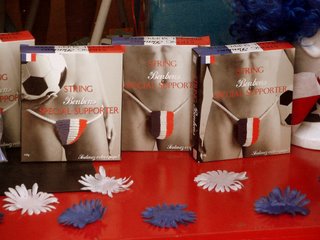
I won't be wearing these "special supporter"s, though. Look closely at these string bikinis — they're bonbons (candy).

Via Paris Daily Photo

quotable

Indeed.

"A dog is the only thing on earth that loves you more than you love yourself."
- Josh Billings (12 April 1818 - 14 October 1885), pen name of the American humorist born Henry Wheeler Shaw.

mardi, juillet 04, 2006

a dedication to the chihuahua in my building

Every so often, my inner Andy Rooney comes out and I complain about people with little dogs. You know the ones — the dogs that are more properly characterized as accessories, as opposed to 'dogs.' (Sidebar: not all little dogs are evil. Nor are all people with little dogs evil. But the fact remains that there are lots of folks who buy a dog when they should just buy a purse instead.)

Anyhow, back to the dogs: it doesn't help that they're often yappy and high-strung. Take, for example, the chihuahua who lives in my building. It spends much of its life whimpering in a high-pitched tone. It turns out I'm not alone in despising the loathsome creatures ... while at the Hillcrest Farmer's Market this Sunday, Leo and I overheard this conversation:

Old, blatantly gay man to his equally old, blatantly gay partner: "God, can't he read the sign?! It says 'no dogs.'"
Partner (in an absentminded tone): "Except for service dogs."
Old, blatantly gay man: "C'mon. That vermin is no service dog."

... which brings me back to the chihuahua in my building. It's 11:52 p.m. and I'm ready to go to bed. But I don't dare open my windows again for fear that I'll hear that varmit. No wonder David Berkowitz went on a rampage.

looking beyond the veil

The styles of Muslim women range from mini-skirts to head-to-toe coverings.

Photographer Kate Brooks talks about capturing fashion - on the streets and on the runways - from Iran to Oman.

Via TIME photoessays

cass' bread pudding and whiskey sauce

Bread pudding
4 eggs
2 cups milk
1/3 cup sugar
1/2 tsp cinnamon
1/4 tsp ground cloves
1/2 tsp vanilla
3 cups bread cubes, dried
1/3 cup golden raisins or dried cranberries

Beat together eggs, milk, sugar, spices, and vanilla. Place bread cubes in large pan. Sprinkle with fruit, cover with remaining bread.

Pour egg mixture over bread. Let milk soak into bread, press down on the bread to make sure that all the bread is soggy.

Bake at 325 for 40-50 minutes or until knife inserted near center comes out clean. Cool slightly and serve warm with whiskey sauce.

Whiskey Sauce
1/4 cup butter
1/2 cup sugar
1 egg yolk (add the extra white to bread pudding)
2 TBSP water
2 TBSP bourbon

Melt butter in saucepan, stir in sugar, and water. Beat egg yolks in a bowl ... slowly add some of the melted butter mixture into the bowl so the egg does not cook, then add it all back into the pan. Bring to a boil, remove from heat, and stir in bourbon. Serve warm.

"he's the e.f. hutton of hip-hop"

"I keep it realer than most,
I know you're feelin' it
Cristal on ice, I like to toast,
I keep on spillin' it."

Jay-Z Puts a Cap on Cristal
By DOUGLAS CENTURY
Published: July 2, 2006
HIP-HOP made Cristal a household name. Can it also unmake it?
Jay-Z called for a boycott of the Champagne after its maker seemed to sniff at its popularity with rap stars, some in the music, night life and beverage industries are predicting a long-term flattening of the $300-a-bottle bubbly.

The first evidence of any effect the boycott might have come Tuesday night in Los Angeles at the BET Awards, which drew an A-list of African-American entertainers like Kanye West, Sean Combs, Mary J. Blige, Prince and Jamie Foxx. But something was missing.

"You normally see Cristal around these festive events, and it was noticeably absent this year," said Marvet Britto, the head of a New York public relations and brand strategy company specializing in the African-American market. "If you saw Champagne on a table, it was Dom Pérignon and Veuve Clicquot." Ms. Britto said this was in stark contrast to last year's MTV Music Awards in Miami, where "you saw people walking the red carpet with Cristal like a badge of honor."

"That's Jay-Z's influence as a tastemaker," she added. "He's the E. F. Hutton of hip-hop."

And what exactly did this E. F. Hutton say about Cristal, whose name he once liberally dropped into his songs as a symbol of the plush life? Two weeks ago, the rapper announced that Cristal would no longer be served at his chain of 40/40 nightclubs, and he called for a consumer boycott. He was reacting to a quotation by Frédéric Rouzaud, the president of Champagne Louis Roederer (maker of Cristal) in The Economist magazine.

Asked by an interviewer if the association with rap's bling-bling set could hurt the brand, Mr. Rouzaud was quoted as saying: "That's a good question, but what can we do? We can't forbid people from buying it." (Mr. Rouzaud later issued a statement saying that the company had "the utmost regard for, and interest in, all forms of art and culture.")

In a phone interview last week, Jay-Z, whose real name is Shawn Carter, said he didn't appreciate the tone of Mr. Rouzaud's initial remarks. "Surely he meant to say, 'Thank you,' right?" Mr. Carter said, referring to the free publicity his and other rappers' music and videos have given the brand over the years. "Anything but a 'Thank you' is racist."

MR. CARTER had also vowed to expunge references to Cristal from his songs at a concert at Radio City Music Hall last Sunday that marked the 10th anniversary of his first album, "Reasonable Doubt." He did so in some songs, but in others — perhaps because it's harder to come up with rhymes for Dom Pérignon — he left the mention of the brand.

"When I was conscious, I could change them," he said by way of explanation. "When I perform sometimes I go in so far. That's where you're supposed to really operate the whole time, on an unconscious level."

Mr. Carter, who once famously rapped, "I'm not a businessman; I'm a business, man," was ranked at No. 16 in Fortune magazine's "40 Under 40" list in 2004 with a net worth of $286 million. Largely retired as a performer, he keeps busy as president of Def Jam records and as a part-owner of the New Jersey Nets basketball team. He is keenly aware of the power of music to build brands. The materialistic mid-90's school of rap he championed, along with Notorious B.I.G. and others, was a beat-heavy version of the Robb Report, full of references to luxury products.

dimanche, juillet 02, 2006

happy birthday, rick

In the words of Dylan, you are "the coolest authority figure ever."

Hope this picture and story remind you of the good times working with us in San Diego ... it was also great seeing you and many of the usual suspects at John's party last week.

Incidentally, this is what you get when you google the onion dog balls.