dimanche, août 06, 2006

b-a-a-a-a

Okay, boys and girls. Here's tonight's free history lesson on the granddaddy of modern marketing. (It's not exactly a coincidence that he's related to Freud. ) But first, a word from our sponsors:

  1. You're all sheep, with your own worth being sold to you in print, sound, and images.
  2. No, all marketers aren't evil. (Editor's note: Just the good ones.)
Freud's nephew, Edward Bernays, died in 1998 at the age of 105. He was the founding father of modern advertising. During World War I, Bernays was hired by President Woodrow Wilson to participate in the Creel Commission, the mission of which was to sway popular opinion in favor of entering the war, on the side of Britain. The war propaganda campaign of Bernays produced such an intense anti-German hysteria as to permanently impress American business with the potential of large-scale propaganda to control public opinion.

In 1928, Edward Bernays wrote:

    The conscious and intelligent manipulation of the organized habits and opinions of the masses is an important element in democratic society. Those who manipulate this unseen mechanism of society constitute an invisible government which is the true ruling power of our country. Hollywood and the Pentagon have a long history of making movies together.
    Here's a link to an article, The Incorporation of Dreams: Freud's Machiavellian public relations relation and how he sold the world on capitalism, in which Dennis Lim wrote:


    The Century of the Self, an engrossing quartet of hour-long films by British documentarian Adam Curtis, doesn't so much challenge Freud's theories of the unconscious as shadow them through the corridors of corporate and political power. What emerges is nothing less than a history of 20th-century social control. Installing Freud as unwitting godfather, Curtis fingers Edward Bernays, Freud's American nephew, as the Machiavellian mastermind who first thought to introduce psychoanalytic techniques into the sphere of big business. The true subject of Curtis's lucid, pessimistic film, it turns out, is the frightening adaptability of consumer capitalism.
    Watch the film at Information Clearing House.

    Now do your best to stop bleating and listen to Bill Hicks:
    By the way, if anyone here is in advertising or marketing, kill yourself. Thank you, thank you. Just a little thought. I'm just trying to plant seeds. Maybe one day they'll take root. I don't know. You try. You do what you can. Kill yourselves. Seriously though, if you are, do. No really, there's no rationalisation for what you do, and you are Satan's little helpers, OK? Kill yourselves, seriously. You're the ruiner of all things good. Seriously, no, this is not a joke. There's gonna be a joke coming ... There's no fucking joke coming, you are Satan's spawn, filling the world with bile and garbage, you are fucked and you are fucking us, kill yourselves, it's the only way to save your fucking soul. Kill yourself, kill yourself, kill yourself now. Now, back to the show.
    Via Why Work?

    jeudi, août 03, 2006

    más paella, por favor

    Sunday's paella party for Leo's parents was an unqualified success. Special thanks to Jason and Ash for hosting and everyone for making it a quite fun day.

    The first paella (a traditional Valenciana) had rabbit, chicken, chorizo, and artichokes in it. The second included chicken, chorizo, shrimp, and mussels.


    mercredi, août 02, 2006

    the name's not 007

    It looks like my parents could've have named me "Angry" if I had been born in Malaysia today. But Apple, 007, Camry, and Smelly Head would've been illegal.
    Malaysia outlaws unsuitable baby namesMalaysian authorities have published a list of undesirable titles to prevent parents giving their children names such as Hitler, smelly dog or 007.
    Such choices are not allowed, but there is a right of appeal.

    The list came as a response to the growing number of Malaysians who are applying to change their birth names.

    Malaysia's National Registration Department made the decision after consulting with various religious bodies in the country.

    They represented the country's Muslim, Christian, Hindu, Buddhist and Taoist communities.

    Traditionally, some groups have given newborns inauspicious names to ward off demons and evil spirits.

    Further restrictions
    Now names like the Hokkien Chinese Ah Chwar, meaning snake, and Khiow Khoo, meaning hunchback, are being ruled out.

    So too are Cantonese monikers Chow Tow, meaning smelly head, and Sor Chai, meaning insane.

    Members of Malaysia's Tamil community will be discouraged from using the likes of Karrupusamy (black god), and Malays from trying names like Woti, meaning sexual intercourse.

    But the ban extends further.

    Parents will not be able to call their babies after animals, insects, fruit, vegetables or colours.

    Numbers are also not allowed, so little James Bonds cannot flaunt their 007 status on their ID cards.

    Other restrictions stop parents giving children royal or honorary titles as names or calling their little ones after Japanese cars.
    Via Baglady

    the paki mack agenda

    This weekend, Omer delivered the much-awaited (and deservedly hyped) Paki Mack Agenda, Volumes I-V. The cds include tunes from France, Colombia, Algeria, Argentina, India, Spain, Senegal, Egypt (well, you get the point). The Agenda is a hit with Leo's parents, the paella peeps, Suzi, and pretty much everyone who hears it.

    It was only natural for me to instantly love the cheesiest songs. This one's from Juanes:
    Que mis ojos se despierten con la luz de tu mirada, yo
    A Dios le pido que mi madre no se muera y que mi padre me recuerde,
    A Dios le pido que te quedes a mi lado y que más nunca te me vayas, mi vida,
    A Dios le pido que mi alma no descanse cuando de amarte se trate, mi cielo
    A Dios le pido por los días que me quedan y las noches que aún no llegan yo
    A Dios le pido por los hijos de mis hijos y los hijos de tus hijos
    A Dios le pido que mi pueblo no derrame tanta sangre y se levante mi gente,
    A Dios le pido que mi alma no descanse cuando de amarte se trate, mi cielo
    Un segundo más de vida para darte y mi corazón entero entregarte
    Un segundo más de vida para darte y a tu lado para siempre yo quedarme
    Un segundo más de vida yo a Dios le pido
    Que si me muero sea de amor y si me enamoro sea de vos y que de tu voz sea este corazón todos los días
    A Dios le pido y que si me muero sea de amor y si me enamoro sea de vos y que de tu voz sea este corazón todos los días a Dios le pido,
    A Dios le pido ...

    mardi, août 01, 2006

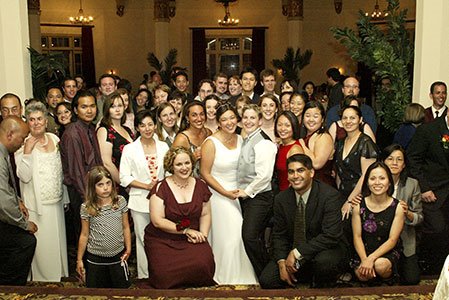
    happy anniversary, d and ophy

    Perhaps it was Omer's visit that reminded me.

    Or maybe it was all the gay pride flags around town this weekend.

    Either way, I was thrilled to be part of Diana and Ophira's commitment ceremony two years ago.

    D and Ophy — I had such a great time at your wedding. I'm honored that you included me in your special day.

    And I'm so proud of you for making a public (and political) statement declaring your love to your friends, family, and the world.

    Here's hoping that the law catches up with reality sooner rather than later ...

    lundi, juillet 31, 2006

    three years on ...

    I realized a few seconds ago that July 29 has come and gone. The day that was pretty much the Krakatoa of my life a few years ago was wonderful this year. What a difference three years makes.

    jeudi, juillet 27, 2006

    san diego eats

    Check out the local's guide to san diego eats.

    I mostly agree with Doug. He's missing a few key spots (Dao Son, Saffron, The Mission, Lorna's Italian Kitchen, Ashoka the Great), but otherwise he's spot-on.

    By the looks of the list: work in progress, he's obviously in my neighborhood — most of the places are within two miles of my house.

    like, duh.

    This e-mail from Diana yesterday just killed me.

    "press release. this just in. lance from nsync says he is gay.
    no, REALLY???
    all my hopes dashed upon the rocks.
    couldn't see that from a freakin' mile away.

    happy gay pride weekend."

    mardi, juillet 25, 2006

    what's your eco footprint?

    I recycle. I buy organic most of the time. I live less than 5 miles from work. I don't drive an SUV. I even carpool every chance I get.

    And, compared to most Americans, I have a pretty small ecological footprint. But the fact remains that if everyone lived like me, we'd need 3.7 planets. Al Gore would be so disappointed in me ...

    some people call me the retarded cowboy ...

    I'm not sure why I think this is so funny. But I do.

    The Joker (Steve Miller Does Dubya)
    Some people call me the retarded cowboy, yeah
    Some call me the gangster of hate
    Some people call me “Boy Ki -iiiiiiiiiiiiing”
    Cause I’m anointed, with too much on my plate

    People talk about me, Kofi
    Say I’m doin’ the world wrong, doin’ it wrong
    Well, don’t you worry, Kofi
    Don’t worry
    Cause while the world’s on fire, Condi and I’ll stay home

    Cause I’m a groper
    I’m a doper
    I’m a mother
    An interloper
    I screw the world up just for fun

    I’m a joker
    I’m a coker
    I’m a pretzel choker
    I sure don’t want to help no one

    Iraq’s the biggest prize
    That I ever did see
    I really love its Shiites
    Who are killin’ Sunnis
    Murder-mayhem, murder-mayhem, murder-mayhem all the time
    Ooo-eee, Kofi, I’ll sure show you a war crime

    I’m a decider
    I’m a grinner
    I’m a frat boy
    I’m a sinner
    I play my role as modern Hun

    I’m a joker
    I’m a coker
    I’m a Halliburton broker
    I get my briefings on the run
    Wooo wooooo

    People talk about me, Kofi
    Say I’m doin’ the world wrong, doin’ it wrong
    Well, don’t you worry, Kofi
    Don’t worry
    Cause while the world’s on fire, Condi and I’ll stay home

    Iraq’s the biggest prize
    That I ever did see
    I really never heard of Shiites
    Or even Sunnis
    Murder-mayhem, murder-mayhem, murder-mayhem on our dime
    Ooo-eee, Kofi, we’ll be there for all time

    Via One Good Move

    no, seriously. stop.

    My French phrase a day calendar currently says:
    Je ne peux pas me passer de chocolate.
    Translation: I can't live without chocolate.

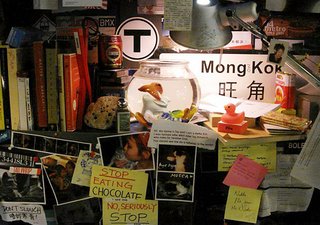
    So I laughed when I saw this photo in Time Magazine's All Cubed In photoessay.

    rolling blackouts here we come (do dah, do dah)

    The last time the California Independent System Operator issued a Stage Two Electrical Emergencies on a regular basis, I was working across town with Rick and a rolling blackout was my code word for a nap.

    Sadly, soaring temperatures have led us back into an energy crisis. Hopefully, my electric bill won't triple like it did in that deregulated (AKA evil, colluding energy companies using the heat as an excuse for price-gouging and rampant profiteering) market.

    But a nap does sound mighty good right about now ...

    kitchen conversation with allison yesterday

    A: So I saw this story on CNN Money today about cooking oil-powered cars.
    **enter cartoon sound effect: the sound of a needle scratching the shit out of a 12-inch vinyl record **
    H: Wait a second. Did you just say "I saw this story on CNN Money today"?
    A: Shut up. Anyway ...
    H: My god, what is this world coming to?! We are MBA dorks.

    lundi, juillet 24, 2006

    thou shalt not be a hypocrite

    Check out Stephen Colbert's interview with Georgia congressman Lynn Westmoreland.

    Westmoreland, a republican, is co-sponsor of a bill on the ten commandments, but can't even name them.
    Via Jennifer and Allison

    academic freedom

    I work in a university. I hear the term "academic freedom" a lot. A whole lot. This op-ed piece helped me clarify what academic freedom is, and isn't.

    The Cliffs Notes version:
    ... academic freedom has nothing to do with content. Rather, academic freedom is the freedom of academics to study anything they like; the freedom, that is, to subject any body of material, however unpromising it might seem, to academic interrogation and analysis.

    In short, whether something is an appropriate object of academic study is a matter not of its content ... but of its availability to serious analysis.

    Any idea can be brought into the classroom if the point is to inquire into its structure, history, influence and so forth. But no idea belongs in the classroom if the point of introducing it is to recruit your students for the political agenda it may be thought to imply.

    Conspiracy Theories 101
    By STANLEY FISH
    Published: July 23, 2006
    KEVIN BARRETT, a lecturer at the University of Wisconsin at Madison, has now taken his place alongside Ward Churchill of the University of Colorado as a college teacher whose views on 9/11 have led politicians and ordinary citizens to demand that he be fired.

    Mr. Barrett, who has a one-semester contract to teach a course titled “Islam: Religion and Culture,” acknowledged on a radio talk show that he has shared with students his strong conviction that the destruction of the World Trade Center was an inside job perpetrated by the American government. The predictable uproar ensued, and the equally predictable battle lines were drawn between those who disagree about what the doctrine of academic freedom does and does not allow.

    Mr. Barrett’s critics argue that academic freedom has limits and should not be invoked to justify the dissemination of lies and fantasies. Mr. Barrett’s supporters (most of whom are not partisans of his conspiracy theory) insist that it is the very point of an academic institution to entertain all points of view, however unpopular. (This was the position taken by the university’s provost, Patrick Farrell, when he ruled on July 10 that Mr. Barrett would be retained: “We cannot allow political pressure from critics of unpopular ideas to inhibit the free exchange of ideas.”)

    Both sides get it wrong. The problem is that each assumes that academic freedom is about protecting the content of a professor’s speech; one side thinks that no content should be ruled out in advance; while the other would draw the line at propositions (like the denial of the Holocaust or the flatness of the world) considered by almost everyone to be crazy or dangerous.

    But in fact, academic freedom has nothing to do with content. It is not a subset of the general freedom of Americans to say anything they like (so long as it is not an incitement to violence or is treasonous or libelous). Rather, academic freedom is the freedom of academics to study anything they like; the freedom, that is, to subject any body of material, however unpromising it might seem, to academic interrogation and analysis.

    Academic freedom means that if I think that there may be an intellectual payoff to be had by turning an academic lens on material others consider trivial — golf tees, gourmet coffee, lingerie ads, convenience stores, street names, whatever — I should get a chance to try. If I manage to demonstrate to my peers and students that studying this material yields insights into matters of general intellectual interest, there is a new topic under the academic sun and a new subject for classroom discussion.

    In short, whether something is an appropriate object of academic study is a matter not of its content — a crackpot theory may have had a history of influence that well rewards scholarly scrutiny — but of its availability to serious analysis. This point was missed by the author of a comment posted to the blog of a University of Wisconsin law professor, Ann Althouse: “When is the University of Wisconsin hiring a professor of astrology?” The question is obviously sarcastic; its intention is to equate the 9/11-inside-job theory with believing in the predictive power of astrology, and to imply that since the university wouldn’t think of hiring someone to teach the one, it should have known better than to hire someone to teach the other.

    But the truth is that it would not be at all outlandish for a university to hire someone to teach astrology — not to profess astrology and recommend it as the basis of decision-making (shades of Nancy Reagan), but to teach the history of its very long career. There is, after all, a good argument for saying that Shakespeare, Chaucer and Dante, among others, cannot be fully understood unless one understands astrology.

    The distinction I am making — between studying astrology and proselytizing for it — is crucial and can be generalized; it shows us where the line between the responsible and irresponsible practice of academic freedom should always be drawn. Any idea can be brought into the classroom if the point is to inquire into its structure, history, influence and so forth. But no idea belongs in the classroom if the point of introducing it is to recruit your students for the political agenda it may be thought to imply.

    And this is where we come back to Mr. Barrett, who, in addition to being a college lecturer, is a member of a group calling itself Scholars for 9/11 Truth, an organization with the decidedly political agenda of persuading Americans that the Bush administration “not only permitted 9/11 to happen but may even have orchestrated these events.”

    Is the fact of this group’s growing presence on the Internet a reason for studying it in a course on 9/11? Sure. Is the instructor who discusses the group’s arguments thereby endorsing them? Not at all. It is perfectly possible to teach a viewpoint without embracing it and urging it. But the moment a professor does embrace and urge it, academic study has ceased and been replaced by partisan advocacy. And that is a moment no college administration should allow to occur.

    Provost Farrell doesn’t quite see it that way, because he is too hung up on questions of content and balance. He thinks that the important thing is to assure a diversity of views in the classroom, and so he is reassured when Mr. Barrett promises to surround his “unconventional” ideas and “personal opinions” with readings “representing a variety of viewpoints.”

    But the number of viewpoints Mr. Barrett presents to his students is not the measure of his responsibility. There is, in fact, no academic requirement to include more than one view of an academic issue, although it is usually pedagogically useful to do so. The true requirement is that no matter how many (or few) views are presented to the students, they should be offered as objects of analysis rather than as candidates for allegiance.

    There is a world of difference, for example, between surveying the pro and con arguments about the Iraq war, a perfectly appropriate academic assignment, and pressing students to come down on your side. Of course the instructor who presides over such a survey is likely to be a partisan of one position or the other — after all, who doesn’t have an opinion on the Iraq war? — but it is part of a teacher’s job to set personal conviction aside for the hour or two when a class is in session and allow the techniques and protocols of academic research full sway.

    This restraint should not be too difficult to exercise. After all, we require and expect it of judges, referees and reporters. And while its exercise may not always be total, it is both important and possible to make the effort.

    Thus the question Provost Farrell should put to Mr. Barrett is not “Do you hold these views?” (he can hold any views he likes) or “Do you proclaim them in public?” (he has that right no less that the rest of us) or even “Do you surround them with the views of others?”

    Rather, the question should be: “Do you separate yourself from your partisan identity when you are in the employ of the citizens of Wisconsin and teach subject matter — whatever it is — rather than urge political action?” If the answer is yes, allowing Mr. Barrett to remain in the classroom is warranted. If the answer is no, (or if a yes answer is followed by classroom behavior that contradicts it) he should be shown the door. Not because he would be teaching the “wrong” things, but because he would have abandoned teaching for indoctrination.

    The advantage of this way of thinking about the issue is that it outflanks the sloganeering and posturing both sides indulge in: on the one hand, faculty members who shout “academic freedom” and mean by it an instructor’s right to say or advocate anything at all with impunity; on the other hand, state legislators who shout “not on our dime” and mean by it that they can tell academics what ideas they can and cannot bring into the classroom.

    All you have to do is remember that academic freedom is just that: the freedom to do an academic job without external interference. It is not the freedom to do other jobs, jobs you are neither trained for nor paid to perform. While there should be no restrictions on what can be taught — no list of interdicted ideas or topics — there should be an absolute restriction on appropriating the scene of teaching for partisan political ideals. Teachers who use the classroom to indoctrinate make the enterprise of higher education vulnerable to its critics and shortchange students in the guise of showing them the true way.

    inspiration comes in many forms


    I saw Lulu & Philippe's gorgeous photos this morning and then my RSS feed served up these food photography tips. Here are some others:
    1. Never use a flash. If you're in a restaurant, choose a table near a window. "The flash flattens everything out," says photographer John Kernick. When that's not possible, choose one of the camera's "white balance" settings; for example, the setting indicated by a light bulb compensates for the yellow tint indoor lights can cast.
    2. Get in close. "If you fill the frame with the dish, it can make the food look heroic," says photographer James Baigrie. Use a camera's macro setting (often indicated by a flower icon) to bring a part of the dish into sharper focus. Or widen the aperture to reduce the depth of field, which allows you to focus on foreground details—say, the crusty corner on a dish of macaroni and cheese—and keep the background soft.
    3. Wipe glasses and plate edges. Be sure surfaces are free of smudges and greasy fingerprints, says food stylist Alison Attenborough. In good light, they really stand out.
    4. Work quickly. The longer it takes to set up a shot, the more salads wilt, sauces congeal. "For food to look delicious, it needs to look fresh," says Baigrie.
    5. Keep hands steady. In low-light conditions, even the slightest tremor can produce a blurry photograph. Brace your elbows against the table to keep the camera steady. Or try thefoodsection.com blogger Josh Friedland's trick: He often uses the top of a water glass as a makeshift tripod.
    6. Shoot a lot. "A photo may seem [okay] on the camera's tiny screen," says Chika Yoshizaki, the blogger at shewhoeats.blogspot.com. "But when I get home and look on my computer, it is likely to be out of focus or too bright. So I click away."
    7. Shoot food as it's being prepared. "Don't get hung up on capturing the quintessential 'final shot,'" says 101cookbooks.com blogger Heidi Swanson. "There are all sorts of great details that emerge throughout the cooking process."
    8. Know what not to shoot. Some foods are notoriously unphotogenic—for example, a meal that's all one color or dishes with brown sauces.
    9. Do your homework. For other tips, skim the food-photo discussion boards at flickr.com. —Rob Willey

    dimanche, juillet 23, 2006

    brownlash and you

    "Brownlash" is a term coined last year by Paul and Anne Ehrlich to describe "a deliberate attempt to minimize the seriousness of environmental problems through misuse or misreporting of science." Here's a prime example:

    Manufactured Doubt: New product for U.S. industry
    Industries growing adept at manipulating science to suit their needs
    By
    Jeff Nesmith,WASHINGTON BUREAU
    Sunday, June 26, 2005
    WASHINGTON — In the 1970s, facing the loss of millions of dollars in sales because of fears that chemicals it produced were shredding the Earth's protective ozone layer, DuPont Corp. fought for time.

    It got what it wanted.

    A carefully designed campaign by the Hill and Knowlton public relations firm attacked the science behind the ozone depletion fears and delayed government action for two years, enough time for DuPont to bring new, ozone-friendly chemicals to market.

    The campaign employed a tactic that is now being used by more and more industries to ward off costly government action, says George Washington University epidemiologist David Michaels.

    He calls it "manufactured doubt."

    By generating and publicizing uncertainty about the scientific underpinnings of proposed action on air pollution, global warming, the health effects of tobacco and other subjects, industries have been able to ward off regulation and buy valuable time, Michaels said.

    Now, with the Bush administration's skepticism about regulation, the "manufactured doubt" tactic is more effective than ever before, Michaels wrote in the current edition of Scientific American.

    "Industry groups have tried to manipulate science no matter which party is in power," he wrote, "but the efforts have grown more brazen since George W. Bush became president. I believe it is fair to say that never in our history have corporate interests been as successful as they are today in shaping science policies to their desires."

    Michaels' article was published shortly before The New York Times reported that a White House official — a former American Petroleum Industry lobbyist with no scientific training — had edited government reports on climate change research, inserting numerous expressions of doubt.

    The official, Philip Cooney, resigned his position at the White House Council on Environmental Quality this month after the White House confirmed that he repeatedly inserted phrases that played down links between greenhouse gases and global warming. He has gone to work for ExxonMobil, according to industry reports. The White House says the resignation was planned before the story appeared.

    Bob Hopkins, a spokesman for the White House Office of Science and Technology Policy, said Michaels' article was a "pretty one-sided presentation."
    "Advocates on all sides try to use data to support their policy goals," Hopkins said. "This administration strongly believes that decisions should be made using the best science available."

    In the case of DuPont, a former Hill and Knowlton executive said the firm did seek to delay government action, but did not bend or hide any facts in doing so.
    After the first scientific paper warned in 1974 that chlorofluorocarbons, chemicals widely used as coolants, solvents and aerosol propellants, were responsible for a huge "hole" in the ozone layer protecting the Earth against dangerous ultraviolet radiation, Hill and Knowlton set up a "quick response" campaign to react to the findings and to temper critical press accounts.

    According to a memorandum on the campaign written in 1989 by Howard Marder, then a Hill and Knowlton senior vice president, DuPont wanted the firm "to help calm fears, get better reporting of the issues and gain up to two or three years before the government took action to ban" the chemicals.

    When the evidence against CFCs mounted, DuPont dropped its opposition to a ban. The chemicals were barred from aerosol sprays in 1978.

    By that time, Marder wrote, "DuPont gained much-needed time to find scientific answers to the allegations and to develop alternatives" to CFCs.

    Marder, now a spokesman for the New York City Housing Authority, said that he did not remember details of the memorandum but that his purpose at Hill and Knowlton was to get the truth out.

    "I would never obfuscate an issue, and I would never spin an issue," he said. "My intention when I worked for Hill and Knowlton was to have the truth be told."
    Michaels, a former assistant secretary of energy in the Clinton administration, acknowledged in an interview that an element of doubt was inevitable in government regulatory decisions because they must be based on the best available science, which by definition can never be absolute.

    However, "corporations and others who manufacture dangerous products and pollutants have realized that by adding manufactured uncertainty to the equation, they can essentially stop the regulatory process from moving forward," he said.
    He said consulting firms hired by industries review critical scientific findings "and pull these studies apart."

    "Industry is able to pick a key point that can destroy a regulation, and they take that one on," he said. "The government scientists are just outgunned. They use basic research, and when their research is attacked, they don't go back and do more research. There's no funding for that."

    "The vilification of threatening research as 'junk science' and the corresponding sanctification of industry-commissioned research as 'sound science' has become nothing less than standard operating procedure in some parts of corporate America," he wrote in the magazine article.

    Although the practice "goes back a long time," it was perfected by the tobacco industry, Michaels said.

    He said one tobacco company executive wrote in a memorandum, which later came to light in tobacco litigation, that "doubt is our product, since it is the best means of competing with as 'body of fact' that exists in the mind of the general public" that smoking is linked to serious health problems.

    William O'Keefe, CEO of the George C. Marshall Institute, a nonprofit organization that has repeatedly promoted the views of scientists who question the prevailing opinion that use of fossil fuels are raising the globe's temperature, said he felt Michaels "had an agenda (in writing the article), and he picked examples to promote it."

    A former executive of the American Petroleum Institute, O'Keefe said Michaels "takes the position that the government is always right and the private sector is always wrong, and I don't believe that."

    "My experience in 25 years in the petroleum industry is that companies are not in business to harm their clients," he said.

    If industry insists that regulations "meet the highest possible standards, I don't know what's wrong with that," O'Keefe said.

    Via Austin American-Statesman

    swift boating the planet

    Swiftboating is American political jargon for an ad hominem attack against a public figure, coordinated by an independent or pseudo-independent group, usually resulting in a benefit to an established political force. Specifically, this form of attack is controversial, easily repeatable, and difficult to verify or disprove because it is generally based on personal feelings or recollections.

    Swift Boating the Planet
    By Paul Krugman
    Published: May 29, 2006
    A brief segment in "An Inconvenient Truth" shows Senator Al Gore questioning James Hansen, a climatologist at NASA, during a 1989 hearing. But the movie doesn't give you much context, or tell you what happened to Dr. Hansen later.

    And that's a story worth telling, for two reasons. It's a good illustration of the way interest groups can create the appearance of doubt even when the facts are clear and cloud the reputations of people who should be regarded as heroes. And it's a warning for Mr. Gore and others who hope to turn global warming into a real political issue: you're going to have to get tougher, because the other side doesn't play by any known rules.

    Dr. Hansen was one of the first climate scientists to say publicly that global warming was under way. In 1988, he made headlines with Senate testimony in which he declared that "the greenhouse effect has been detected, and it is changing our climate now." When he testified again the following year, officials in the first Bush administration altered his prepared statement to downplay the threat. Mr. Gore's movie shows the moment when the administration's tampering was revealed.

    In 1988, Dr. Hansen was well out in front of his scientific colleagues, but over the years that followed he was vindicated by a growing body of evidence. By rights, Dr. Hansen should have been universally acclaimed for both his prescience and his courage.

    But soon after Dr. Hansen's 1988 testimony, energy companies began a campaign to create doubt about global warming, in spite of the increasingly overwhelming evidence. And in the late 1990's, climate skeptics began a smear campaign against Dr. Hansen himself.

    Leading the charge was Patrick Michaels, a professor at the University of Virginia who has received substantial financial support from the energy industry. In Senate testimony, and then in numerous presentations, Dr. Michaels claimed that the actual pace of global warming was falling far short of Dr. Hansen's predictions. As evidence, he presented a chart supposedly taken from a 1988 paper written by Dr. Hansen and others, which showed a curve of rising temperatures considerably steeper than the trend that has actually taken place.

    In fact, the chart Dr. Michaels showed was a fraud — that is, it wasn't what Dr. Hansen actually predicted. The original paper showed a range of possibilities, and the actual rise in temperature has fallen squarely in the middle of that range. So how did Dr. Michaels make it seem as if Dr. Hansen's prediction was wildly off? Why, he erased all the lower curves, leaving only the curve that the original paper described as being "on the high side of reality."

    The experts at
    www.realclimate.org, the go-to site for climate science, suggest that the smears against Dr. Hansen "might be viewed by some as a positive sign, indicative of just how intellectually bankrupt the contrarian movement has become." But I think they're misreading the situation. In fact, the smears have been around for a long time, and Dr. Hansen has been trying to correct the record for years. Yet the claim that Dr. Hansen vastly overpredicted global warming has remained in circulation, and has become a staple of climate change skeptics, from Michael Crichton to Robert Novak.

    There's a concise way to describe what happened to Dr. Hansen: he was Swift-boated.

    John Kerry, a genuine war hero, didn't realize that he could successfully be portrayed as a coward. And it seems to me that Dr. Hansen, whose predictions about global warming have proved remarkably accurate, didn't believe that he could successfully be portrayed as an unreliable exaggerator. His first response to Dr. Michaels, in January 1999, was astonishingly diffident. He pointed out that Dr. Michaels misrepresented his work, but rather than denouncing the fraud involved, he offered a rather plaintive appeal for better behavior.

    Even now, Dr. Hansen seems reluctant to say the obvious. "Is this treading close to scientific fraud?" he recently asked about Dr. Michaels's smear. The answer is no: it isn't "treading close," it's fraud pure and simple.

    Now, Dr. Hansen isn't running for office. But Mr. Gore might be, and even if he isn't, he hopes to promote global warming as a political issue. And if he wants to do that, he and those on his side will have to learn to call liars what they are.

    Via The New York Times

    vendredi, juillet 21, 2006

    pharmacogenetics and you

    Medicine is a law of averages. The average person with sympton X has condition Y. And the average person given drug A will respond with side effects B, C, and / or D. That would work just fine if weren't for the fact that we're not all average people.

    Everyone's body breaks down prescription drugs differently and new genetic tests for certain drugs show what's best for different people.

    NPR : Gene Test Promises to Find Right Drug, Right Dose
    Doc, what can you tell me about pharmacogenetics?

    If you pose that question to your physician, you want to find out whether a medication you're taking (or are about to take) is the right dose (and the right drug) for your body. Pharmacogenetics is the science of using genetic tests to fine-tune prescriptions. But it's so new, your doctor might not be aware of it.

    Tests are available, or soon to be available, for a number of medical conditions. Finding the right drug and the right dose is part of the art of medicine. A genetic test designed to help doctors determine just that is being sold by The Mayo Clinic, it announced this week. The test is part of a new science called pharmacogenetics.

    Finding the Right Drug
    A few years ago, doctors were having trouble finding the right drug for Marla Flood's son Jacob. Jacob has autism and a long history of biting, hitting, kicking and scratching, his mother says.

    "We had probably tried every drug there is for the treatment of his aggressiveness, his obsessive-type behaviors," Flood says. "He always had a negative reaction, either an increase in aggression or just some side effects that were very harmful to him."

    Jacob’s doctor, autism expert Patty Manning-Courtney at Cincinnati Children's Hospital and Medical Center, says it's not that uncommon in children.

    "Occasionally there are patients who didn't respond or were, in fact, worse on meds," Manning-Courtney says. "In children with autism, it's a lot of trial-and error-practice with medicines."

    Jacob was given Risperdal, a powerful antipsychotic drug that helps many children with autism and behavior problems. But it didn’t help Jacob, his mother says.

    "Jake started having tremors; he would just shake all over, unable to focus," Flood says. "I would give him his medication; he would sit on my lap and just be a zombie. That's the only way I can describe what he looked like."

    Testing Drug-Metabolizing Genes
    Jacob's hospital is a pioneer in the new field of pharmacogenetic testing. It offers tests for two genes that produce enzymes that break down drugs. These genes control how the body metabolizes 25 percent of all drugs, including some used for autism.

    Dr. Manning ordered the tests for Jacob. Results showed that he is part of a small minority that metabolizes drugs differently.

    A normal dose of Risperdal was actually an overdose for Jacob. So Marla Flood agreed to start her son back on the drug -- at an extra-low dose.

    "Now he's not near as aggressive as he has been," Flood says. "I don't have bruises on me now."

    More Research Necessary
    The promise of pharmacogenetic testing is that people get the right dose of the right drug. Sometimes the tests show that a drug doesn't work. For example, codeine, a pain reliever, cannot be broken down by seven percent of whites and two percent of blacks. These people get the side effects and none of the pain relief.

    Commercial tests are available, but only one is approved by the Food and Drug Administration. It costs about $300. Some university hospitals do their own testing, and the Mayo Clinic offers some tests nationally.

    Pharmacogenetics pioneer David Flockhart of Indiana University says the question is who should be tested and when. Eventually, people may be tested at birth, he says.

    The FDA already recommends that doctors consider a gene test before prescribing the breast cancer drug Herceptin and the attention-deficit and hyperactivity drug Strattera.

    But Flockhart says it will take more research before doctors embrace the tests. So what should patients currently taking drugs do if the drug doesn’t seem to be working, or if it is creating bad side effects?

    Flockhart says patients are their own best advocates and should consult a physician.

    Other experts, including Russ Altman of Stanford University, say pharmacogenetics is such a new science that most doctors didn't learn about it in medical school. Clinicians have to find a laboratory that offers the test and learn how to read the results, he says.

    For additional information on pharmacogenetics, visit the
    National Institutes of Health site. Or read this explainer at the Food and Drug Administration's site.
    Via NPR

    jeudi, juillet 20, 2006

    and we shall call them avocados

    I detest avocados. (But I realize that I am very much in the minority on this one.)

    I was fascinated to learn how the fruit got its English name and that the Aztec word for avocado, ahuacate, means testicle.

    shooting the shi...

    I heart ze frank.

    Check out Wednesday's the show with zefrank to learn what Bush said to Tony Blair re: Hezbollah when he didn't know his microphone was still on at the G8 summit.

    And yes, we don't torture. We freedom tickle.

    mercredi, juillet 19, 2006

    equals

    Nothing ventured, nothing gained.

    it's in the water

    I'm taking a business ethics class right now. (Spare me the oxymoron jokes. I'm way ahead of you.)

    Reason #295,438,211 that I see most corporations as evil incarnate: Atrazine.

    Atrazine is a powerful herbicide applied to 70% of America's cornfields. Traces of the chemical routinely turn up in American streams and wells and even in the rain; the F.D.A. also finds residues of Atrazine in our food.

    So what? The chemical was recently banned by the European Union and is a suspected carcinogen and endocrine disruptor that has been linked to low sperm counts among farmers. A couple of years ago, a U.C. Berkeley herpetologist named Tyrone Hayes, while doing research on behalf of Syngenta (Atrazine's manufacturer) found that even at concentrations as low as 0.1 part per billion, the herbicide will chemically emasculate a male frog, causing its gonads to produce eggs — in effect, turning males into hermaphrodites.

    Atrazine is often present in American waterways at much higher concentrations than 0.1 part per billion. But American regulators generally won't ban a pesticide until the bodies, or cancer cases, begin to pile up — until, that is, scientists can prove the link between the suspect molecule and illness in humans or ecological catastrophe. So Atrazine is, at least in the American food system, deemed innocent until proved guilty — a standard of proof extremely difficult to achieve, since it awaits the results of chemical testing on humans that we, rightly, don't perform.
    Via the New York Times

    mardi, juillet 18, 2006

    eye color calculator

    A friend of mine who is currently pregnant sent me this site: What Color Eyes Would Your Children Have?

    I especially liked her comment: "I love that we have scientists who can grok stuff like quantum physics, but there are aspects of eye color that we still don't understand. Mysteries like that are so cool!"

    My only disappointment with the site: my eyes are hazel and the system only accepts blue, green, and brown as inputs.

    it means "peace"

    I had more fun at Balkan Beat Box than I did at any other show at Bonnaroo.

    The group includes percussion and keyboards and beat boxing and singing, and well ... you get the picture.

    The crowd was rocking out at 3 a.m. when the band dedicated a song to "bad boy Bush."

    You could sense that the crowd wasn't sure if we should support what they were singing about or not, as it was in a language most of us didn't understand.

    When the lead singer clarified "it means peace" — we were all a bit relieved and (of course) screamed for peace.

    an energy tax

    This is an interesting idea.

    The Big Idea: An Energy Tax
    by Charles Wheelan, Ph.D.
    July 5, 2006
    I had lunch not long ago with a fund-raiser for a prospective presidential candidate. He admitted that his candidate is still looking for a "big idea."

    I won't say who the candidate is, or even what party he or she belongs to, but I will offer a "big idea" for whoever wants to take it. Since this proposal isn't inherently liberal or conservative (arguably it's both), it would work for a Republican or a Democrat, provided he or she has the backbone for it.

    So here's the idea: Create a carbon tax -- basically a tax on energy calculated based on its carbon content -- and use the new revenue to provide offsetting cuts in the income tax, the payroll tax (the tax on wages used to fund Social Security), or both.

    The whole package should be revenue neutral, meaning that it will not increase or decrease the total amount of revenue the government collects. The money will simply come from different sources.

    High Price, Low Demand
    Yes, I'm arguing that we should increase your taxes and cut your taxes at the same time. To understand why that makes sense, you must appreciate an often-overlooked feature of taxation: Taxing something does not merely raise revenue; it also changes behavior.

    If we tax red sports cars more than blue sports cars, some car buyers are going to switch from red to blue. In real life, even taxes on addictive products like cigarettes have been shown to cut smoking.

    A tax raises the price of something, and the most basic idea in economics is that when price goes up, demand goes down. And that is exactly the point of my "big idea."

    A carbon tax raises the price of using carbon-based energy, everything from coal to gasoline. As a society, we're better off if we curtail our use of fossil fuels. We can start to make progress on global warming; we will improve air quality; we will be less dependent on places like Saudi Arabia and Venezuela; and we could even improve traffic congestion, the bane of just about every metropolitan area in the U.S., by making it more expensive to commute long distances alone by car.

    More Than Just Talk
    We can talk about our "addiction to oil," as President Bush did in his last State of the Union address, or we can actually do something that will change behavior in a major way. Think about the incentives created by a broad-based carbon tax:

    We'll use less carbon-based energy. Have you seen the sales figures for SUVs lately? People kvetched about SUVs for a decade, but they only stopped buying the really big ones when gas got to be $3 a gallon.

    We'll invest more in conservation and alternative sources of energy. Ours is the most entrepreneurial nation in the history of human civilization. How about using that talent to find some new, cleaner sources of energy? When the old kinds of energy become more expensive, the new kinds of energy look a lot more profitable. That helps to focus the great minds of corporate America.

    Meanwhile, cutting the income tax and/or the payroll tax increases the returns from working. A tax cut on income is the same as a pay increase, which makes work more attractive - meaning more hours, a second job, a spouse going back to work, agreeing to write a column for Yahoo! Finance, and so on.

    The Payoff
    Obviously, gas prices are already painfully high and nobody wants to pay more. But before you hit "Send" on a vitriolic email response to this column, remember that you're also getting the tax cut on the income side. On average, one cancels out the other.

    Will that be true for everyone? No, but that's the point. The tax burden will go up for those who use more than the average amount of carbon-based energy and down for those who use less.

    In the grand scheme of global injustice (e.g., being born in a malarial village in rural Africa), that just does not strike me as terribly unfair. If you contribute more than your fair share to global warming, traffic congestion, air pollution, and propping up a repressive regime in Saudi Arabia, then you should pay more.

    And if you bicycle to work from your modest, solar-powered home, then society should cut you some slack. (As a matter of disclosure, I do bicycle to work, though I have never owned a solar- or wind-powered home.)

    Caveats to Consider
    Before the presidential candidates rush to embrace my plan, I would offer a couple of caveats.

    First, the plan should take into account the fact that higher energy prices hit low-income households hardest. The poor are likely to spend a higher proportion of their income on gas and utilities and may have fewer options for minimizing those expenses. A family living from paycheck to paycheck cannot run out and buy a Prius or a house closer to work. Thus, the offsetting tax cuts on income should be designed explicitly to address the regressive impact of higher energy prices.

    Second, things become a little tricky when government depends on revenue from activities that we're trying to discourage. The good news about a carbon tax is that people will use less energy. The bad news -- or at least the complication -- is that when people use less energy, the government gets less money. That's not an intractable problem, but it is something that has to be considered when designing the plan.

    Those are details. To my mind, the big idea is compelling: If we've got to raise revenue somehow, we might as well do it in a way that creates socially desirable incentives. How does someone legally avoid the income tax? By working less. How does the same person legally avoid a carbon tax? By using less energy. Which do you think is better for society?

    I'm eager to see which presidential candidate jumps on the idea first.
    Via James

    eggs-ellent, smithers

    Is nothing sacred?

    Advertising: For CBS’s Fall Lineup, Check Inside Your Refrigerator
    By DAVID S. JOACHIM
    July 17, 2006
    IN September, CBS plans to start using a new place to advertise its fall television lineup: your breakfast.

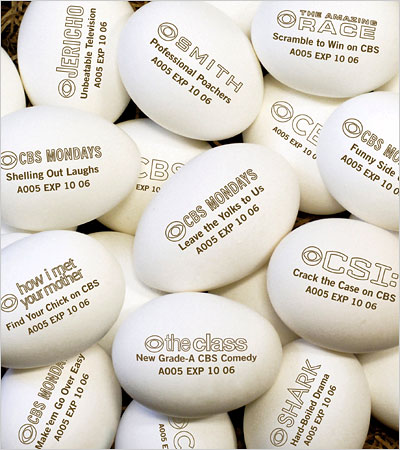
    The network plans to announce today that it will place laser imprints of its trademark eye insignia, as well as logos for some of its shows, on eggs — 35 million of them in September and October. CBS’s copywriters are referring to the medium as “egg-vertising,” hinting at the wordplay they have in store. Some of their planned slogans: “CSI” (“Crack the Case on CBS”); “The Amazing Race” (“Scramble to Win on CBS”); and “Shark” (“Hard-Boiled Drama.”). Variations on the ad for its Monday night lineup of comedy shows include “Shelling Out Laughs,” “Funny Side Up” and “Leave the Yolks to Us.”

    George Schweitzer, president of the CBS marketing group, said he was hoping to generate some laughter in American kitchens. “We’ve gone through every possible sad takeoff on shelling and scrambling and frying,” he said, adding, “It’s a great way to reach people in an unexpected form.”

    Newspapers, magazines and Web sites are so crowded with ads for entertainment programming that CBS was ready to try something different, Mr. Schweitzer said. The best thing about the egg concept was its intrusiveness.

    “You can’t avoid it,” he said. He liked the idea so much that he arranged for CBS to be the only advertiser this fall to use the new etching technology. •The CBS ads are the first to use imprinting technology developed by a company called EggFusion, based in Deerfield, Ill. Bradley Parker, who founded the company, wanted to reassure shoppers that egg producers were not placing old eggs in new cartons, so he developed a laser-etching technique to put the expiration date directly on an egg during the washing and grading process.

    EggFusion, which was founded in 2001, started production last year with one egg company, Radlo Foods, which has since produced 30 million Born Free brand farm-raised eggs with etching. In May, EggFusion landed its first large grocery chain, A.& P., which will use the imprints on 400,000 America’s Choice conventional eggs sold each day in A.& P., Waldbaum’s, Food Emporium and Super Fresh stores from Connecticut to Maryland. Mr. Parker, whose family runs a chicken farm in North Carolina, knew that the way to get egg producers to cooperate was to make it worth their while. His answer was advertising on eggs.

    “It’s unlike any other ad medium in the world, because you are looking at the medium while you are using it,” he says.

    Egg producers, distributors and retailers all share in the ad revenue. EggFusion is selling the ads on its own, but plans to enlist the help of advertising agencies, company executives said.

    As EggFusion sees it, consumers look at a single egg shells at least a few times: when they open a carton in the store to see if any eggs are cracked, if they transfer them from the carton to the refrigerator, and when they crack them open.

    Mr. Parker said the destination of eggs was tracked so precisely that he envisioned being able to offer localized advertising, even aiming at specific ZIP codes, to promote events like local food festivals and concerts. He is setting aside a portion of the ads for charities, too, he said. The imprint is applied in the packaging plant, as the eggs are washed, graded and “candled,” or inspected for flaws, when the eggs are held by calipers and moved along a production line at 225 feet a minute. Right before an egg is packaged, laser light is applied to the shell, giving it the etching. Each imprint takes 34 milliseconds to 73 milliseconds, so the processing of eggs is not appreciably slowed down, Mr. Parker said.

    The etching is ultrathin, to a depth of 50 to 90 micrometers, or 5 percent of the shell’s thickness. The imprint cannot be altered without breaking the shell, Mr. Parker said, in contrast to Europe, where ink is used to apply expiration dates on eggs.

    “Ink is alcohol dye, so it can be wiped off. And ink splatters,” he said.

    •A similar process to EggFusion’s has been used on a limited scale in the United States with fruits and vegetables, but mostly for replacing the price stickers used by grocers to track inventory and ring up an order.

    It is not clear how commonly old eggs are placed in new cartons to appear fresher than they are. Repackaging is illegal, said Al Pope, president of the United Egg Producers industry group, and he says he believes it is rarely done. However, “If a consumer feels that having a date on the egg has some value, then it’s up to the consumer,” he said. “We believe in choices.”

    Shaun M. Emerson, EggFusion’s chief executive, said: “I’m not sure you could ever know” how often repackaging old eggs occurs.

    EggFusion has technicians assigned to each egg plant, and it owns the equipment and the freshness data, to ensure that no tampering occurs, the company’s executives said.

    The eggs also carry a code that can be checked on a Web site, www.myfreshegg.com, to find out where the egg originated, the date it left the plant and the names of the distributor and retailer.

    Both Radlo and A.& P. pay for the etchings — they will not say how much — but because A.& P.’s eggs will carry the CBS ads, it will also share in the ad revenue. But is egg-vertising an idea with staying power, or will the novelty expire after a few dozen bad puns?

    “At this point it’s too early to tell,” Mr. Schweitzer of CBS acknowledges. “I think it’s like you know good ideas when you see them.”

    red dress run photos now online

    I finally uploaded my photos from this year's Red Dress Run.

    And next year, I hope to also see Becki, Susan, Rhiannon, and Zach on the trail. The jury's still out on Leo, as he "doesn't chase his beer."

    Trevor -- I can't do Mondays (school), but I do want to do more hashing. And to finally get the clever name you came up with.

    lundi, juillet 17, 2006

    contain yourself

    I love The Container Store.

    Sadly, it doesn't take competitor's coupons. It also doesn't do storewide sales — until now. This summer, it is sponsoring a series of “private college nights.”

    Everything will be sold at a 20 percent discount to anyone with college or high-school identification.

    I'll be at the FashionValley store for the college night (I am a grad student, after all) this Sunday, July 23 from 6:30 - 8:30 p.m.